
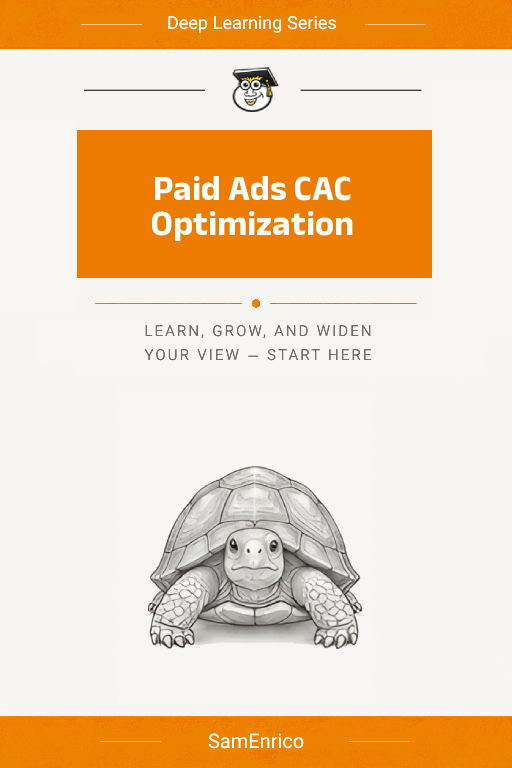
Paid Ads CAC Optimization eBook
Reduce Facebook, Google, and TikTok ad acquisition
Reduce Facebook, Google, and TikTok ad acquisition costs through creative testing and targeting.
Formats
Free sample
Chapter 1: The Dead Moat--–- In 2018, I paid a consultant 12,000fora"secretaudiencestack."Itwasaspreadsheetof47interests,layeredexclusions,andlookalikepercentagesthathesworewouldunlocksub−12,000 for a "secret audience stack." It was a spreadsheet of 47 interests, layered exclusions, and lookalike percentages that he swore would unlock sub-12,000fora"secretaudiencestack."Itwasaspreadsheetof47interests,layeredexclusions,andlookalikepercentagesthathesworewouldunlocksub−20 CACs. I ran the campaign for six weeks. My cost per acquisition never dropped below $78. The consultant blamed my creative. I blamed the targeting.
We were both wrong, but he was more wrong.That story haunts me not because I lost twelve thousand dollars—I've lost more since, in dumber ways—but because it perfectly captures the central delusion that has poisoned direct response advertising for the last decade. The delusion is this: that you can "find" the right customer through clever audience configuration, and that doing so is a scalable competitive advantage. The consultants who sold this idea built entire agencies around it. The platforms encouraged it because it kept advertisers busy tweaking instead of creating. And for a brief window, between roughly 2015 and 2021, it even worked.Then the algorithms got smarter.This chapter dismantles the traditional agency model that relies on manual targeting, lookalike audiences, and third-party data.
More importantly, it introduces the single idea that will underpin every tactic, test, and framework in this book: The First Principle. Once you internalize this principle, you will never again pay for audience building as a standalone service. You will stop obsessing over interests and behaviors. You will stop asking "who should I target?" and start asking "what should I make them feel?" That shift is the difference between competing in 2021 and competing in 2026.The Great Unraveling Let me tell you exactly when the old model died.In September 2023, Meta quietly changed its ad auction documentation. Buried in a developer update was a phrase that should have sent shockwaves through every agency holding company: "Broad targeting is now the recommended default for most campaign objectives." Not a suggestion.
Not a test. The recommendation.Six months later, Google removed the ability to exclude certain audience segments from Performance Max campaigns. Advertisers screamed. Google ignored them. By early 2025, Tik Tok's algorithm was famously ignoring most targeting parameters unless you paid for the highest-tier Spark Ads.
The platforms had all arrived at the same conclusion independently: their neural networks were better at predicting conversion propensity than any human-configured audience ever could be.I want you to sit with that for a moment.A machine that has seen billions of conversion events, trillions of impressions, and every possible combination of user behavior in between—that machine is now bidding on behalf of advertisers. When you set up a campaign today, you are not "selecting" an audience. You are suggesting an audience. The algorithm then decides whether to take your suggestion or ignore it entirely based on real-time performance signals. And increasingly, it ignores you.I have audited over 200 ad accounts in the last 18 months.
In accounts where advertisers insisted on narrow targeting—hyper-specific interests, layered exclusions, custom audiences with fewer than 50,000 users—the algorithm spent less than 40% of the budget within the requested targeting parameters. The other 60% went to "exploration" outside the targeting bubble. And in every single case, the exploration delivered lower CACs than the intended target.This is not opinion. This is the mathematical reality of how modern ad auctions work.The Auction You Didn't Know You Were Losing Before we go further, you need to understand what actually happens when you click "publish" on a campaign. Most advertisers think of the auction as a simple bid: whoever pays the most gets the impression.
That hasn't been true since 2018.Today's auction is a second-price, quality-adjusted, multi-variable optimization problem. Here is the simplified version of what the platform calculates for every single impression opportunity:Ad Rank = (Bid) × (Estimated Action Rate) × (Quality Signals)The Estimated Action Rate is where everything changed. That number is the platform's prediction of how likely a given user is to click, convert, or engage with your specific ad. It is calculated in milliseconds using neural networks that incorporate user history, contextual signals, and crucially—the engagement history of your creative.Here is the implication that destroys the old model: a lower bid with a high Estimated Action Rate will beat a higher bid with a low Estimated Action Rate. Every time.Let me give you a real example from my own account.
I ran two campaigns for the same product, same landing page, same offer. Campaign A used narrow targeting (15 interests, 3 exclusions) with a bid cap of 25.Campaign Busedbroadtargeting(nointerests,noexclusions,justcountryandage)withabidcapof25. Campaign B used broad targeting (no interests, no exclusions, just country and age) with a bid cap of 25.Campaign Busedbroadtargeting(nointerests,noexclusions,justcountryandage)withabidcapof18. Campaign A had a CTR of 1.2%. Campaign B had a CTR of 3.8% because I had tested into a better creative.Campaign B won the auction at 18.Campaign Alostat18.
Campaign A lost at 18.Campaign Alostat25. The platform charged Campaign B 14perconversion.Campaign A,whenitdidwinimpressions,charged14 per conversion. Campaign A, when it did win impressions, charged 14perconversion.Campaign A,whenitdidwinimpressions,charged27.The algorithm did not care about my clever audience stack. It cared about the creative.This is the truth that agencies don't want you to know. The moment you understand it, you stop being a customer of audience consultants and start being a student of creative pressure.The First Principle Let me state this clearly and permanently.
This is the bedrock upon which every subsequent chapter is built. I will reference it throughout the book without repeating the full explanation, so commit it to memory now:The First Principle: In modern ad auctions, the algorithm rewards high-engagement assets with lower bids, making creative effectiveness the primary lever for CAC reduction, not targeting configuration.That is not a marketing slogan. It is a mathematical description of how the auction is designed. The platform wants to maximize user satisfaction. User satisfaction correlates strongly with engagement signals (clicks, dwell time, video completion, reactions, shares).
When your creative generates strong engagement signals, the platform predicts that showing your ad will produce a satisfied user. To encourage you to show that ad more often, the platform discounts your bid.This creates a flywheel:High-engagement creative → Lower effective bid Lower bid → More impressions won More impressions → More conversion data More data → Better optimization Better optimization → Lower CACAnd a death spiral:Low-engagement creative → Higher effective bid Higher bid → Fewer impressions won Fewer impressions → Sparse conversion data Sparse data → Poor optimization Poor optimization → Higher CACMost advertisers are stuck in the death spiral and they don't know it. They blame the platform, the algorithm, the "IOS14 apocalypse," or the economy. They tweak their targeting. They adjust bids by 5%.
They add more exclusions. They are rearranging deck chairs while the creative engine is on fire.The Excess Share of Creativity In his work on System1's The Creative Dividend, researcher Orlando Wood introduced a concept that deserves far more attention than it has received. He argued that the most profitable brands consistently achieve what he called Excess Share of Voice—spending more than their market share would suggest. But within that framework, a more specific phenomenon exists: Excess Share of Creativity.ESOC is the gap between your creative effectiveness and your competitors' creative…
This is the end of the free sample. Get the eBook to keep going. Buy now
About this book
Details
- Author
- Varela Shavon
- Publisher
- SamEnrico
- Language
- English
- Genre
- Non-Fiction, Startup Guide
- Released
- 2026-05-29
- Pages (approx.)
- 130
- Available as
- eBook, Audiobook

Read better in the ZLOADR app
Your eBooks on your phone or tablet. Sign in with your SamEnrico account and start reading.
More by Varela Shavon
 Women's Shelter Fraud Cases CourseVarela Shavon$11.99
 Guided Sleep MeditationVarela Shavon$11.99
 Conversation Repair GuideVarela Shavon$11.99
 Blue Zone Faith Community GuideVarela Shavon$11.99
 The Trigger Method GuideVarela Shavon$11.99
 The Lion’s Gold: The Great Counterfeit Coin Heist of ZanzibarVarela Shavon$11.99
 How to Start a Photograph Colouring Business (Beginners Guide)Varela Shavon$11.99
 Barbenheimer: Summer of Cinema 2023Varela Shavon$11.99
 Founder Depression After AcquisitionVarela Shavon$12.99
 Understanding Wolff–parkinson–white SyndromeVarela Shavon$17.99
You may also like
 Hong Kong Handover 1997Dunn Johnnie$11.99
 Zumba For Postnatal Recovery CourseNeal Christian$11.99
 Zumba for BeginnersLadner Nikia$11.99
 YouTube Comment Mining GuideHumes Pandora$12.99
 Worry Box MeditationCarlin Rudy$11.99
 Workplace Stress MeditationNguyen Lynn$11.99
 Workplace Stress and Sleep RepairHawley Ivory$11.99
 Workplace Perfectionism CureDelaney Jeffry$11.99
 Workplace Injustice Anger GuideWallen Isabelle$11.99
 Work Addiction and Burnout LinkGreenwood Ester$11.99
 Women in Yoga and WellnessBeattie Galina$11.99
 Women in Stand Up ComedyChun Evangeline$11.99