
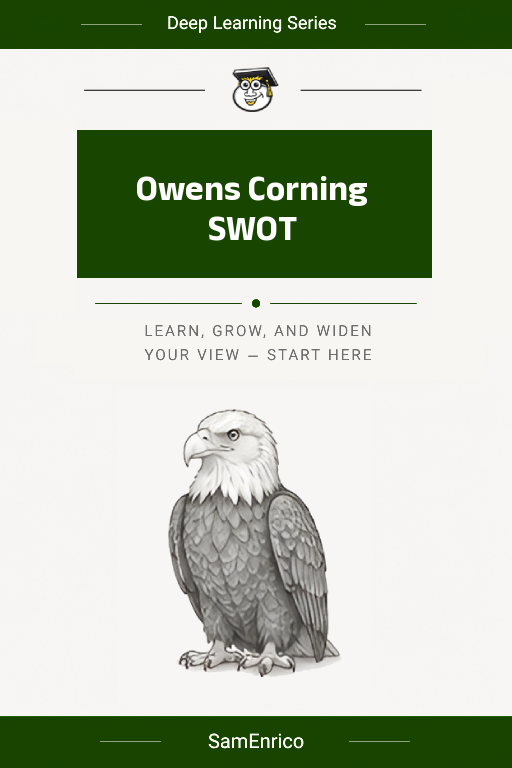
Non-FictionStrategic AtlasBuilding Materials
Owens Corning SWOT
Assess insulation, roofing, composites, constructi
Assess insulation, roofing, composites, construction demand, and commodity input costs.
Formats
About this book
Free sample
Chapter 1: The Roof Never Sleeps--The single most expensive mistake investors make about Owens Corning is believing that roofs are built when houses are built. This error has cost value managers hundreds of millions in forgone returns, caused growth funds to sell at precisely the wrong moments, and created a persistent valuation gap that the market has been slow to correct. The mistake is understandable—on its face, roofing shingles are construction products, and construction products should follow housing starts. But this assumption collapses under the weight of a simple, powerful, and largely invisible force: the relentless, non-negotiable, economically independent demand for roof replacement.Every roof in America fails. Not maybe, not sometimes, not if the economy cooperates.
Every single roof. The average asphalt shingle roof lasts between fifteen and twenty years, depending on climate, installation quality, and weather exposure. After that window, it leaks. When a roof leaks, water damages ceilings, walls, insulation, electrical systems, and personal property. Homeowners insurance policies require functional roofs as a condition of coverage.
Mortgage lenders require insurance. Therefore, a leaking roof is not a discretionary expense—it is a legally and financially enforceable obligation.This chapter dismantles the housing proxy fallacy that dominates Wall Street thinking about Owens Corning. It introduces the concept of the Invisible Cycle, provides rigorous data demonstrating roofing's decoupling from new construction, analyzes the commodity input cost structure that drives margins, and establishes the foundational thesis that will run through every subsequent chapter: Owens Corning is not a housing company. It is a replacement company disguised as one.The Housing Proxy Fallacy Wall Street loves simplicity. Analogs, comps, and simple heuristics make the complex world of equity research navigable.
One of the most persistent shortcuts is treating building products companies as leveraged plays on housing starts. The logic appears sound: new homes require roofing, insulation, and doors. When housing starts rise, these companies sell more products. When housing starts fall, they sell less. Therefore, an investor can approximate Owens Corning's revenue trajectory by tracking monthly Census Bureau data on new residential construction.This logic is dangerously incomplete.The problem begins with magnitude.…
This is the end of the free sample. Get the eBook to keep going. Buy now
Contents
- Chapter 1
- Chapter 2
- Chapter 3
- Chapter 4
- Chapter 5
- Chapter 6
- Chapter 7
- Chapter 8
- Chapter 9
- Chapter 10
- Chapter 11
- Chapter 12
Details
- Author
- Barnard Karina
- Publisher
- SamEnrico
- Language
- English
- Genre
- Non-Fiction, Strategic Atlas, Building Materials
- Released
- 2026-06-01
- Pages (approx.)
- 149
- Available as
- eBook, Audiobook

Read better in the ZLOADR app
Your eBooks on your phone or tablet. Sign in with your SamEnrico account and start reading.
More by Barnard Karina
 The Morning Body Scan EnergizerBarnard Karina$11.99
 Mindful Walking Daily Practice WorkbookBarnard Karina$11.99
 The Apology You Never GotBarnard Karina$11.99
 Prospective Memory Reminder SystemBarnard Karina$11.99
 Inpatient Rehab Preparation GuideBarnard Karina$11.99
 The Visionary Who Built the Beautiful Game: Ricardo Aldao and the Rise of Argentine FootballBarnard Karina$11.99
 Understanding Norrie DiseaseBarnard Karina$17.99
 Saturnian Ring Energy CollectorBarnard Karina$11.99
 How to Start a Osier Preparation Business (Beginners Guide)Barnard Karina$11.99
 College Essay Conclusion WorkshopBarnard Karina$12.99
You may also like
 Hong Kong Handover 1997Dunn Johnnie$11.99
 Zumba For Postnatal Recovery CourseNeal Christian$11.99
 Zumba for BeginnersLadner Nikia$11.99
 YouTube Comment Mining GuideHumes Pandora$12.99
 Worry Box MeditationCarlin Rudy$11.99
 Workplace Stress MeditationNguyen Lynn$11.99
 Workplace Stress and Sleep RepairHawley Ivory$11.99
 Workplace Perfectionism CureDelaney Jeffry$11.99
 Workplace Injustice Anger GuideWallen Isabelle$11.99
 Work Addiction and Burnout LinkGreenwood Ester$11.99
 Women in Yoga and WellnessBeattie Galina$11.99
 Women in Stand Up ComedyChun Evangeline$11.99