
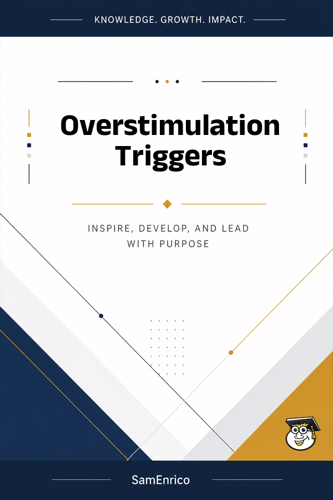
Non-FictionSelf-HelpSensory Health
Overstimulation Triggers eBook
Identify noise, clutter, and crowds as anger sourc
by Mclain Alysa
Identify noise, clutter, and crowds as anger sources using this workbook.
Formats
Free sample
Chapter 1: Your Sensory Fingerprint--–- You do not have an anger problem. You have a sensory threshold problem. This distinction is not semantic—it is the difference between years of failed therapy and six weeks of genuine relief. If you have ever been told to “just calm down,” “take a deep breath,” or “let it go” when the real issue was a leaf blower outside your window, a counter buried in mail, or a grocery store aisle blocked by three carts and a crying toddler, then you have been misdiagnosed. Not by a doctor, necessarily, but by a culture that treats all anger as emotional rather than environmental.Let me tell you about Mara.
Mara is a 41-year-old graphic designer who came to me after her husband gave her an ultimatum: get anger management help, or he was leaving. She had screamed at her eight-year-old for spilling milk—not a small scream, but a full-throated, vein-popping, neighbor-closing-the-windows kind of scream. In therapy, she was taught breathing exercises. She was told to count to ten. She was given a workbook about identifying “underlying resentment.” None of it worked.
Because the milk spill was not the problem. The milk spill was the two hundredth trigger of a day that had started at 6:15 AM with a garbage truck’s reverse beep outside her bedroom window, followed by her husband’s phone alarm (which he snoozed four times), followed by the visual chaos of yesterday’s dishes still in the sink, followed by the sound of her daughter’s tablet playing a cartoon at full volume, followed by the pressure of getting everyone out the door, followed by an open-plan office where she could hear three conversations at once, followed by a crowded train home, followed by the refrigerator’s intermittent hum, followed by the sight of unopened mail stacked on the counter, followed by her son’s repetitive video game music, followed by the milk spill. The milk spill was not a cause. It was a final straw. And no amount of deep breathing could fix the 199 triggers that came before it.This chapter will give you the language and the tools to understand your own sensory fingerprint—the unique pattern of thresholds, triggers, and recovery times that determines how your nervous system responds to the world.
By the end of this chapter, you will know whether you have a low, medium, or high sensory threshold. You will understand the difference between hyperarousal and hypoarousal. You will complete your first inventory of personal triggers. And most importantly, you will stop blaming yourself for reactions that were never a character flaw to begin with.THE MYTH OF THE “ANGER PROBLEM”We are taught, from a very young age, that anger is a feeling that arises from within. Something happens, we interpret it as unfair or threatening, and we get angry.
This model suggests that anger is a response to meaning—to what we think about an event. And for some anger, this is true. Cognitive anger—the kind that builds when you are cut off in traffic, or disrespected by a coworker, or treated unfairly by a system—does come from interpretation. You believe you have been wronged, and your body prepares to defend itself.But sensory anger works differently. Sensory anger does not pass through the interpretive centers of your brain.
It bypasses the prefrontal cortex entirely and goes straight to the amygdala, the almond-shaped cluster of neurons that serves as your brain’s threat-detection system. The amygdala does not care about meaning. It does not care about intentions. It cares about one thing: is this environment safe? When the amygdala detects a threat—and for sensitive nervous systems, a sudden loud noise, a cluttered visual field, or an unexpected shoulder bump in a crowd registers as a threat—it initiates the fight-or-flight response in under two hundred milliseconds.
That is faster than conscious thought. That is faster than you can say “I should stay calm.” That is faster than any breathing technique can possibly intervene.This is why traditional anger management often fails for sensory-driven anger. You cannot cognitive-reframe your way out of a nervous system that has already decided you are under attack. You cannot breathe your way out of a response that was designed to help you outrun a predator. And you cannot talk yourself into calm when your environment continues to bombard you with triggers faster than you can process them.The good news is that sensory anger is not a mystery.
It follows predictable patterns. It is triggered by predictable stimuli. And once you understand your own sensory fingerprint, you can stop reacting and start designing a life that does not constantly push you past your limit.WHAT IS A SENSORY FINGERPRINT?Every human being has a sensory threshold—the point at which incoming sensory information becomes too much to process comfortably. Think of it as a cup. Every sound, every visual input, every physical sensation, every social demand pours a little more water into your cup.
When the cup is empty or half-full, you feel fine. You can handle a moderate amount of noise. You can tolerate a messy desk. You can navigate a crowded sidewalk without wanting to scream. But when the cup overflows, the nervous system floods with stress hormones, and anger becomes the emergency release valve.Your sensory fingerprint is the unique combination of three things: (1) how large your cup is (your baseline threshold), (2) what fills your cup fastest (your specific triggers), and (3) how quickly your cup empties (your recovery rate).
Some people are born with small cups. They are easily overstimulated from birth—the baby who cried at loud noises, the toddler who covered their ears at birthday parties, the child who melted down after crowded school assemblies. Other people develop smaller cups over time due to chronic stress, trauma, illness, or neurodivergence. Autism, ADHD, PTSD, anxiety disorders, and even long COVID can lower sensory thresholds significantly. And some people simply live in environments that keep their cups permanently near the brim—open-plan offices, noisy cities, chaotic homes, high-pressure jobs—so that even a small additional trigger causes a spill.Here is what most people get wrong about sensory thresholds: they assume that having a low threshold is a weakness or a flaw.
It is not. It is a difference. People with low sensory thresholds often have corresponding strengths—heightened pattern recognition, deeper emotional processing, stronger attention to detail, and greater empathy. The problem is not the low threshold. The problem is living in a world that was designed for people with much larger cups.
And the solution is not to try to grow a larger cup. The solution is to stop pouring so much water into it.HYPERAROUSAL VERSUS HYPOAROUSAL: TWO WAYS TO OVERLOADYour nervous system has two primary responses to overstimulation, and they look completely different from the outside. One is visible, explosive, and easily labeled as “anger.” The other is invisible, silent, and often mislabeled as “coldness” or “avoidance.” Understanding which one you tend toward is essential for recognizing when you are already overstimulated.Hyperarousal is the classic fight-or-flight response. Your heart races. Your muscles tense.
Your jaw clenches. Your breathing becomes shallow. You feel jittery, irritable, and on edge. Small annoyances feel unbearable. You snap…
This is the end of the free sample. Get the eBook to keep going. Buy now
About this book
Details
- Author
- Mclain Alysa
- Publisher
- SamEnrico
- Language
- English
- Genre
- Non-Fiction, Self-Help, Sensory Health
- Released
- 2026-06-06
- Pages (approx.)
- 132
- Available as
- eBook, Audiobook

Read better in the ZLOADR app
Your eBooks on your phone or tablet. Sign in with your SamEnrico account and start reading.
More by Mclain Alysa
 Retail Sales PsychologyMclain Alysa$11.99
 Park Ranger Suspect TheoryMclain Alysa$11.99
 Small Talk That Actually WorksMclain Alysa$11.99
 Police Showup DangersMclain Alysa$11.99
 Inner Child Letter WritingMclain Alysa$11.99
 Nightmare Rescripting Audio GuideMclain Alysa$11.99
 Note Taking For LecturesMclain Alysa$11.99
 The Master Forger of Bruges: How Han van Meegeren Fooled the WorldMclain Alysa$11.99
 The Ballerina of the Andes: The Untold Story of the First Female Chasqui RunnerMclain Alysa$11.99
 How to Produce Sport Safety Lights and ReflectorsMclain Alysa$11.99
 A Collector's Handbook to the Daimler El24Mclain Alysa$11.99
 Freemium User Onboarding GuideMclain Alysa$12.99
You may also like
 Hong Kong Handover 1997Dunn Johnnie$11.99
 Zumba For Postnatal Recovery CourseNeal Christian$11.99
 Zumba for BeginnersLadner Nikia$11.99
 YouTube Comment Mining GuideHumes Pandora$12.99
 Worry Box MeditationCarlin Rudy$11.99
 Workplace Stress MeditationNguyen Lynn$11.99
 Workplace Stress and Sleep RepairHawley Ivory$11.99
 Workplace Perfectionism CureDelaney Jeffry$11.99
 Workplace Injustice Anger GuideWallen Isabelle$11.99
 Work Addiction and Burnout LinkGreenwood Ester$11.99
 Women in Yoga and WellnessBeattie Galina$11.99
 Women in Stand Up ComedyChun Evangeline$11.99