
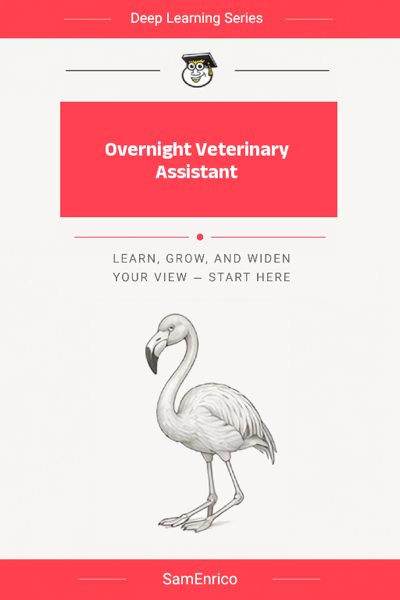
Non-FictionInformativeEducational
Overnight Veterinary Assistant eBook
A Coursebook on Overnight Veterinary Assistant
by Sam Cecille
A Coursebook on Overnight Veterinary Assistant
Formats
Free sample
Chapter 1: The Graveyard Hour--The phone rings at 11:47 PM. You are three hours into your shift, halfway through your first cup of coffee, and the overnight doctor is in the radiology suite positioning a difficult view. You pick up the line. A woman’s voice, trembling, says, “My dog ate an entire bottle of ibuprofen. I don’t know how many.
Maybe thirty? He’s a beagle. Please, please tell me what to do.”Your heart rate spikes. Your mouth goes dry. The doctor is unavailable for at least another ten minutes.
The waiting room has two other owners already filling out forms. And somewhere in the treatment area, a hospitalized cat’s IV pump starts beeping. This is the moment. This is why you are here. This is the graveyard hour.Welcome to the overnight shift.What This Chapter Will Do For You By the time you finish reading this chapter, you will understand exactly what makes overnight veterinary work fundamentally different from daytime practice.
You will learn how to reset your body’s internal clock so you can think clearly at 3 AM. You will know who is on your team, what each person can and cannot do, and where you fit into the hierarchy. You will master the handoff protocol that separates chaos from control. And perhaps most importantly, you will develop the mindset that keeps you calm when everything around you is falling apart.This is not a chapter about theory. This is a chapter about survival.The Daylight Lie: Why Day Shift Won’t Prepare You for Night Shift Let us be honest about something most veterinary programs will not tell you.
Daytime general practice and overnight emergency medicine are not the same profession. They share a building, a patient base, and some equipment. But the rhythm, the pressure, and the psychology are entirely different.During the day, you have appointments. Each patient gets a scheduled block of time. The doctor is awake, alert, and in the building.
There is a full team of assistants, technicians, and receptionists. If you have a question, someone is standing right next to you with an answer. If a patient crashes, there are four pairs of hands to respond. The phone calls are mostly routine. The owners are mostly calm.
The lights are bright. The coffee is fresh.The overnight shift is the opposite of everything just described.You have no appointments. Instead, you have a door that opens at any moment to reveal anything from a seizing Chihuahua to a hit-by-car Great Dane to a vomiting parrot. The doctor is often exhausted, sometimes sleeping in the break room between emergencies, and always stretched thin. The team is you, one DVM, and if you are very lucky, a VTS (ECC)—a veterinary technician specialist in emergency and critical care.
That is it. Three people, sometimes two, covering an entire hospital.When a patient crashes overnight, you may be the only person in the room for the first sixty seconds. When the phone rings at 2 AM, you are the one answering it. When the IV pump alarms, when the oxygen concentrator fails, when the lab results come back with numbers that make no sense—you are the one standing there, alone, trying to figure out what to do next.This is not a warning to scare you away. This is a description of reality.
The overnight assistant who succeeds is not the one with the most medical knowledge. It is the one who has accepted that they will be alone, that they will have to make decisions without supervision, and that they will sometimes be wrong. The key is learning how to be wrong in ways that do not kill patients.Rewiring Your Body: The Science of Night Shift Survival Before you can save anyone else’s life, you have to keep your own body functioning. Sleep deprivation is not a badge of honor. It is a patient safety risk.
A study published in the Journal of Veterinary Emergency and Critical Care found that veterinary professionals working overnight shifts made three times as many medication errors as their day-shift counterparts. The difference was not skill. The difference was sleep.You cannot eliminate the fatigue of night work. But you can manage it.The Non-Negotiable Sleep Schedule Your body has a circadian rhythm, an internal clock that wants you awake during daylight and asleep in darkness. Night shift fights that rhythm.
You cannot change the rhythm entirely, but you can shift it.The most successful overnight assistants treat sleep like a medical prescription. You must sleep the same hours every day, including your days off. If you work from 10 PM to 8 AM, you should be in bed by 9 AM and asleep by 10 AM. On your nights off, you should maintain that same schedule. The temptation to switch back to a day schedule on weekends is powerful.
Resist it. Each time you flip your sleep schedule, you induce jet lag without the benefit of travel.Light Management Light is the most powerful cue for your circadian rhythm. Bright light tells your brain it is time to be awake. Darkness tells your brain to produce melatonin, the hormone that induces sleep.On your way home from a night shift, wear blue-light-blocking glasses or sunglasses, even before sunrise. Once you are home, make your bedroom completely dark.
Use blackout curtains, cover any electronic lights, and consider a sleep mask. When you wake up in the evening, expose yourself to bright light immediately. Turn on every light in your house. This helps convince your brain that “evening” is your “morning.”Strategic Caffeine Caffeine works by blocking adenosine, the chemical that makes you feel tired. But caffeine has a half-life of approximately five hours.
That means if you drink a cup of coffee at midnight, half of that caffeine is still in your system at 5 AM. A second cup at 2 AM means you still have one full cup’s worth of caffeine in your blood at 7 AM, when you should be winding down.The rule is simple: no caffeine within six hours of your planned bedtime. If you finish your shift at 8 AM and want to be asleep by 9 AM, your last caffeine should be no later than 3 AM. This takes discipline. It means saying no to the 4 AM coffee run.
But it will improve your sleep quality dramatically.Nutrition for the Night Your digestive system also follows a circadian rhythm. At night, it produces fewer digestive enzymes and moves food through more slowly. Heavy meals at 2 AM will sit in your stomach, cause reflux, and disrupt your sleep when you finally get home.The overnight assistant’s eating strategy is small, frequent meals. Eat a full meal before your shift starts. Then eat light snacks every two to three hours during the shift: yogurt, fruit, nuts, a sandwich half.
Avoid greasy, fried, or spicy foods. Drink water constantly. Dehydration amplifies fatigue.Napping on Shift In some overnight facilities, the doctor and assistant take turns napping when no active emergencies exist. This is not laziness. This is operational necessity.
A ten-minute nap can restore alertness for two to three hours. However, napping requires protocol. You and the doctor must…
This is the end of the free sample. Get the eBook to keep going. Buy now
About this book
Details
- Author
- Sam Cecille
- Publisher
- SamEnrico
- Language
- English
- Genre
- Non-Fiction, Informative, Educational
- Released
- 2026-06-02
- Pages (approx.)
- 156
- Available as
- eBook, Audiobook

Read better in the ZLOADR app
Your eBooks on your phone or tablet. Sign in with your SamEnrico account and start reading.
More by Sam Cecille
 Gaming Screen Time ResetSam Cecille$11.99
 Umayyad Expansion Conquest GuideSam Cecille$11.99
 HGH and Kidney AgingSam Cecille$11.99
 AI Video Production Cost ReductionSam Cecille$11.99
 Agoraphobia School Pickup Anxiety ManualSam Cecille$11.99
 The Great Moon Hoax: When Newspapers Tricked the WorldSam Cecille$11.99
 The Poisoned Perfume: The Untold Story of the Tylenol MurdersSam Cecille$11.99
 Small Business Payroll AI GuideSam Cecille$12.99
 Global Coding Bootcamp RankingsSam Cecille$12.99
 Understanding Bronchogenic CystSam Cecille$17.99
 How to Start a Rubber Cement Manufacturing BusinessSam Cecille$11.99
You may also like
 Hong Kong Handover 1997Dunn Johnnie$11.99
 Zumba For Postnatal Recovery CourseNeal Christian$11.99
 Zumba for BeginnersLadner Nikia$11.99
 YouTube Comment Mining GuideHumes Pandora$12.99
 Worry Box MeditationCarlin Rudy$11.99
 Workplace Stress MeditationNguyen Lynn$11.99
 Workplace Stress and Sleep RepairHawley Ivory$11.99
 Workplace Perfectionism CureDelaney Jeffry$11.99
 Workplace Injustice Anger GuideWallen Isabelle$11.99
 Work Addiction and Burnout LinkGreenwood Ester$11.99
 Women in Yoga and WellnessBeattie Galina$11.99
 Women in Stand Up ComedyChun Evangeline$11.99