
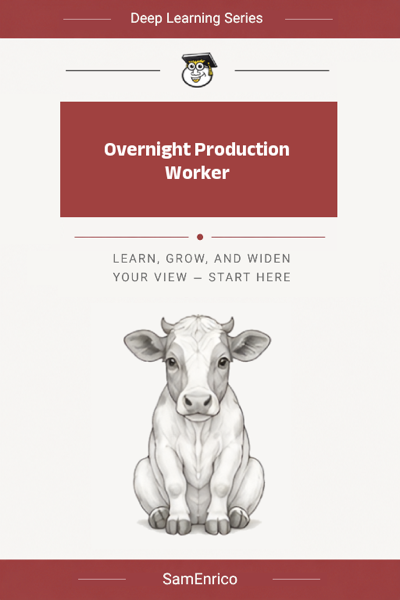
Non-FictionInformativeEducational
Overnight Production Worker eBook
A Coursebook on Overnight Production Worker
by Yost Joline
A Coursebook on Overnight Production Worker
Formats
Free sample
Chapter 1: Owning the Night...–- The alarm clock reads 4:47 PM. For most people, this is the late afternoon—a time for finishing work, picking up kids from school, or starting dinner. For you, it is the middle of the night. You roll out of bed with a mouth like sandpaper and eyes that feel full of grit. The sun is still high in the sky, but your internal clock screams that something is fundamentally wrong.
Your spouse or roommate is just getting home from their day job. Your children are finishing homework. The neighbor is mowing the lawn. And you? You are drinking your first cup of coffee, already doing the mental math: shower by 5:00, leave by 5:30, clock in by 5:55, on the production floor by 6:07.
That gives you exactly fifty-three minutes to become a functional human being before the night truly begins.This is the reality of the third shift. And if you are reading this book, you are either living it right now or about to start. Let me be direct with you about something that no HR orientation packet will ever say: working overnight in a production facility is not normal. It is not natural. Human beings evolved over hundreds of thousands of years to sleep when it is dark and be active when the sun is up.
Every cell in your body—your brain, your digestive system, your heart, your liver, your immune system—runs on a roughly twenty-four-hour clock called the circadian rhythm. When you work six PM to six AM, or ten PM to six AM, or any variation of the graveyard shift, you are asking your biology to do something it was never designed to do.And yet, millions of people do it every single night.In the United States alone, approximately twenty percent of the workforce—roughly thirty million people—work non-daylight hours. That includes production workers in automotive plants, food processing facilities, plastics manufacturing, pharmaceutical production, logistics centers, warehouses, and packaging lines. It includes healthcare workers, first responders, transportation drivers, and utility operators. But this book is specifically for you: the production worker.
The person standing on the concrete floor in steel-toed boots, wearing hearing protection and safety glasses, watching a machine cycle every forty-five seconds, pulling parts, checking dimensions, clearing jams, and doing it all over again until the morning shift arrives sipping coffee and asking, "Anything happen last night?"If that is you, welcome. You have finally found the book that should have been handed to you on your very first day.Why This Book Exists Most training for overnight production workers is a disaster of disjointed information. Safety training comes from OSHA compliance manuals that read like legal documents written by people who have never set foot on a factory floor. Shift work advice comes from blogs written by people who worked nights for six months a decade ago and think they understand your life. Health guidance comes from general nutrition articles written for people who work nine to five and have never heard of the four AM hunger crash.
Career advice assumes you want to be a manager or that you are a temporary worker passing through. It assumes you have options. Sometimes you do. Sometimes you do not. This book assumes nothing except that you are here, you are working nights, and you want to do it better.This book exists because the night shift does not have to destroy you.Over the next twelve chapters, you will learn not just how to survive the night shift but how to own it.
You will learn the science of why three AM feels like death and exactly what to do about it. You will learn how to sleep during the day in a house full of noise, light, and people who do not understand why you cannot just "go to bed earlier." You will learn how to eat, move, and hydrate in ways that protect your long-term health rather than slowly destroying it. You will learn the technical skills that make you valuable: lockout and tagout procedures, visual inspection techniques, quality metrics, and troubleshooting. You will learn how to navigate the bizarre social dynamics of the night crew, how to resolve conflicts with the grumpy coworker who has been there for twenty-two years and hates everyone, and how to communicate with the day shift without starting a war.And perhaps most importantly, you will learn how to use the night shift as a launching pad for something better—not a life sentence.But before any of that, we need to talk about the schedule itself. Because without understanding the structural reality of your workweek, the rest of this book will not make sense.The Two Schedules That Rule Production If you work in a factory, a processing plant, or a large-scale packaging facility, your shift schedule overwhelmingly falls into one of two categories.
There are variations—every plant has its own unique fingerprint of start times, shift rotations, and weekend policies—but the vast majority of overnight production workers operate on either a permanent night schedule or a rotating schedule.Let me start with the permanent night schedule.This is exactly what it sounds like: you work overnight, every shift, week after week, month after month. Your start time might be six PM, seven PM, eight PM, or even ten PM. Your end time is typically eight to twelve hours later. Permanent night workers have one significant advantage: consistency. Your body, over time, can partially adapt to a fixed nocturnal schedule.
Not fully—because the sun still rises and your social world still operates during daylight hours and your neighbor still mows the lawn at nine AM—but partially. You can establish a regular sleep window, a regular meal schedule, and a regular routine. Your spouse and family can learn when you are available and when you are not. The downside is that permanent nights are socially brutal. You never flip back to days.
Every weekend, every holiday, every family gathering, every birthday dinner, every kid's soccer game requires you to either stay nocturnal or wreck your sleep.The second schedule is the rotating shift.This is far more common in large manufacturing facilities, particularly those that run twenty-four hours a day, seven days a week, three hundred sixty-five days a year. Rotating schedules come in many flavors, but the most common in production is the two-two-three pattern—also known as the Dupont schedule or the continental shift pattern.Here is how the two-two-three works. You work two day shifts, then two night shifts, then you have three days off. Then the pattern flips again. Over the course of a month, you will work a mix of days and nights, often switching back and forth with barely a day of recovery time between them.
The schedule is efficient for the company because it covers all shifts with almost no overlap. For the worker, it is a nightmare. Your circadian rhythm never gets a chance to settle. Just as your body begins to adapt to being awake at night, you flip back to days. Just as it adapts to being awake during the day, you flip back to nights.
Chronic sleep deprivation becomes your baseline condition. You stop remembering what "well-rested" even feels like.Then there is the twelve-hour rotating…
This is the end of the free sample. Get the eBook to keep going. Buy now
About this book
Details
- Author
- Yost Joline
- Publisher
- SamEnrico
- Language
- English
- Genre
- Non-Fiction, Informative, Educational
- Released
- 2026-05-11
- Pages (approx.)
- 143
- Available as
- eBook, Audiobook

Read better in the ZLOADR app
Your eBooks on your phone or tablet. Sign in with your SamEnrico account and start reading.
More by Yost Joline
 Leadership Nonverbal GuideYost Joline$11.99
 The Flame Retardant GuideYost Joline$11.99
 Black Dahlia Drug Connection TheoriesYost Joline$11.99
 Burnout and Sleep RecoveryYost Joline$11.99
 The Madness of William Burke: Grave Robbery and Murder in 19th-Century CanadaYost Joline$11.99
 How to Produce a Berry-picking RakeYost Joline$11.99
 How to Become a Machine Try-out SetterYost Joline$11.99
 YouTube Financial IndependenceYost Joline$12.99
You may also like
 Hong Kong Handover 1997Dunn Johnnie$11.99
 Zumba For Postnatal Recovery CourseNeal Christian$11.99
 Zumba for BeginnersLadner Nikia$11.99
 YouTube Comment Mining GuideHumes Pandora$12.99
 Worry Box MeditationCarlin Rudy$11.99
 Workplace Stress MeditationNguyen Lynn$11.99
 Workplace Stress and Sleep RepairHawley Ivory$11.99
 Workplace Perfectionism CureDelaney Jeffry$11.99
 Workplace Injustice Anger GuideWallen Isabelle$11.99
 Work Addiction and Burnout LinkGreenwood Ester$11.99
 Women in Yoga and WellnessBeattie Galina$11.99
 Women in Stand Up ComedyChun Evangeline$11.99