
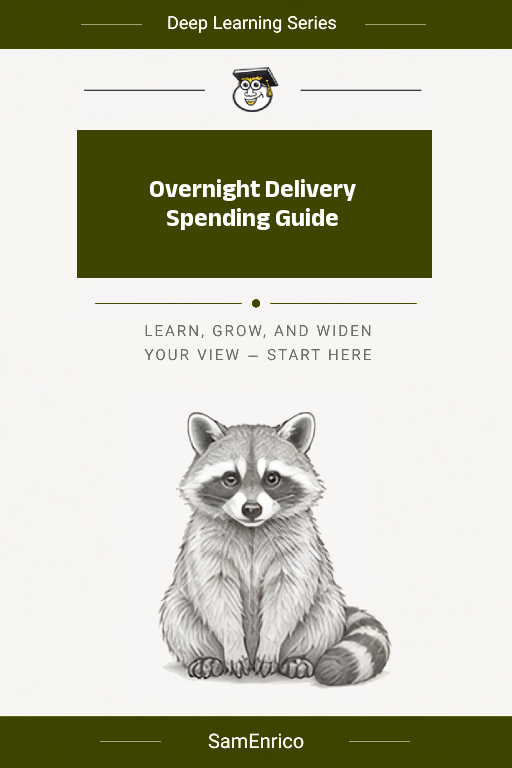
Non-FictionForecast & OutlookInstant Spending
Overnight Delivery Spending Guide eBook
Explore ultrafast delivery adoption, convenience p
Explore ultrafast delivery adoption, convenience premiums, and dark store expansion by region.
Formats
Free sample
Chapter 1: The $7 Toothpaste...--It was 10:47 PM on a Tuesday in Mumbai, and Priya had just realized she was out of toothpaste. Not the fancy kind—just basic fluoride paste. The shop two blocks away had closed at 10:00 PM. She could walk to the 24-hour pharmacy, a fifteen-minute round trip, or she could open an app. She opened the app.
Nine minutes and forty-two seconds later, a delivery rider handed her a small paper bag. The toothpaste cost 1.50atthestore.Afterplatformfees,deliverycharges,andatip,Priyapaid1.50 at the store. After platform fees, delivery charges, and a tip, Priya paid 1.50atthestore.Afterplatformfees,deliverycharges,andatip,Priyapaid7.12. She was not angry. She was relieved.
She was grateful. She was, by every measure, delighted.This is not a story about a woman who overpaid for toothpaste. This is a story about how an entire global economy has been rewired to make you feel good about doing exactly that. The $7 toothpaste is not an anomaly. It is a window into the most profound shift in consumer behavior since the invention of the shopping mall—and like that earlier revolution, most of us never saw it coming.We are living through the death of patience, and we paid for the funeral ourselves.The Great Compression Not long ago, waiting was simply part of life.
If you ordered a product from a catalog in the 1980s, the fine print read "please allow 6–8 weeks for delivery." Weeks. Plural. If you called a restaurant for takeout in the 1990s, they told you "twenty minutes," and you showed up in twenty-five, and everyone understood that this was the natural order of things. If you bought something on e Bay in the early 2000s, you tracked the package across the country with the same patient resignation as a farmer watching crops grow.Then something changed. It did not change because of technology alone.
It changed because a handful of companies made a calculated bet that if they spent enough money, they could train human beings to want things faster than they needed them. And they were right.The compression of delivery windows is one of the most dramatic behavioral shifts in modern economic history. What took six weeks in 1985 took five days in 2005. What took five days in 2005 takes fifteen minutes in 2025. But here is what the timeline does not show: the gap between "five days" and "fifteen minutes" required exponentially more investment than the gap between "six weeks" and "five days." The marginal improvement from slow to faster was cheap.
The marginal improvement from fast to instant has been extraordinarily expensive. And someone has been paying that bill.That someone, for now, is venture capital.The Manufactured Need Let us be precise about what has happened, because the industry benefits from your confusion. You have been trained to believe that you discovered a need for instant delivery. In fact, the need was manufactured for you.Consider the non-urgent item. Toothpaste.
Snacks. Phone chargers. Over-the-counter medication. Laundry detergent. These are not life-saving goods.
A person who runs out of toothpaste at 10:47 PM can brush without paste for one night and buy a tube in the morning. A person who wants a snack can eat an apple instead of opening a delivery app. A person who forgot to charge their phone can wait until they get to work. There is no emergency here. There is only discomfort, and discomfort is precisely what platforms have learned to monetize.The strategy is simple and devastatingly effective.
First, offer a service that eliminates a small, everyday discomfort. Second, make it so cheap that refusing it feels irrational. Third, wait for habit to form. Fourth, raise prices once the habit is locked in. This is not conspiracy theory—it is the standard playbook of every successful on-demand platform from Uber to Door Dash to Amazon Prime.Amazon Prime provides the clearest historical example.
When Prime launched in 2005, two-day shipping was remarkable. But Amazon did not charge the true cost of that service. Instead, they bundled it into a flat annual fee that was deliberately underpriced. The goal was not to make money on shipping. The goal was to change how often people shopped.
Before Prime, the average Amazon customer placed an order every thirty-seven days. After Prime, that interval dropped to every twelve days. Within five years, it dropped to every six days. The customer was not saving money. They were spending more—much more—but the friction of paying per shipment had been removed, and with it, the pause that allows rational decision-making.Today, the average Prime member places seventy-one orders per year.
The average non-Prime Amazon customer places twelve. That difference is not explained by need. It is explained by manufactured habit.By the Numbers: The Q‑Commerce Explosion The scale of this transformation is staggering. In 2025, the global quick commerce market—defined as delivery of consumer goods within sixty minutes—reached approximately 185billion.By2030,projectionsplaceitat185 billion. By 2030, projections place it at 185billion.By2030,projectionsplaceitat385 billion.
For context, that is larger than the entire global coffee shop industry. It is larger than the airline catering industry. It is approaching the size of the global video game market.But these numbers require interpretation. A 185billionmarketdoesnotmeanthat185 billion market does not mean that 185billionmarketdoesnotmeanthat185 billion of value has been created. It means that $185 billion has changed hands, much of it in the form of subsidies that have not yet been repaid.
The distinction matters because it determines whether this market is sustainable or whether it is a Ponzi scheme with better marketing.Let us break down where that 185billioncomesfrom.Roughly185 billion comes from. Roughly 185billioncomesfrom.Roughly60 billion represents the actual cost of goods sold—the toothpaste, the snacks, the detergent at wholesale prices. Another 40billionrepresentsplatformfeesanddeliverychargespaidbycustomers.Theremaining40 billion represents platform fees and delivery charges paid by customers. The remaining 40billionrepresentsplatformfeesanddeliverychargespaidbycustomers.Theremaining85 billion? That is the gap between what customers pay and what it actually costs to get a bag of groceries from a dark store shelf to an apartment door in under fifteen minutes.
That gap has been covered by investors who believe that eventually, somehow, the math will work out.This is the central fact of the overnight delivery economy: it is not yet profitable at scale. Nearly every major player operates at a loss. Some have never had a profitable quarter. They survive on successive rounds of funding, each round premised on the idea that next year, or the year after, the unit economics will finally click into place. Meanwhile, hundreds of billions of dollars have been spent training you to expect instant gratification.
The investors are betting that once the training is complete, you will pay enough to make them whole.Will you? That is the question this book exists to answer.The Three Layers of the Urgency Economy To understand how we arrived at this moment, it helps to distinguish between three distinct layers of the overnight delivery ecosystem. Each layer has its own economics, its own players, and its own trajectory. Confusing them is the first mistake most observers make.Layer One: The Legacy Incumbents. Amazon, Walmart, Target, Tesco, Carrefour.
These companies built logistics networks over decades. They did not start with instant delivery; they started with reliable delivery, then…
This is the end of the free sample. Get the eBook to keep going. Buy now
About this book
Details
- Author
- Reiter Xiomara
- Publisher
- SamEnrico
- Language
- English
- Genre
- Non-Fiction, Forecast & Outlook, Instant Spending
- Released
- 2026-06-01
- Pages (approx.)
- 145
- Available as
- eBook, Audiobook

Read better in the ZLOADR app
Your eBooks on your phone or tablet. Sign in with your SamEnrico account and start reading.
More by Reiter Xiomara
 MVII AI Compositing GuideReiter Xiomara$11.99
 Car Wash Operation Secret RecordingsReiter Xiomara$11.99
 Annual Goal Planning WorkshopReiter Xiomara$11.99
 Phobia Support Group GuideReiter Xiomara$11.99
 Mind Body Exercises for Craving ReliefReiter Xiomara$11.99
 Anansi Weaves the Stars: The Spider’s Great TrickReiter Xiomara$11.99
 Collecting Christmas AccessoriesReiter Xiomara$11.99
 Understanding Instability Mitotic Non Disjunction SyndromeReiter Xiomara$17.99
 How to Become a Chip-applying-machine TenderReiter Xiomara$11.99
 Remote Worker Burnout ShieldReiter Xiomara$12.99
You may also like
 Hong Kong Handover 1997Dunn Johnnie$11.99
 Zumba For Postnatal Recovery CourseNeal Christian$11.99
 Zumba for BeginnersLadner Nikia$11.99
 YouTube Comment Mining GuideHumes Pandora$12.99
 Worry Box MeditationCarlin Rudy$11.99
 Workplace Stress MeditationNguyen Lynn$11.99
 Workplace Stress and Sleep RepairHawley Ivory$11.99
 Workplace Perfectionism CureDelaney Jeffry$11.99
 Workplace Injustice Anger GuideWallen Isabelle$11.99
 Work Addiction and Burnout LinkGreenwood Ester$11.99
 Women in Yoga and WellnessBeattie Galina$11.99
 Women in Stand Up ComedyChun Evangeline$11.99