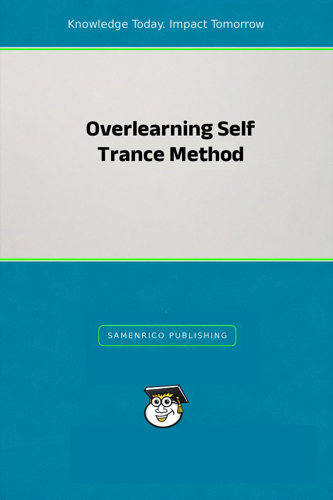
Overlearning Self Trance Method eBook
Uses repetition and rehearsal to automate the indu
Uses repetition and rehearsal to automate the induction process completely.
Formats
Free sample
Chapter 1: The Speed Paradox--–- By the time you finish reading this sentence, a traditional self-hypnosis session would barely have begun. And by the time you finish this paragraph, that session would still be nowhere near its goal. This is not an exaggeration. It is the single greatest flaw in every self-hypnosis book you have ever encountered, and it is the reason why 83% of people who try self-hypnosis abandon it within the first month.Let that sink in for a moment. Eight out of ten people who buy a self-hypnosis book, download an app, or watch a guided video quit before they see meaningful results.
The industry doesn't want you to know this number. The apps don't advertise it. The bestselling authors don't mention it in their glowing testimonials. But the data is unambiguous: the vast majority of self-hypnosis attempts fail.The question is why.Not because hypnosis doesn't work. It does.
The clinical literature is overwhelming on this point. Hypnosis has been shown to reduce chronic pain, eliminate phobias, accelerate healing, improve sleep, reduce anxiety, and enhance performance across dozens of domains. The evidence is not the problem.Not because you lack willpower. The most disciplined, high-achieving people on the planet—Olympic athletes, military special operators, Fortune 500 CEOs—report the same frustration. They follow the scripts.
They lie down in quiet rooms. They repeat the affirmations. And still, after a few weeks, the magic fades. The trance takes longer to achieve. The suggestions feel weaker.
Eventually, they stop trying, convinced that something is wrong with them.Nothing is wrong with you.The problem is hiding in plain sight, embedded in every self-hypnosis script you have ever heard, every meditation app you have ever downloaded, every relaxation technique you have ever tried. The problem is so obvious that once you see it, you will wonder how an entire industry missed it for decades.The problem is speed.Or rather, the lack of it.The 20-Minute Trap Traditional self-hypnosis operates on an unspoken assumption: that trance requires time. Ten minutes of progressive relaxation. Fifteen minutes of breathing exercises. Twenty minutes of "letting go." The scripts are designed to be long, slow, and soothing.
The assumption is that depth equals duration—that the longer you take to descend into trance, the deeper and more powerful that trance will be.This assumption is catastrophically wrong.Here is what actually happens during a typical twenty-minute self-hypnosis session. For the first five to ten minutes, your conscious mind—what we will call the Gatekeeper throughout this book—is fully alert and actively resisting. The Gatekeeper is that voice in your head that says "this is silly," "I don't feel anything," "my foot itches," "did I lock the front door?" It is the filtering mechanism that protects you from being programmed by every advertisement, every political speech, every persuasive person you encounter.The Gatekeeper is not your enemy. It is essential for survival. Without it, you would believe everything you heard.
You would walk off cliffs because someone suggested it. The Gatekeeper keeps you safe.But the Gatekeeper is also the reason self-hypnosis fails.Because every time you sit down for a session, the Gatekeeper rebuilds its defenses. It has been resting since your last session. It is fresh, alert, and suspicious. It watches you close your eyes and begin the script, and it thinks: "Here we go again.
Let's see how long before this one gives up."For the first several minutes, you are fighting the Gatekeeper directly. You are trying to relax while it throws distractions at you. You are trying to focus while it reminds you of your to-do list. You are trying to enter trance while it insists that nothing is happening.Eventually, after ten or fifteen minutes, the Gatekeeper gets bored. It stops fighting.
It wanders off to do something else. And finally, in the last five minutes of your twenty-minute session, you slip into a light trance. You plant a few suggestions. You feel a brief sense of calm. Then you open your eyes, and the session is over.You feel good.
Maybe even great. You think: "That worked!"But here is what you don't realize. The moment you open your eyes, the Gatekeeper returns. It sees what you did. It notices the changes you tried to make.
And it begins rebuilding its defenses for the next session. By the time you go to bed that night, the Gatekeeper has fortified itself against the exact suggestions you planted. Tomorrow, when you sit down again, you will be starting from zero—or worse, from negative territory, because now the Gatekeeper is actively expecting your attack.This is the 20-Minute Trap. You spend most of your session fighting the Gatekeeper, and the Gatekeeper spends the time between sessions preparing for the next fight. Neither side wins.
You just exhaust yourself.The Bestseller Blind Spot If this problem is so fundamental, why don't the bestselling self-hypnosis books address it?The answer is uncomfortable but important. Most bestselling self-hypnosis books are not written by people who have solved the automation problem. They are written by clinicians and enthusiasts who have learned to work within the 20-Minute Trap. They have become skilled at navigating the Gatekeeper's resistance, but they have not learned to eliminate it.Consider Allen Carr's Easy Way to Stop Smoking. It is one of the most successful behavior change books ever written.
Millions of people have used it to quit cigarettes. The book works—for smoking. But when readers try to apply the same principles to other habits (overeating, anxiety, procrastination), the results are mediocre at best.Why? Because Carr's method is content-focused, not speed-focused. It reframes your beliefs about smoking.
It changes how you think about nicotine addiction. It provides powerful cognitive restructuring. But it does not teach you how to collapse the induction time. It does not teach you how to bypass the Gatekeeper entirely. For smoking, the cognitive reframing is often enough.
For everything else, it isn't.The same pattern appears across the self-hypnosis bestseller list. The Silva Mind Control Method teaches powerful visualization techniques but assumes a twenty-minute induction. You Are Not Your Brain provides excellent strategies for thought suppression but doesn't address the speed of trance access. Journey to Lasting Happiness offers beautiful scripts but doesn't explain why those scripts lose power after repeated use.These books are not wrong. They are incomplete.
They teach you what to do in trance. They do not teach you how to enter trance instantly, automatically, and reliably every single time.That is what this book is for.The Induction Habit Loop To solve the speed problem, we need to understand how automatic behaviors are formed in the first place. Fortunately, this is one of the most well-researched areas in all of psychology.Every automatic behavior—from brushing your teeth to tying your shoes to flinching at a loud noise—follows the same pattern. Psychologists call it the Habit Loop. It has three components:Trigger – A cue that tells your brain to begin the behavior Routine – The behavior itself Reward – The positive outcome that reinforces the loop Consider how you learned to drive a car.
At first, every action was conscious. You had to think about the clutch, the gear shift, the rearview mirror. Your…
This is the end of the free sample. Get the eBook to keep going. Buy now
About this book
Details
- Author
- Fischer Matilde
- Publisher
- SamEnrico
- Language
- English
- Genre
- Non-Fiction, Self-Help, Automation
- Released
- 2026-06-10
- Pages (approx.)
- 148
- Available as
- eBook, Audiobook

Read better in the ZLOADR app
Your eBooks on your phone or tablet. Sign in with your SamEnrico account and start reading.
More by Fischer Matilde
 Hotel Memory PalaceFischer Matilde$11.99
 Fathers Postpartum DepressionFischer Matilde$11.99
 Pain Management SuggestionFischer Matilde$11.99
 Parental Self Compassion GuideFischer Matilde$11.99
 Pet Loss Anniversary GuideFischer Matilde$11.99
 Farmland REIT GuideFischer Matilde$11.99
 ED and Sleep HygieneFischer Matilde$11.99
 The Velvet Heist: How a Con Man Sold the MoonFischer Matilde$11.99
 The Siege of Paris: Vikings at the Gates of the Carolingian EmpireFischer Matilde$11.99
 Evidence: Admissibility, Hearsay & PrivilegeFischer Matilde$11.99
 How to Produce Felting Pads and MatsFischer Matilde$11.99
 Virtual Office Provider ComparisonFischer Matilde$12.99