
Non-FictionNon-Obvious CareerRemote Work
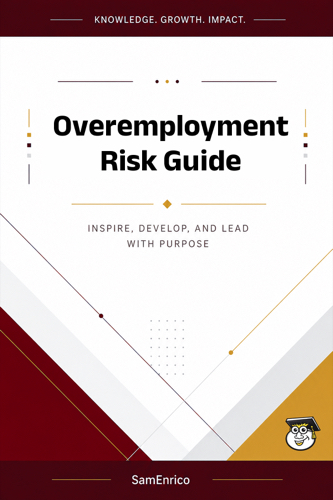
Overemployment Risk Guide eBook
Teaches avoiding detection and managing overlappin
by Darnell Mi
Teaches avoiding detection and managing overlapping meeting schedules.
Formats
Free sample
Chapter 1: The Permission Structure--–- Every high-income skill has a ceiling. Your salary, no matter how impressive, is still a negotiation between what you produce and what your employer believes they can replace you for. The moment you accept that the ceiling is arbitrary, enforced by convention rather than economics, you have taken the first step toward overemployment. This chapter is not about tactics. It is not about calendar blocking or mouse jigglers or Linked In hibernation.
Those come later. This chapter is about unlearning everything you have been taught about work, loyalty, and the relationship between hours logged and value created.The Lie of the Linear Deal Most professionals operate under an implicit contract they never consciously signed. It goes something like this: You will work approximately forty hours per week. You will be present and responsive during core business hours. You will devote your best mental energy to a single employer.
In exchange, that employer will provide a predictable paycheck, health insurance, a retirement match, and the promise of gradual advancement. This is the linear deal. It is the water in which most white-collar workers swim, invisible until something forces them to notice it.The linear deal is also a lie. Not because employers are malicious, but because the deal was designed for a different era of work. The forty-hour week emerged from labor movements in the nineteenth century, codified by Henry Ford in 1926, and enshrined in the Fair Labor Standards Act of 1938.
It assumed factory floors, assembly lines, and physical presence. It assumed that output was roughly proportional to time spent. It assumed that a worker could not meaningfully contribute to two factories simultaneously because the factories existed in physical space.Remote work shattered every assumption underpinning the linear deal. When your work is measured by tickets closed, code commits, reports delivered, or calls resolved, the relationship between time and output becomes non-linear. A skilled data analyst who has automated their reporting pipeline can produce the same deliverables in ten hours that a junior analyst requires forty hours to produce.
A software engineer who has mastered their toolchain can resolve tickets in fifteen minutes that consume two hours for a less experienced colleague. This is not laziness. This is competence. And the linear deal has no mechanism for compensating competence beyond the annual raise cycle, which rarely exceeds five percent.The gap between what you produce and what you are paid is not theft. It is the fundamental inefficiency that makes employment viable at all.
Every employee produces more value than their salary, otherwise the company would not employ them. The question is not whether that gap exists, but who captures it. In the linear deal, the employer captures the vast majority of the surplus. Your labor creates $150,000 of value. They pay you $100,000.
The $50,000 difference goes to shareholders, executives, and corporate overhead. This is not evil. It is simply the structure of wage labor.Overemployment inverts this structure. By adding a second employer, you capture surplus from two sources simultaneously. Your output at J1 remains unchanged.
Your output at J2 represents pure surplus conversion. The employers continue to capture their respective surpluses from your labor, but you now capture the surplus from the second relationship entirely. More precisely, you capture the difference between what J2 pays you and what it would cost them to replace you with a full-time, single-job employee performing the same output. That difference can be substantial.The Moral Panic and Its Refutation Anyone who discusses overemployment publicly will encounter moral outrage. The objections follow predictable patterns, each of which deserves a direct refutation before any practical advice can be offered.
You must internalize these refutations not because you owe anyone an argument, but because the guilt and fear they generate will compromise your operational security. A practitioner who believes, even subconsciously, that they are doing something wrong will make mistakes. They will hesitate. They will over-explain. They will leave traces.Objection one: "You are stealing time from your employer." This objection assumes that time is the commodity being purchased.
It is not. Your employer purchases output. Read your employment agreement. It will specify job responsibilities, deliverables, and sometimes hours expectations, but rarely will it guarantee that you will be intellectually challenged for forty hours each week. If you complete your assigned work in twenty hours and spend the remaining twenty hours on standby, you have not stolen anything.
You have delivered exactly what was promised. The fact that you used the standby period for another job rather than browsing the internet or watching Netflix is morally irrelevant. Both are non-work activities. One produces income. The other does not.
Your employer is indifferent to which you choose, provided your output remains consistent.Objection two: "You are deceiving your employer." This objection is more substantive but ultimately collapses under scrutiny. Yes, you are omitting information. But employment is not a marriage. You are not required to disclose every aspect of your life. Do you tell your employer about your side business selling crafts on Etsy?
Do you disclose that you are studying for a graduate degree during lunch breaks? Do you report that you spent Tuesday afternoon helping a friend move furniture? Of course not. Employment relationships are transactional. You deliver output.
They deliver compensation. The contents of your other hours are your own, subject only to explicit contractual restrictions like non-compete agreements and conflict of interest clauses. Overemployment violates neither of these if you choose unrelated industries and roles.Objection three: "You are taking a job that someone else needs." This objection is emotionally powerful but economically illiterate. The labor market is not a zero-sum game where every job you hold denies a job to someone else. Employers hire because they have work that needs to be done.
If you perform that work efficiently, the employer benefits. The hypothetical unemployed person who might have taken that job is not made worse off by your efficiency. They are competing in the same market you are. Your success does not cause their failure. Moreover, the vast majority of OE practitioners hold roles that are chronically understaffed: software engineering, data analysis, accounting, compliance.
These are not scarce resources. They are functions that employers struggle to fill even in strong labor markets.Objection four: "You will ruin remote work for everyone." This is the most sophisticated objection, and it deserves a serious response. The concern is that widespread overemployment will lead employers to mandate return-to-office policies, install invasive monitoring software, or require camera-on at all times. This is a real risk, but the causal arrow points in the wrong direction. Employers do not mandate RTO because a small percentage of employees hold second jobs.
Employers mandate RTO because they have real estate investments to justify, middle managers who cannot evaluate output remotely, and a cultural attachment to presenteeism that predates overemployment by decades. Blaming OE for RTO is like blaming umbrellas for rain. The rain was coming regardless. The umbrella is a rational adaptation.Furthermore, the best defense against invasive monitoring is not to avoid OE. It is to ensure that your output remains so consistently excellent that monitoring you becomes a waste of your manager's time.
Employers who measure output rather than activity will never care if you hold a second job. Employers who measure activity…
This is the end of the free sample. Get the eBook to keep going. Buy now
About this book
Details
- Author
- Darnell Mi
- Publisher
- SamEnrico
- Language
- English
- Genre
- Non-Fiction, Non-Obvious Career, Remote Work
- Released
- 2026-06-05
- Pages (approx.)
- 138
- Available as
- eBook, Audiobook

Read better in the ZLOADR app
Your eBooks on your phone or tablet. Sign in with your SamEnrico account and start reading.
More by Darnell Mi
 Anger Restructuring MythsDarnell Mi$11.99
 Packaging Innovation GuideDarnell Mi$11.99
 Blue Zone Dinner GuideDarnell Mi$11.99
 EDS Joint Pain PracticeDarnell Mi$11.99
 Support Group for Baby LossDarnell Mi$11.99
 PPC for WholesalersDarnell Mi$11.99
 Gaming and RelationshipsDarnell Mi$11.99
 The Day the Internet Almost Broke: The Great Cloudflare Outage of 2020Darnell Mi$11.99
 Gallipoli: The Anzac Dream ShatteredDarnell Mi$11.99
 A Collector's Handbook to the Alfa Romeo Alfasud TiDarnell Mi$11.99
 How to Produce Reptile and Amphibian FoodDarnell Mi$11.99
 How to Produce Fabric FinishDarnell Mi$11.99
You may also like
 Hong Kong Handover 1997Dunn Johnnie$11.99
 Zumba For Postnatal Recovery CourseNeal Christian$11.99
 Zumba for BeginnersLadner Nikia$11.99
 YouTube Comment Mining GuideHumes Pandora$12.99
 Worry Box MeditationCarlin Rudy$11.99
 Workplace Stress MeditationNguyen Lynn$11.99
 Workplace Stress and Sleep RepairHawley Ivory$11.99
 Workplace Perfectionism CureDelaney Jeffry$11.99
 Workplace Injustice Anger GuideWallen Isabelle$11.99
 Work Addiction and Burnout LinkGreenwood Ester$11.99
 Women in Yoga and WellnessBeattie Galina$11.99
 Women in Stand Up ComedyChun Evangeline$11.99