
Non-FictionBusiness BriefStrategic Planning
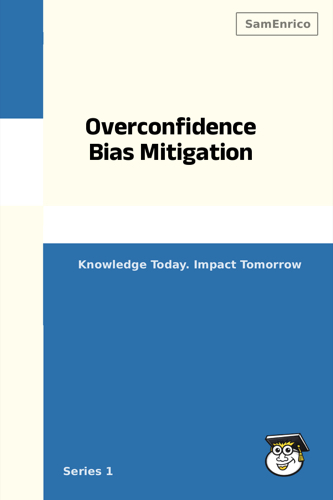
Overconfidence Bias Mitigation eBook
Tempers unrealistic business projections.
Tempers unrealistic business projections.
Formats
Free sample
Chapter 1: The Optimism Virus--Every failed business projection begins with the same innocent phrase: “This time is different.”The CEO leans back in her chair, surrounded by a team of talented analysts. The spreadsheet on the screen shows a hockey-stick growth curve. Revenue triples in year two. Market share hits 40% by year three. The board is excited.
The investors are ready to wire funds. And everyone in the room genuinely believes the numbers are realistic.They are almost certainly wrong.Not because they are stupid. Not because they are lazy. Not because they lack data. They are wrong because they are human.
And being human means being infected with a cognitive virus that distorts every business projection you will ever make. That virus is overconfidence.This chapter is not an academic exercise. It is a diagnostic. By the time you finish reading these pages, you will understand exactly why 81% of startup founders believe their chance of success is 70% or higher when the actual failure rate exceeds 90%. You will learn the single most powerful framework for distinguishing healthy confidence from pathological overconfidence.
And you will take a self-diagnostic quiz that will likely make you uncomfortable—because it will reveal that you, right now, are probably overconfident about at least one major projection on your desk.Let us begin with a story.The $2 Billion Mistake That Changed Everything In 2012, a well-funded technology company called Fab.com was the darling of the e-commerce world. The founder, Jason Goldberg, had raised over $300 million from top venture capital firms. His projection was simple: Fab would become the “next Amazon for design products,” generating $500 million in annual revenue by 2014.The team built detailed financial models. They hired hundreds of employees. They expanded to Europe.
They acquired competitors. Everything about the projection felt solid because every assumption was justified by a story: “We have better logistics,” “Our design aesthetic is unique,” “The market is ready for us.”By 2014, Fab was not generating $500 million. It was generating less than $150 million and burning through cash at an unsustainable rate. The company laid off hundreds of employees, sold its assets for pennies on the dollar, and became a cautionary tale taught in business schools.What went wrong? Every assumption was plausible.
The product was good. The team was talented. The market was real. But the projection was built entirely on the Inside View—the belief that Fab’s specific circumstances would override historical patterns. The founders ignored the Outside View: the base rate of e-commerce companies that successfully scale to $500 million in revenue within three years is less than 2%.Goldberg later admitted in an interview: “We believed our own story so completely that we stopped asking whether the story was likely.” That is the Optimism Virus in its purest form.Defining the Virus: What Overconfidence Actually Is Before we can mitigate overconfidence, we must define it with surgical precision.
Most people use the word “overconfidence” to mean “being too sure of yourself.” That is imprecise and unhelpful. In the behavioral economics literature—drawing on the foundational work of Daniel Kahneman, Amos Tversky, and Don Moore—overconfidence is defined as systematic miscalibration between subjective belief and objective reality.Let me translate that. If you believe there is a 70% chance your project will succeed, but the true historical success rate for similar projects is 30%, you are miscalibrated by 40 percentage points. That is overconfidence. It does not matter how smart you are.
It does not matter how hard you work. The gap between belief and reality is the only thing that matters.This definition reveals something uncomfortable: overconfidence is not about personality. It is about accuracy. A humble person can be overconfident if their conservative estimate is still too optimistic relative to base rates. A bold person can be well-calibrated if their aggressive estimate matches historical outcomes.The distinction matters because most books on business psychology tell you to “be more confident” or “be less confident.” That advice is worse than useless—it is actively harmful.
The goal is not to adjust your confidence level up or down. The goal is to align your confidence with reality.The Quantifiable Threshold: Healthy vs. Pathological This book introduces a rule that will appear throughout every subsequent chapter: Confidence is healthy only when your subjective probability is within 20 percentage points of the relevant base rate.Let me illustrate with examples.Example A (Healthy Confidence): You are launching a software product. Historical data shows that similar products in your category have a 40% success rate (however you define success). You believe your chance of success is 50%.
You are within the 20-point threshold. Your confidence is healthy. It may be slightly optimistic, but it is grounded.Example B (Pathological Overconfidence): Same historical base rate of 40%. You believe your chance of success is 80%. You are 40 points above reality.
You are pathologically overconfident. Your belief is not confidence—it is delusion.Example C (Pathological Underconfidence): Same base rate of 40%. You believe your chance of success is 10%. You are 30 points below reality. You are pathologically underconfident.
This is less common in entrepreneurial settings but common in large organizations where punishment for failure has created a culture of extreme pessimism.The 20-point threshold is not arbitrary. It comes from calibration research by Philip Tetlock and Barbara Mellers, who studied thousands of forecasts from professional intelligence analysts. They found that well-calibrated forecasters consistently produce probabilities within 15-20 points of actual base rates. Beyond that range, the forecaster is systematically biased.Throughout this book, whenever you read a case study or a tool, you should return to this threshold. Ask yourself: “Is my subjective probability within 20 points of the base rate?” If the answer is no, you are not confident.
You are infected.The Planning Fallacy: The Primary Mechanism of Overconfidence Now we arrive at the engine of the Optimism Virus. The Planning Fallacy is the tendency to systematically underestimate the time, costs, and risks of future actions while overestimating their benefits—even when you know that similar past projects have failed.Kahneman and Tversky first documented the Planning Fallacy in the 1970s through a series of elegant experiments. In one study, they asked graduate students to estimate how long it would take them to complete their senior theses. The students provided three estimates: a “best-case” estimate (if everything went perfectly), a “realistic” estimate (if things went normally), and a “worst-case” estimate (if everything went poorly).The results were devastating. The average student believed there was only a 1% chance that their thesis would take longer than their worst-case estimate.
In reality, more than 70% of students took longer than their worst-case estimate. They did not just underestimate time—they systematically underestimated their own underestimation.The Planning Fallacy operates through three distinct mechanisms, each of which you have probably experienced:Mechanism One: The Inside View. When you plan a project, your attention naturally focuses on the unique details of that specific project. You think about your team’s talent, your innovative strategy, your superior execution. You construct a narrative that explains why this project is different.
This is the Inside View, and it is your brain’s default setting.Mechanism Two: Base Rate Neglect. While you are immersed in the Inside View, you ignore the Outside View—what actually happened to…
This is the end of the free sample. Get the eBook to keep going. Buy now
About this book
Details
- Author
- Kopp Alphonso
- Publisher
- SamEnrico
- Language
- English
- Genre
- Non-Fiction, Business Brief, Strategic Planning
- Released
- 2026-06-09
- Pages (approx.)
- 148
- Available as
- eBook, Audiobook

Read better in the ZLOADR app
Your eBooks on your phone or tablet. Sign in with your SamEnrico account and start reading.
More by Kopp Alphonso
 Special Needs Parent RageKopp Alphonso$11.99
 Eisenhower For FreelancersKopp Alphonso$11.99
 Leadership Presence BuildingKopp Alphonso$11.99
 Aging Parent Guilt ReleaseKopp Alphonso$11.99
 Tension Headache and SinusitisKopp Alphonso$11.99
 Dealing with Difficult PeopleKopp Alphonso$11.99
 Creatine Brain Muscle GuideKopp Alphonso$11.99
 Sadness Recognition ToolsKopp Alphonso$11.99
 The Green Revolution: How Frank Lloyd Wright’s Legacy Shaped Sustainable ArchitectureKopp Alphonso$11.99
 The Last Flight of the Phoenix: How a 19th-Century Balloonist Disappeared Over the AtlanticKopp Alphonso$11.99
 Hashtag Revolution: The Viral Rise of the Arab SpringKopp Alphonso$11.99
 Toll Free Numbers WorldwideKopp Alphonso$12.99
You may also like
 Hong Kong Handover 1997Dunn Johnnie$11.99
 Zumba For Postnatal Recovery CourseNeal Christian$11.99
 Zumba for BeginnersLadner Nikia$11.99
 YouTube Comment Mining GuideHumes Pandora$12.99
 Worry Box MeditationCarlin Rudy$11.99
 Workplace Stress MeditationNguyen Lynn$11.99
 Workplace Stress and Sleep RepairHawley Ivory$11.99
 Workplace Perfectionism CureDelaney Jeffry$11.99
 Workplace Injustice Anger GuideWallen Isabelle$11.99
 Work Addiction and Burnout LinkGreenwood Ester$11.99
 Women in Yoga and WellnessBeattie Galina$11.99
 Women in Stand Up ComedyChun Evangeline$11.99