

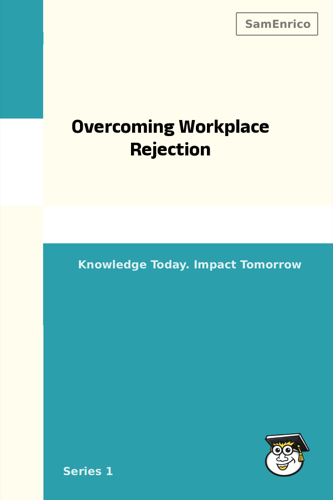
Overcoming Workplace Rejection eBook
Handle project turndowns and idea rejections witho
Handle project turndowns and idea rejections without internalizing failure.
Formats
Free sample
Chapter 1: The Neural Handshake--It happens in a fraction of a second. One moment you are sitting in a meeting, confident in the proposal you have spent weeks preparing. The next moment, your manager says four words: "We're going a different direction." And something inside you shatters.Not metaphorically. Literally.Your chest tightens. Your throat constricts.
Heat floods your face. Your stomach drops as if you have just missed the bottom step on a staircase. Your mind, which moments ago was full of data points and logical arguments, goes completely blank. You feel exposed, small, and desperate to escape the room. Later, alone, you will replay the moment dozens of times.
You will wonder what you did wrong. You will question whether you belong in this career, this company, or maybe any company at all.Here is the truth that no performance review will ever tell you: That reaction is not weakness. It is not insecurity. It is not impostor syndrome run amok. It is biology.
And once you understand that biology, you can stop being victimized by it and start using it as information.This chapter will take you inside your own brain during a rejection event. You will learn why a dismissed idea can feel like a punch to the gut, why neurodivergent professionals experience rejection more intensely, and why your ancient survival instincts are currently mismatched to modern corporate life. Most importantly, you will learn the first and most fundamental skill of rejection resilience: recognizing the sting for what it is, so you can choose your response instead of being hijacked by it.The f MRI That Changed Everything In 2003, a team of social neuroscientists led by Naomi Eisenberger at UCLA conducted an experiment that would fundamentally change how we understand rejection. They placed volunteers inside functional magnetic resonance imaging machines—f MRI scanners that measure brain activity by tracking blood flow—and had them play a virtual ball-tossing game called Cyberball.The game was simple. The participant believed they were tossing a virtual ball with two other players.
In reality, those other players were controlled by a computer. For the first few minutes, everyone played fairly. The ball moved from player to player. The participant felt included. Then, without warning, the computer-controlled players stopped tossing the ball to the participant.
They threw it only to each other. The participant was, for all practical purposes, excluded.Inside the scanner, something remarkable happened. The same brain regions that light up when a person experiences physical pain—the dorsal anterior cingulate cortex and the anterior insula—activated during social exclusion. The participants were not being shocked, burned, or struck. They were simply being left out of a virtual ball toss.
And their brains processed that exclusion as pain.This finding has been replicated dozens of times across cultures and age groups. Your brain does not have a dedicated "rejection detector" that differs from its "physical pain detector." It uses the same wiring for both. When your manager says no to your proposal, your brain processes that event using the same neural infrastructure it would use if you had been punched.Let that land for a moment. You are not being dramatic when you say that rejection hurts. You are being scientifically precise.The Neural Handshake: Why Your Brain Can't Tell Past from Present The reason for this overlap is evolutionary.
For the vast majority of human history—roughly two hundred thousand years—being rejected by your social group was a life-threatening event. If your tribe excluded you, you lost access to food, shelter, protection, and mating opportunities. You did not just feel bad. You died.Your brain evolved to treat social rejection as an emergency because, for your ancestors, it was an emergency. The dorsal anterior cingulate cortex developed the ability to register social pain quickly and intensely because speed mattered.
The faster you noticed you had been excluded, the faster you could scramble to repair the relationship or find a new group.This is what I call the Neural Handshake—the brain's inability to distinguish between being excluded from a hunting party ten thousand years ago and being excluded from a project meeting ten minutes ago. The same alarm system activates. The same stress hormones flood your system. Your heart races, your palms sweat, and your prefrontal cortex—the rational, planning part of your brain—gets partially shut down so that your survival instincts can take over.This is why you cannot think clearly immediately after a rejection. It is not a character flaw.
It is a neurological feature. Your brain has temporarily reduced blood flow to the regions responsible for complex reasoning because it believes you are under threat. From your brain's perspective, you are. It just cannot tell that the threat is a budget decision rather than a saber-toothed tiger.The Physical Experience of Rejection Now that you understand the neural mechanism, let us walk through exactly what happens in your body during a workplace rejection. You will recognize some of these sensations.
The goal is not to pathologize them but to name them. Naming gives you power.When your manager says no, your amygdala—the brain's threat-detection center—fires within milliseconds. It sends an alarm signal to your hypothalamus, which activates your sympathetic nervous system. Your adrenal glands release a flood of catecholamines, primarily adrenaline and noradrenaline. Your heart rate accelerates.
Your blood pressure rises. Your breathing becomes shallow and rapid.Your body is preparing for fight or flight. But you are sitting in a conference room. There is nothing to fight and nowhere to flee. So the energy has nowhere to go.
It becomes tension in your shoulders, a knot in your stomach, a lump in your throat.Meanwhile, your body releases cortisol, the primary stress hormone. Cortisol increases glucose in your bloodstream, enhances your brain's use of glucose, and increases the availability of substances that repair tissues. In a real physical threat, this is helpful. In a conference room, it means you will feel shaky and wired for hours.Your vagus nerve, which connects your brain to your heart and digestive system, also responds to rejection. Some people experience nausea.
Others feel a hollow sensation in their chest. These are not psychosomatic. They are physiological responses to a perceived social threat.Finally, your brain releases endogenous opioids—natural painkillers—to help you cope with the distress. This is why rejection can feel oddly numbing or why some people describe feeling "blank" after a significant no. Your brain is medicating you.Here is the most important thing to understand about all of this: You do not choose these responses.
They happen automatically. They are reflexes, not decisions. And once you recognize them as reflexes, you can stop judging yourself for having them.The RSD Amplifier: When Rejection Hits Harder For most people, the neural response to rejection is intense but temporary. However, for a significant subset of the population—estimates suggest fifteen to twenty percent—the response is dramatically amplified. These individuals experience what is clinically known as Rejection Sensitivity Dysphoria, or RSD.RSD is not a character flaw or a lack of resilience.
It is a neurobiological condition, most commonly associated with ADHD and autism, in which perceived or actual rejection triggers an…
This is the end of the free sample. Get the eBook to keep going. Buy now
About this book
Details
- Author
- Goldstein Daren
- Publisher
- SamEnrico
- Language
- English
- Genre
- Non-Fiction, Self-Help, Rejection
- Released
- 2026-06-07
- Pages (approx.)
- 143
- Available as
- eBook, Audiobook

Read better in the ZLOADR app
Your eBooks on your phone or tablet. Sign in with your SamEnrico account and start reading.
More by Goldstein Daren
 Ancestral Legacy HealingGoldstein Daren$11.99
 Reservation Price NegotiationGoldstein Daren$11.99
 Alcohol Craving Management WorkbookGoldstein Daren$11.99
 Interruption ChecklistGoldstein Daren$11.99
 Divorce With TeenagersGoldstein Daren$11.99
 The Updating Ability GuideGoldstein Daren$11.99
 Social Media Wealth ComparisonGoldstein Daren$11.99
 Baba Yaga's Bone Forest: The Witch Who Walks the WildsGoldstein Daren$11.99
 The Silent Siege: How a Single Hacker Took Down Estonia in 2007Goldstein Daren$11.99
 How to Produce Law ServicesGoldstein Daren$11.99
 Growing BaueraGoldstein Daren$11.99
 A Collector's Handbook to the Riley 1½-litreGoldstein Daren$11.99
You may also like
 Hong Kong Handover 1997Dunn Johnnie$11.99
 Zumba For Postnatal Recovery CourseNeal Christian$11.99
 Zumba for BeginnersLadner Nikia$11.99
 YouTube Comment Mining GuideHumes Pandora$12.99
 Worry Box MeditationCarlin Rudy$11.99
 Workplace Stress MeditationNguyen Lynn$11.99
 Workplace Stress and Sleep RepairHawley Ivory$11.99
 Workplace Perfectionism CureDelaney Jeffry$11.99
 Workplace Injustice Anger GuideWallen Isabelle$11.99
 Work Addiction and Burnout LinkGreenwood Ester$11.99
 Women in Yoga and WellnessBeattie Galina$11.99
 Women in Stand Up ComedyChun Evangeline$11.99