
Non-FictionSelf-HelpProcrastination
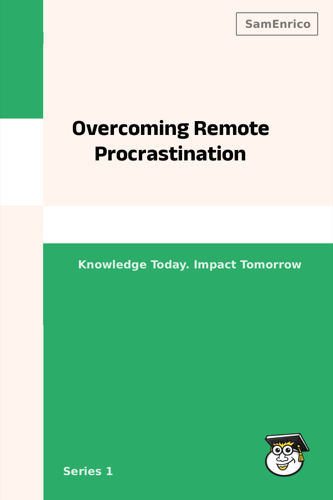
Overcoming Remote Procrastination eBook
Beats home office distractions with accountability
by Bolt Huey
Beats home office distractions with accountability.
Formats
Free sample
Chapter 1: The Comfy Lie--The most dangerous room in your house is not the kitchen with its sharp knives or the bathroom with its slippery floor. It is your home office. And it is dangerous precisely because it feels safe.You wake up. You pour coffee. You walk fifteen feet to your desk, still wearing the same sweatpants you slept in.
You open your laptop, and for a moment, everything feels civilized. No commute. No traffic. No fluorescent office lights buzzing overhead like angry insects. This, you tell yourself, is the future of work.
This is freedom.But by 2:47 PM, you have done something strange. You have folded laundry that did not need folding. You have scrolled through the Instagram feed of a person you have not spoken to since high school. You have opened the refrigerator seven times despite not being hungry. You have replied to twenty-three emails, none of which required a reply before tomorrow.
And the one thing you absolutely needed to finish—the presentation, the report, the code, the proposal—remains untouched, a small gray icon on your screen staring back at you with what feels like judgment.You tell yourself you lack discipline. You tell yourself you are lazy. You tell yourself that if you just tried harder, you would be different.This chapter exists to tell you that you are wrong. Not slightly wrong. Completely, fundamentally, structurally wrong.The problem is not your character.
The problem is your environment. And until you understand how profoundly your physical surroundings dictate your behavior, you will continue to lose the battle against remote procrastination—not because you are weak, but because you are human.The Myth of the Natural Worker There is a pervasive fantasy that working from home should be easy. The fantasy goes something like this: remove the distractions of the open-plan office—the chatty coworker, the unnecessary meetings, the long commute—and what remains is a pure, undistracted version of yourself, finally free to do your best work.This fantasy is seductive because it contains a grain of truth. Open offices are distracting. Commutes are draining.
Meetings are often pointless. But the fantasy makes a catastrophic error: it assumes that the default state of a human being is focused, productive, and self-directed. It assumes that distraction is something imposed upon you from the outside, and that by removing external distractions, you will naturally fall into a state of deep, effortless concentration.Nothing could be further from the truth.The default state of a human brain is not focus. It is what neuroscientists call the "default mode network"—a state of mind-wandering, daydreaming, and environmental scanning. Your brain evolved to notice the rustle in the grass, the change in the wind, the movement at the edge of your vision.
For one hundred thousand years, the humans who survived were the ones who could not sustain focus. They were the ones who looked up from their task every few minutes to check for predators.Focus is not natural. Focus is a technology. It is a muscle that must be trained, and more importantly for our purposes, it is a behavior that must be cued by the environment.In an office, the environment cues focus without you having to think about it. The mere act of putting on business casual clothing tells your brain: we are now in work mode.
The forty-five-minute commute—as miserable as it may be—serves as a transition ritual, a psychological bridge between home-self and work-self. The presence of other people working silently at their desks creates a phenomenon social scientists call social facilitation: the tendency to perform better on tasks when others are present, even if those others are not watching you.When you work from home, all of those cues vanish. You wake up in your bedroom, walk to your desk in the same clothes, and sit down in a room that, six hours earlier, was where you watched Netflix. Your brain receives no signal that anything has changed. As far as your ancient, pattern-matching nervous system is concerned, you are still at home, and home means rest, leisure, and safety.The result is not laziness.
The result is a perfectly predictable environmental mismatch. You are asking your brain to perform a task that it evolved to resist, in an environment that provides no signal that the rules have changed. You are not failing. You are being set up to fail.The Ten-Foot Couch Problem Let me introduce you to a concept that will appear throughout this book: the Ten-Foot Couch Problem.Imagine your desk is in the corner of your living room. Ten feet away sits your couch, soft and inviting.
In front of the couch is a television. On the television is a streaming service that remembers exactly where you paused your show last night.Here is what happens inside your brain when you try to work in that room.Every few minutes, your eyes drift from the screen to the couch. You do not consciously decide to look. Your peripheral vision, that ancient predator-detection system, simply registers the presence of the couch. The couch triggers a memory of comfort.
The memory triggers a small release of dopamine—the neurotransmitter associated with anticipation of reward. The dopamine makes you feel, just for a moment, that moving to the couch would feel better than staying at your desk.You resist. You look back at your screen. But the resistance costs energy. Every glance at the couch is a tiny negotiation with yourself.
Should I? No. But it would be so nice. Just for five minutes. No, stay focused.By the end of an hour, you have spent as much energy resisting the couch as you have spent on your actual work.
This is called ego depletion: the finite resource of self-control that gets used up over the course of a day. And you are burning it on furniture.Now multiply the couch by everything else in your home. The refrigerator. The dishwasher that needs unloading. The bed that is still unmade.
The phone that buzzes with a text from a friend. The window that looks out at a nice day. The dog that needs to be walked. The children who are home from school.Each of these is a competing cue—an environmental signal that your brain interprets as an invitation to do something other than work. In an office, these competing cues are largely absent.
Your office does not contain a couch, a refrigerator, an unmade bed, or your dog. The only cues in an office are work cues: the computer, the phone, the stack of papers, the colleague at the next desk.When you work from home, you are not working in a neutral environment. You are working in an environment that has been meticulously designed—by evolution, by culture, and by your own past behavior—to cue everything except work. And then you blame yourself for failing.Context-Dependent Memory: Why You Forget Everything There is a specific form of remote procrastination that has nothing to do with laziness and everything to do with how memory works. It goes like this:You are sitting at your desk, working on a task.…
This is the end of the free sample. Get the eBook to keep going. Buy now
About this book
Details
- Author
- Bolt Huey
- Publisher
- SamEnrico
- Language
- English
- Genre
- Non-Fiction, Self-Help, Procrastination
- Released
- 2026-06-07
- Pages (approx.)
- 145
- Available as
- eBook, Audiobook

Read better in the ZLOADR app
Your eBooks on your phone or tablet. Sign in with your SamEnrico account and start reading.
More by Bolt Huey
 Asking Clarifying Questions EffectivelyBolt Huey$11.99
 Fear of Failure Affirmation DeckBolt Huey$11.99
 Mindful Social Media ScrollBolt Huey$11.99
 Fertility Benefit ComplianceBolt Huey$11.99
 SAD And Music TherapyBolt Huey$11.99
 De escalation JournalBolt Huey$11.99
 Networking for Data ScientistsBolt Huey$11.99
 The Portrait That Broke the Curse: Peter Graham and the All Blacks' RedemptionBolt Huey$11.99
 How to Produce Wall Plates and CoversBolt Huey$11.99
 US Virtual Address for LLC FormationBolt Huey$12.99
 Angel Investor Non-Disclosure AgreementsBolt Huey$12.99
 How to Produce LeisBolt Huey$11.99
You may also like
 Hong Kong Handover 1997Dunn Johnnie$11.99
 Zumba For Postnatal Recovery CourseNeal Christian$11.99
 Zumba for BeginnersLadner Nikia$11.99
 YouTube Comment Mining GuideHumes Pandora$12.99
 Worry Box MeditationCarlin Rudy$11.99
 Workplace Stress MeditationNguyen Lynn$11.99
 Workplace Stress and Sleep RepairHawley Ivory$11.99
 Workplace Perfectionism CureDelaney Jeffry$11.99
 Workplace Injustice Anger GuideWallen Isabelle$11.99
 Work Addiction and Burnout LinkGreenwood Ester$11.99
 Women in Yoga and WellnessBeattie Galina$11.99
 Women in Stand Up ComedyChun Evangeline$11.99