
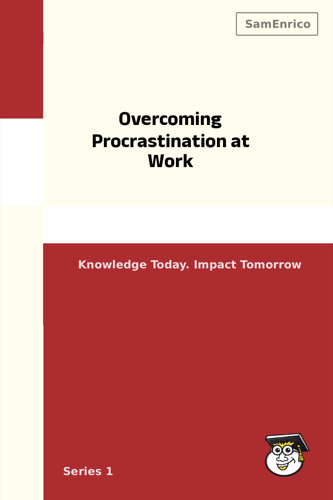
Overcoming Procrastination at Work eBook
Beats workplace delay and deadline avoidance.
by Paine Un
Beats workplace delay and deadline avoidance.
Formats
Free sample
Chapter 1: The Pressure Junkie’s Lie--–- You tell yourself you work best under pressure. You have the late-night victories to prove it—the report sent at 11:57 PM, the presentation finished thirty minutes before the board meeting, the sprint that somehow came together in the final hour. You call yourself a “deadline driver” or a “pressure performer.” You might even wear it as a badge of honor.The problem is that nearly everything you believe about working under pressure is wrong.Not just slightly exaggerated or mildly optimistic—but neurologically, empirically, and predictably wrong.This chapter dismantles the most seductive myth in workplace productivity: that last-minute panic is a viable strategy for doing your best work. Along the way, you will discover why procrastination has nothing to do with laziness, why your brain keeps tricking you into delay, and the single most important truth that will change how you think about every missed deadline you have ever had.Let us begin with a confession.The Confession That Changed Everything In 2018, a senior partner at a global consulting firm named Marcus walked into my office and sat down. He was forty-seven years old, had made the firm over twelve million dollars in the previous three years, and was widely considered one of the best client strategists in his region.
He was also, by his own admission, a mess.“I haven’t started the Johnson presentation,” he said. “It’s due in six hours.”I had heard this from Marcus before. What I had not heard was what came next.“I told my team I’d have the draft to them by noon today,” he continued. “It’s now four in the afternoon. I’ve been sitting here for six hours.
I’ve checked email. I’ve organized my desktop folders. I’ve read three articles about the history of office furniture. I have not written one slide.”Marcus was not lazy. He had run marathons, built a seven-figure book of business, and raised three children while maintaining a marriage.
His problem was not a lack of discipline or ambition. His problem was that he genuinely believed he worked better under pressure—and his brain kept manufacturing that pressure whether he needed it or not.“The last time I pulled an all-nighter,” he told me, “I delivered a pitch that won a two-million-dollar account. I slept four hours, flew to Chicago, and closed the deal. That’s why I keep doing this.”I asked him a question that stopped him cold: “How many all-nighters have you pulled in your career?”He thought for a moment. “Maybe fifty.”“And how many of those fifty resulted in your best work?”Long pause.
“Maybe five.”“What about the other forty-five?”Marcus looked at the floor. “The other forty-five were just… survival. I got it done. But it wasn’t good. And I was wrecked for days afterward.”This is the lie of the pressure junkie.
You remember the wins. You forget the losses. And your brain, which is designed to remember threats more vividly than neutral events, locks onto the five victories and uses them to justify the forty-five episodes of unnecessary suffering.The Two Faces of Workplace Delay Before we go further, we need to name something important. Not all procrastination is the same. In fact, researchers have identified two fundamentally different drivers of delay, and understanding which one affects you—and when—is the first step toward real change.Avoidant Procrastination This is the most common form of workplace delay, accounting for approximately eighty-five percent of all procrastination episodes.
Avoidant procrastination happens when a task triggers a negative emotion—fear, boredom, self-doubt, frustration, or anxiety—and you delay to escape that feeling.When Marcus avoided the Johnson presentation, he was not seeking excitement. He was avoiding the discomfort of not knowing where to start, the fear that his ideas were not good enough, and the vulnerability of sharing unfinished work with his team. Every click on email, every desktop folder reorganization, every article about office furniture was an escape from those feelings.Here is what makes avoidant procrastination so tricky: the escape works. In the short term. Checking email actually does reduce the immediate discomfort of facing a difficult task.
Your brain learns, very quickly, that switching to a less threatening activity provides relief. And what the brain learns, it repeats.Arousal Procrastination This is the less common but more glamorous cousin. Arousal procrastinators delay specifically to generate an adrenaline rush from the looming deadline. They wait until the last minute because they enjoy—or believe they need—the high-stakes pressure to perform.Here is the truth about arousal procrastination: it is real, but it is rare. Genuine arousal procrastinators make up perhaps five to ten percent of the population.
The rest of us who think we are arousal procrastinators? We are actually avoidant procrastinators who have learned to reframe our panic as productivity.Marcus believed he was an arousal procrastinator. He told himself he needed the pressure. But when we looked closely at his pattern, the truth was different. He did not delay because he loved the adrenaline.
He delayed because he was afraid. The adrenaline was just the aftertaste.The Performance Curve That Destroys the Myth In 1908, psychologists Robert Yerkes and John Dodson discovered something that has been replicated hundreds of times since. The Yerkes-Dodson Law describes the relationship between arousal (stress, pressure, alertness) and performance. It looks like an upside-down U.Low arousal (boredom, lethargy) produces low performance. Moderate arousal (focused alertness, healthy challenge) produces peak performance.
High arousal (panic, terror, extreme time pressure) produces collapsing performance.Here is what this means for you: The idea that “more pressure equals better work” is only true up to a point. Beyond that point, pressure destroys your cognitive abilities. Working memory fails. Creativity plummets. Attention narrows to tunnel vision.
Error rates spike. And your brain’s threat-detection system—the amygdala—takes over from your planning center—the prefrontal cortex.When Marcus worked through the night to finish the Johnson presentation, he was not operating at his peak. He was operating at the cliff’s edge of cognitive collapse. The fact that he occasionally succeeded does not prove that pressure works. It proves that he was talented enough to survive despite the pressure.The Real Cost of “I Work Better Under Pressure”Let us calculate what the pressure junkie mentality actually costs you.
Not in abstract terms. In concrete, measurable damage.The Cognitive Cost When your brain is in a state of high arousal, your prefrontal cortex—the part responsible for planning, reasoning, and impulse control—starts to shut down. Your amygdala takes over. You become reactive instead of strategic. You prioritize speed over accuracy.
You make mistakes you would never make in a calm state.In Marcus’s case, the all-nighters produced slides that were technically correct but strategically shallow. He won accounts not because of the all-nighters but despite them. His best work—the work that built his reputation—came from projects he started early and refined over time.The Health Cost Chronic workplace delay raises cortisol levels. Elevated cortisol weakens your immune system, impairs sleep quality, increases blood pressure, and has been linked to long-term…
This is the end of the free sample. Get the eBook to keep going. Buy now
About this book
Details
- Author
- Paine Un
- Publisher
- SamEnrico
- Language
- English
- Genre
- Non-Fiction, Self-Help, Workplace
- Released
- 2026-06-06
- Pages (approx.)
- 139
- Available as
- eBook, Audiobook

Read better in the ZLOADR app
Your eBooks on your phone or tablet. Sign in with your SamEnrico account and start reading.
More by Paine Un
 Adolescent Dream ThemesPaine Un$11.99
 Hinton Forgiveness Of StatePaine Un$11.99
 Anger Journaling Recovery MethodPaine Un$11.99
 Method Of Loci For Credit CardsPaine Un$11.99
 Greased Cartridge Incident UncoveredPaine Un$11.99
 Dream Journaling for Healthcare WorkersPaine Un$11.99
 Gold Coast To GhanaPaine Un$11.99
 The Siege of Vienna: The Ottomans' Last Gasp (1683)Paine Un$11.99
 The Shadow of the Mask: Africa's Forgotten Silent Film Revival (1896-1905)Paine Un$11.99
 Fique: Fiber Plant HarvestingPaine Un$11.99
 Mastering The WristPaine Un$11.99
 How to Produce Drum KitsPaine Un$11.99
You may also like
 Hong Kong Handover 1997Dunn Johnnie$11.99
 Zumba For Postnatal Recovery CourseNeal Christian$11.99
 Zumba for BeginnersLadner Nikia$11.99
 YouTube Comment Mining GuideHumes Pandora$12.99
 Worry Box MeditationCarlin Rudy$11.99
 Workplace Stress MeditationNguyen Lynn$11.99
 Workplace Stress and Sleep RepairHawley Ivory$11.99
 Workplace Perfectionism CureDelaney Jeffry$11.99
 Workplace Injustice Anger GuideWallen Isabelle$11.99
 Work Addiction and Burnout LinkGreenwood Ester$11.99
 Women in Yoga and WellnessBeattie Galina$11.99
 Women in Stand Up ComedyChun Evangeline$11.99