
Non-FictionSelf-HelpSocial Connection
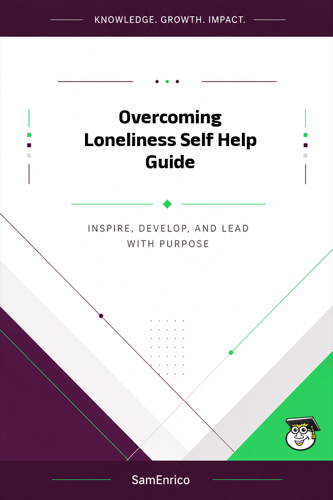
Overcoming Loneliness Self Help Guide
Teaches practical steps to build meaningful connec
Teaches practical steps to build meaningful connections and reduce isolation.
Formats
About this book
Free sample
Chapter 1: The Feedback Loop--–- The text message sat unread for three hours. Then six. Then twelve. By the time your friend finally replied—"Sorry, crazy day!"—you had already constructed an entire narrative. They're angry at you.
They're secretly phasing you out. You said something wrong last Tuesday. They never really liked you anyway. By evening, you had felt a familiar ache in your chest, a heaviness that made you want to crawl under a blanket and cancel all plans for the weekend. You were lonely.
And here is the cruelest part: the person who did this to you was not your friend. It was your own brain.This chapter introduces the single most important concept you will learn in this book: the loneliness feedback loop. Understanding this loop is not optional. It is the foundation upon which every subsequent chapter is built. Without it, the practical exercises in later chapters will feel like putting a bandage on a broken bone.
With it, you gain something more valuable than any social script or conversation tip: the ability to see your own loneliness as a mechanical process, not a verdict on your worth as a human being.If you read only one chapter of this book, make it this one. Because once you see the loop, you cannot unsee it. And once you cannot unsee it, you can begin to break it.The Biological Lie Your Brain Tells You Let us start with a radical reframing that will challenge almost everything you have been told about loneliness. Loneliness is not an emotion. Not really.
Emotions like sadness, anger, or joy are responses to events. Loneliness is something else entirely. It is a biological signal, as primal and ancient as hunger or thirst.Dr. John Cacioppo, the late neuroscientist who spent three decades studying loneliness at the University of Chicago, made this discovery through a series of elegant experiments. When he placed socially isolated rats in f MRI machines, he observed that their brains showed the same patterns of activation as rats who had been physically starved.
The same neural circuits lit up. The same stress hormones flooded their systems. The rat brain could not distinguish between…
This is the end of the free sample. Get the eBook to keep going. Buy now
Contents
- Chapter 1
- Chapter 2
- Chapter 3
- Chapter 4
- Chapter 5
- Chapter 6
- Chapter 7
- Chapter 8
- Chapter 9
- Chapter 10
- Chapter 11
- Chapter 12
Details
- Author
- Mccarty Brianne
- Publisher
- SamEnrico
- Language
- English
- Genre
- Non-Fiction, Self-Help, Social Connection
- Released
- 2026-06-09
- Pages (approx.)
- 145
- Available as
- eBook, Audiobook

Read better in the ZLOADR app
Your eBooks on your phone or tablet. Sign in with your SamEnrico account and start reading.
More by Mccarty Brianne
 Earnout Structure DatabaseMccarty Brianne$11.99
 One That Got AwayMccarty Brianne$11.99
 FODMAP Symptom Journal WorkbookMccarty Brianne$11.99
 Bariatric Surgery Coffee Caffeine GuideMccarty Brianne$11.99
 Hashtag Revolution: How #MeToo Changed the 2020 ElectionMccarty Brianne$11.99
 The Reef Beneath the Ash: How a Soviet Scientist Uncovered the Great Barrier Reef’s Secret PastMccarty Brianne$11.99
 Understanding Cdg Syndrome Type 1cMccarty Brianne$17.99
 Java Chicken BreedingMccarty Brianne$11.99
 How to Start a Post Business (Beginners Guide)Mccarty Brianne$11.99
 Proposal Writer Block SolutionsMccarty Brianne$12.99
 AI Financial Data StandardizationMccarty Brianne$12.99
You may also like
 Hong Kong Handover 1997Dunn Johnnie$11.99
 Zumba For Postnatal Recovery CourseNeal Christian$11.99
 Zumba for BeginnersLadner Nikia$11.99
 YouTube Comment Mining GuideHumes Pandora$12.99
 Worry Box MeditationCarlin Rudy$11.99
 Workplace Stress MeditationNguyen Lynn$11.99
 Workplace Stress and Sleep RepairHawley Ivory$11.99
 Workplace Perfectionism CureDelaney Jeffry$11.99
 Workplace Injustice Anger GuideWallen Isabelle$11.99
 Work Addiction and Burnout LinkGreenwood Ester$11.99
 Women in Yoga and WellnessBeattie Galina$11.99
 Women in Stand Up ComedyChun Evangeline$11.99