
Non-FictionSelf-HelpVideo Editing
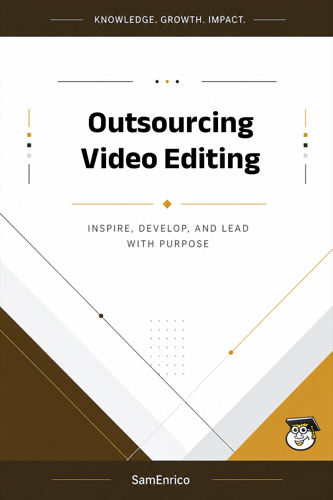
Outsourcing Video Editing eBook
Send raw footage to remote editor for post product
Send raw footage to remote editor for post production.
Formats
Free sample
Chapter 1: The Hidden Math--Every video creator I know has a secret ledger. It's not written down anywhere. You won't find it in Quick Books or scrawled on a napkin. But it exists in the quiet hours of the night when you're alone with your timeline, rendering a project that was due yesterday, watching the progress bar crawl from 47 percent to 48 percent, and doing the math you're afraid to admit out loud.How much is my time actually worth? And why am I spending it here?I remember the exact moment this question stopped being abstract for me.
I was twenty-seven years old, sitting on the floor of my one-bedroom apartment at 2:47 AM, surrounded by coffee cups that had long since gone cold. My laptop fans were screaming. The render timer said another forty-three minutes. I had a shoot in six hours, three hundred miles away, and I hadn't packed my gear. My girlfriend had stopped asking when I'd be done three months ago.
She just left a glass of water on the desk and went to bed alone.I was editing a corporate testimonial video for a client who had paid me four thousand dollars. That felt like a win at the time. Four thousand dollars! I was a real filmmaker now. But here's what I didn't understand then, what I want you to understand in the first pages of this book: I wasn't keeping four thousand dollars.
I was paying myself a wage so embarrassingly low that if I had seen it on a job posting, I would have laughed and scrolled past.Let me show you the math I did that night, the math that changed everything.The project had taken me forty-seven hours from importing the first clip to exporting the final master. Forty-seven hours of my life. I had filmed it myself, which took another eight hours on location. I had driven six hours round trip. I had spent three hours emailing with the client about changes they wanted—changes that, in retrospect, could have been handled in a single fifteen-minute phone call.
I had rendered the video four times because I kept noticing small mistakes after the export finished, mistakes I should have caught during the review.My total time invested was sixty-four hours. My total revenue was four thousand dollars. That works out to sixty-two dollars and fifty cents per hour.Sixty-two fifty.Before taxes.Before software subscriptions.Before equipment depreciation.Before the cost of the coffee keeping me awake.After all of that, I was making less than the plumber who had charged me three hundred dollars to unclog my sink in twenty minutes. I was making less than the server at the restaurant where I sometimes treated myself to a meal I didn't have to cook. I was, in the most literal sense, working for less than minimum wage in several developed countries.And here's the part that still makes me angry when I think about it: I thought I was being smart.
I thought I was saving money by editing my own work. I thought hiring an editor was an expense, a luxury for people with bigger budgets and better clients. I had convinced myself that my editing was "good enough" and that no one else could capture my "creative vision" anyway.Both of those beliefs were wrong. They were not just wrong—they were expensive. They were the kind of wrong that keeps talented, hardworking creators stuck at the exact same revenue level for years while watching others zoom past them.The Hidden Ledger The secret ledger I mentioned earlier has two columns.
In the left column, you write down every dollar that comes in from clients. This is the number you tell people at parties. It feels good to say. "I made eighty thousand dollars last year" or "I just landed a ten-thousand-dollar project." These numbers are real, and they matter.But the right column is where the truth lives. In the right column, you write down every hour you spend to earn those dollars.
Every hour shooting. Every hour editing. Every hour emailing. Every hour scrolling through stock footage websites looking for the perfect b-roll shot. Every hour watching tutorials because you don't know how to do something in After Effects.
Every hour rendering. Every hour uploading. Every hour watching the same ten-second clip twenty times trying to decide if the cut should happen on the word "and" or the word "so."When you divide the left column by the right column, you get your real hourly rate. And for most video creators I meet, that number is somewhere between twenty and fifty dollars.Let me say that again: Most professional video creators, people with years of experience, expensive cameras, and legitimate client rosters, are effectively earning less per hour than a shift manager at a fast-food restaurant.I am not saying this to shame you. I am saying this because I was you.
I spent five years building a video business the hard way, grinding out edits at 2 AM, telling myself that this was what success looked like. And I was wrong.The Three Leverage Points The concept that changed everything for me came from a book I read shortly after that 2:47 AM breakdown. The book was about business, not video, but it introduced me to the idea of "economic value added"—the principle that not all work creates equal value. Some activities are high-leverage, meaning they generate significant returns for the time invested. Others are low-leverage, meaning they consume time without moving the needle.For video creators, there are exactly three high-leverage activities.
Everything else is support work.The first high-leverage activity is client acquisition. Finding new clients, closing deals, negotiating contracts, building relationships. Without clients, you have no business. Every hour spent on acquisition has unlimited potential upside—one good conversation can lead to a five-figure project.The second high-leverage activity is creative direction. Deciding what a video should be, shaping the narrative, guiding the tone, making the big-picture decisions that determine whether a project succeeds or fails.
This is where your unique creative vision actually matters. This is why clients hire you specifically.The third high-leverage activity is shooting, but only for certain types of creators. If you are the on-camera talent, your face and voice are irreplaceable. If you are a documentary filmmaker, your access and rapport with subjects cannot be outsourced. If you are a commercial director, your ability to work with talent and capture specific performances is your核心竞争力.Notice what is not on this list.Editing is not on this list.
Color grading is not on this list. Sound mixing is not on this list. Motion graphics are not on this list. Adding captions is not on this list. Exporting, transcoding, uploading, organizing files, renaming clips, syncing audio—none of these are high-leverage activities.They are tasks.
Important tasks, yes. Tasks that need to be done well. But they are not the reason you can charge premium rates. They are not the activities that will double your revenue or transform your business. They are, in the cold light of economic reality, the work you should be paying someone else to do.The…
This is the end of the free sample. Get the eBook to keep going. Buy now
About this book
Details
- Author
- Pearce Chanda
- Publisher
- SamEnrico
- Language
- English
- Genre
- Non-Fiction, Self-Help, Video Editing
- Released
- 2026-06-07
- Pages (approx.)
- 123
- Available as
- eBook, Audiobook

Read better in the ZLOADR app
Your eBooks on your phone or tablet. Sign in with your SamEnrico account and start reading.
More by Pearce Chanda
 Body Language MicroexpressionsPearce Chanda$11.99
 Public Speaking for AcademicsPearce Chanda$11.99
 Crohn's Disease NutritionPearce Chanda$11.99
 The Forger's Canvas: The Scandal That Shook African Art (1960s)Pearce Chanda$11.99
 10 Ways to Use Almond Paste (Recipe Book)Pearce Chanda$11.99
 Launch Pricing Without Fear GuidePearce Chanda$12.99
 How to Produce Carts and IslandsPearce Chanda$11.99
 Medical Front Desk ReceptionistPearce Chanda$11.99
You may also like
 Hong Kong Handover 1997Dunn Johnnie$11.99
 Zumba For Postnatal Recovery CourseNeal Christian$11.99
 Zumba for BeginnersLadner Nikia$11.99
 YouTube Comment Mining GuideHumes Pandora$12.99
 Worry Box MeditationCarlin Rudy$11.99
 Workplace Stress MeditationNguyen Lynn$11.99
 Workplace Stress and Sleep RepairHawley Ivory$11.99
 Workplace Perfectionism CureDelaney Jeffry$11.99
 Workplace Injustice Anger GuideWallen Isabelle$11.99
 Work Addiction and Burnout LinkGreenwood Ester$11.99
 Women in Yoga and WellnessBeattie Galina$11.99
 Women in Stand Up ComedyChun Evangeline$11.99