
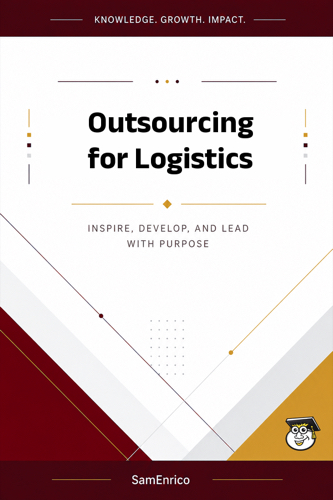
Outsourcing for Logistics eBook
Delegate warehousing and shipping to 3PL providers
Delegate warehousing and shipping to 3PL providers.
Formats
Free sample
Chapter 1: The Garage Ceiling--–- The cardboard boxes were stacked so high that Maria had to use a step stool to reach the top row, and even then, the tower wobbled dangerously every time she pulled one down. Her garage, once a two-car space with room for her Honda and her husband’s workbench, had become a fulfillment center in the most literal and depressing sense of the term. Two months earlier, when her online candle business had hit two hundred orders a week, she had celebrated with champagne. Now, at four hundred orders a week, she was crying in a U-Haul parking lot at 10 PM on a Tuesday because she had run out of 12x9x6 boxes and the only place still open was forty minutes away.Maria’s story is not unique. It is, in fact, the precise moment when thousands of e-commerce founders and operations managers every single year discover a brutal truth that no business school case study ever prepares them for.
The work that made you successful—picking, packing, shipping—becomes the work that traps you. The garage ceiling is not a metaphor for limitations of space. It is a metaphor for the invisible ceiling that grows on top of every in-house logistics operation: the ceiling of your own capacity, your own sanity, and your own growth.This book is about breaking through that ceiling. But before we can talk about solutions, we have to talk about the moment that makes them necessary. We have to talk about the breaking point.The 11 PM Reality Check Let us define the breaking point with clinical precision.
The breaking point is not when you feel busy. Busy is fine. Busy means demand exists. The breaking point is when the logistics of shipping your product begins to actively damage the rest of your business. It is when you miss a product launch because you were packing orders.
It is when your customer service scores drop because you shipped the wrong item. It is when your spouse asks, “Are you coming to bed?” and you reply, “I have to print thirty-seven shipping labels first.”The breaking point has specific, measurable symptoms. Take a moment to run through this diagnostic checklist. If three or more of these statements are true for your business, you have hit the breaking point:You have delayed a new product launch because your warehouse (garage, basement, spare bedroom) cannot accommodate the additional SKUs.You have lost a customer due to a shipping error in the last ninety days.You cannot remember the last time you spent a full day on marketing, product development, or customer relationships without being pulled back into logistics.Your shipping costs as a percentage of revenue have increased in the last twelve months despite stable carrier rates.You have considered turning off your marketing campaigns because you are afraid you cannot fulfill the resulting orders.You have hidden the true cost of your logistics operation from your P&L because you are afraid to see the number.Someone on your team has cried in the last thirty days because of a logistics problem.If you checked three or more boxes, you are exactly where Maria was the night she drove forty minutes for cardboard boxes. And like Maria, you have probably told yourself a series of comforting lies to justify staying in this situation.The Comforting Lies We Tell Ourselves Lie number one: “It’s cheaper to do it ourselves.” This is the most dangerous and persistent myth in all of logistics.
It persists because it feels true. When you run a warehouse out of your garage, you do not pay rent for that garage—you already own it or rent it for your family. When you and your cousin pack boxes, you do not count your own labor as a cost because you are not writing yourself a paycheck for those hours. When you use your personal printer for shipping labels, you do not depreciate that printer or count the ink. So the math looks good on the back of a napkin.
But the math on the back of a napkin is lying to you.We will spend an entire chapter on the true cost calculation later, but for now, understand this: the question is not whether in-house logistics costs you money. The question is whether it costs you more than outsourcing. For the vast majority of businesses crossing four hundred orders per week, the answer is a definitive yes—not because 3PLs are cheap, but because your hidden costs are astronomical. Every hour you spend packing boxes is an hour you are not spending on customer acquisition, product innovation, or strategic partnerships. Every square foot of garage space consumed by inventory is a square foot not available for living, working, or thinking.
Every dollar tied up in shelving, barcode scanners, and pallet jacks is a dollar not invested in growth.Lie number two: “Outsourcing means losing control.” This lie is more emotional than financial, which makes it harder to defeat. The fear is real: if someone else handles your inventory, how do you know it is safe? If someone else ships to your customers, how do you know they will represent your brand well? These are legitimate concerns, and we will address every single one of them in the chapters ahead. But the lie is in the assumption that in-house logistics gives you control.
It does not. It gives you proximity to the problem, not control over it. When your garage is full and your team is exhausted and your error rate is climbing, you are not in control. You are just closer to the disaster.The founders who outsource successfully do not trade control for convenience. They trade operational control for strategic control.
They stop managing pallet jacks and start managing partnerships. They stop driving to U-Haul at 10 PM and start driving their business forward. The difference is not the loss of control. The difference is the elevation of control to things that actually matter.Lie number three: “I just need to optimize a little more.” This is the most seductive lie because it contains a grain of truth. Yes, you can improve your pick paths.
Yes, you can negotiate better rates with UPS. Yes, you can install better shelving. But optimization has diminishing returns, and at a certain scale, the marginal gains from tweaking your in-house operation become vanishingly small compared to the leap you could make by outsourcing entirely. You are not a logistics company. You are a company that sells candles (or supplements, or apparel, or electronics).
Your core competency is not warehouse management. Your core competency is whatever makes your product valuable. Every hour you spend optimizing your garage is an hour stolen from that core competency.The Core vs. Commodity Framework This brings us to the single most important strategic framework in this entire book. I call it the Core vs.
Commodity Matrix. It is simple, but internalizing it will change how you see every operational decision in your business.Draw a two-by-two grid. On the vertical axis, place Strategic Value—how much this activity differentiates your brand and drives customer loyalty. On the horizontal axis…
This is the end of the free sample. Get the eBook to keep going. Buy now
About this book
Details
- Author
- Velez Shawana
- Publisher
- SamEnrico
- Language
- English
- Genre
- Non-Fiction, Self-Help, Logistics
- Released
- 2026-06-07
- Pages (approx.)
- 118
- Available as
- eBook, Audiobook

Read better in the ZLOADR app
Your eBooks on your phone or tablet. Sign in with your SamEnrico account and start reading.
More by Velez Shawana
 Downsizing for Widowed Retirees CourseVelez Shawana$11.99
 TM Famous Practitioners GuideVelez Shawana$11.99
 Men's Coronary Bypass Recovery GuideVelez Shawana$11.99
 Innocence Project California CasesVelez Shawana$11.99
 Jazz & Justice: The Untold Story of the 1925 Harlem Renaissance ProtestsVelez Shawana$11.99
 Ice and Iron: The Race to the North Pole’s Hidden Secrets (1950s)Velez Shawana$11.99
 Resume Builder RetentionVelez Shawana$12.99
 Vendor Email Communication GuideVelez Shawana$12.99
 Therapeutic Riding InstructorVelez Shawana$11.99
 Understanding Chromosome 14 TrisomyVelez Shawana$17.99
 How to Become a Calculating-machine OperatorVelez Shawana$11.99
You may also like
 Hong Kong Handover 1997Dunn Johnnie$11.99
 Zumba For Postnatal Recovery CourseNeal Christian$11.99
 Zumba for BeginnersLadner Nikia$11.99
 YouTube Comment Mining GuideHumes Pandora$12.99
 Worry Box MeditationCarlin Rudy$11.99
 Workplace Stress MeditationNguyen Lynn$11.99
 Workplace Stress and Sleep RepairHawley Ivory$11.99
 Workplace Perfectionism CureDelaney Jeffry$11.99
 Workplace Injustice Anger GuideWallen Isabelle$11.99
 Work Addiction and Burnout LinkGreenwood Ester$11.99
 Women in Yoga and WellnessBeattie Galina$11.99
 Women in Stand Up ComedyChun Evangeline$11.99