
Non-FictionSelf-HelpOutsourcing
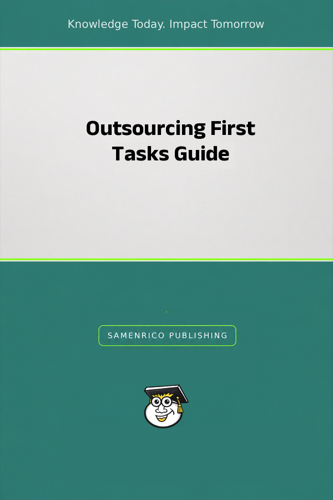
Outsourcing First Tasks Guide eBook
Start with repetitive, low skill, time consuming a
Start with repetitive, low skill, time consuming activities.
Formats
Free sample
Chapter 1: The $10 Hour...--–- The first time I realized I was paying $10,000 a year to do work that could be done for $1,000, I was sitting in my home office at 11:47 PM on a Tuesday, manually reformatting a spreadsheet of client email addresses. My back hurt. My eyes were dry. And somewhere in the back of my exhausted mind, a tiny voice whispered: This is insane.I ignored that voice for three more years.If you are reading this book, that voice is probably whispering to you too. Maybe it whispers while you are sorting receipts for your accountant.
Maybe it whispers while you are transcribing voicemails or moving files from one folder to another or copying data from a PDF into a spreadsheet for the hundredth time. The voice says: Why are you doing this? And then a louder voice answers: Because no one else will do it right. Because it is faster if I just do it myself. Because outsourcing is expensive.
Because I don't trust anyone else.All of those answers are wrong. And this chapter is going to prove it to you with math, psychology, and a simple framework that will change how you see every single task on your to-do list.The Myth of "Free"Let us start with the most dangerous lie in all of productivity.The lie is this: Doing it yourself costs nothing.When you sit down at your computer and spend thirty minutes cleaning up a messy spreadsheet, you did not spend any money. Your credit card did not get charged. No invoice arrived in your inbox. So it feels free.
It feels like the responsible, frugal, sensible thing to do.But you are not a machine that runs on nothing. You have an hourly value. And every hour you spend on low-skill work is an hour you are not spending on high-value work. That is not a moral failing. It is simple arithmetic.Imagine you earn $100,000 per year.
Working roughly 2,000 hours per year (fifty weeks at forty hours per week), your time is worth $50 per hour. Every hour you spend reformatting spreadsheets is an hour you could have spent on client work, strategic planning, business development, or simply resting so you perform better tomorrow.Now imagine you outsource that spreadsheet cleanup to a virtual assistant who charges $10 per hour. That same hour now costs you $10 instead of $50. You just saved $40. More importantly, you freed yourself to do something that only you can do.But most people never do this math.
They see the $10 outflow and feel the loss. They do not see the $40 invisible savings. This is what behavioral economists call loss aversion—the human tendency to feel losses more acutely than gains. Losing $10 from your wallet feels worse than saving $40 that you never see.This chapter is going to rewire that instinct.The Rate of Replacement Formula Here is the single most important equation in this entire book. Memorize it.
Write it on a sticky note and put it on your monitor. Teach it to your spouse, your business partner, your children.Your Hourly Value ÷ Outsourced Hourly Rate = ROI Multiplier That is it. That is the formula that will set you free.Let me walk you through it with real numbers.For employees: Take your annual salary and divide it by 2,000 (the standard number of working hours in a year). Then add 30 percent for benefits, taxes, and overhead. If you earn $60,000 per year, your base hourly rate is $30.
Add 30 percent, and your true hourly value to your employer is approximately $40 per hour.For business owners: Take your annual revenue and divide it by the actual hours you work each year. Not the hours you tell people you work. The real hours. If your business does $200,000 per year and you work 2,500 hours, your hourly value is $80 per hour. If you work 3,000 hours, it drops to $67 per hour.
This is important because it reveals the hidden incentive: the more low-skill hours you work, the lower your effective hourly rate becomes.For freelancers: Take your average billable rate and multiply it by 0.7. Why 0.7? Because you cannot bill every hour you work. You spend time on administration, marketing, email, and proposal writing. If you bill $100 per hour for client work, your true hourly value across all your working hours is closer to $70.Now let us apply the formula.Let us say your hourly value is $50.
You find a virtual assistant on Upwork who charges $10 per hour. Your ROI multiplier is $50 ÷ $10 = 5x. Every dollar you spend on that VA returns five dollars of value to you.Let us make it concrete. A task takes you two hours. That costs you $100 of your time.
The same task takes the VA two hours. That costs you $20. The $80 difference is not imaginary. It is not theoretical. It is real profit, real freed capacity, real time that you can now spend on something that moves the needle.And here is where it gets exponential.
When you outsource ten hours of work per week at a 5x ROI multiplier, you generate $400 of value per week. Over a year, that is nearly $21,000. That is not a small number. That is a vacation. That is a new computer.
That is a college fund contribution. That is breathing room.The Four Psychological Barriers If the math is so clear, why doesn't everyone outsource their low-skill tasks immediately?Because we are not rational machines. We are emotional, fearful, habit-driven creatures. And there are four specific psychological barriers that keep us trapped in the $10/hour cycle.Barrier 1: Perfectionism You believe that no one else will do the task as well as you. And you are probably right.
At least at first. A VA might make mistakes. They might format a phone number incorrectly or miss a duplicate row or misinterpret an instruction.But here is the question you must ask yourself: Does this task need to be perfect?For low-skill, repetitive tasks, the answer is almost always no. A spreadsheet with 99 percent accuracy is fine. An inbox where 98 percent of emails are triaged correctly is fine.
A list of leads where 95 percent of the contact information is correct is fine.The pursuit of perfection is not excellence. It is procrastination disguised as standards.Barrier 2: Guilt You feel guilty asking someone else to do work that you could do yourself. This guilt often comes from a place of privilege—you recognize that you are fortunate to have the skills and the time, and you feel that outsourcing is somehow lazy or exploitative.Let me reframe this. You were not hired to sort spreadsheets. You were not born to clean data.
Your unique value—the thing that makes you irreplaceable—is not your ability to copy and paste. Every hour you spend on low-skill work is an hour you are not spending on the work that actually matters. The guilt should flow in the opposite direction: you should feel guilty for hoarding low-skill work that someone else could use to earn a living.Barrier 3: Fear of Losing Control You worry that if someone else handles your email or your data or your calendar, something will go wrong. A client will be missed. A deadline will slip.
A file will be lost.This fear is real, but it is also manageable. The solution is not to keep control.…
This is the end of the free sample. Get the eBook to keep going. Buy now
About this book
Details
- Author
- Espinoza Aaron
- Publisher
- SamEnrico
- Language
- English
- Genre
- Non-Fiction, Self-Help, Outsourcing
- Released
- 2026-06-09
- Pages (approx.)
- 142
- Available as
- eBook, Audiobook

Read better in the ZLOADR app
Your eBooks on your phone or tablet. Sign in with your SamEnrico account and start reading.
More by Espinoza Aaron
 Public Speaking for LeadersEspinoza Aaron$11.99
 Nonverbal Networking GuideEspinoza Aaron$11.99
 Bed Bound ExercisesEspinoza Aaron$11.99
 The Secret Scripts of The Oxford Revue: How a University Troupe Shaped Modern ComedyEspinoza Aaron$11.99
 Manager AuditEspinoza Aaron$11.99
 Service Business Pricing Without FearEspinoza Aaron$12.99
 How to Produce Cargo NetEspinoza Aaron$11.99
 How to Start a Lyes Business (Beginners Guide)Espinoza Aaron$11.99
You may also like
 Hong Kong Handover 1997Dunn Johnnie$11.99
 Zumba For Postnatal Recovery CourseNeal Christian$11.99
 Zumba for BeginnersLadner Nikia$11.99
 YouTube Comment Mining GuideHumes Pandora$12.99
 Worry Box MeditationCarlin Rudy$11.99
 Workplace Stress MeditationNguyen Lynn$11.99
 Workplace Stress and Sleep RepairHawley Ivory$11.99
 Workplace Perfectionism CureDelaney Jeffry$11.99
 Workplace Injustice Anger GuideWallen Isabelle$11.99
 Work Addiction and Burnout LinkGreenwood Ester$11.99
 Women in Yoga and WellnessBeattie Galina$11.99
 Women in Stand Up ComedyChun Evangeline$11.99