
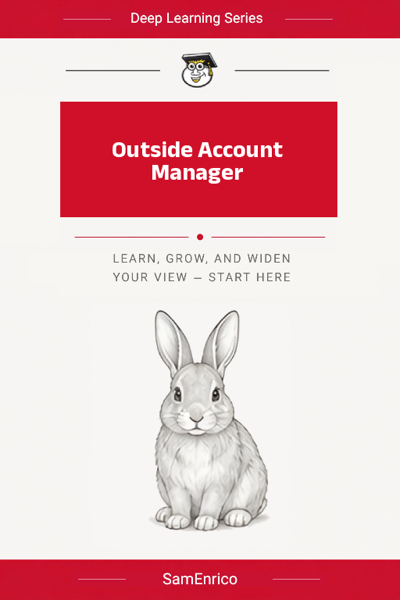
Non-FictionInformativeEducational
Outside Account Manager eBook
A Coursebook on Outside Account Manager
A Coursebook on Outside Account Manager
Formats
Free sample
Chapter 1: The Windshield Tax--–- The first time Mark calculated his true earnings per mile, he almost pulled over on the shoulder of Interstate 80. He had been an Outside Account Manager for eleven years. He drove a leased Ford Explorer that smelled like coffee and despair. He visited twenty-three clients the previous week, logged 847 miles, and collected exactly zero new contracts. His commission check, after taxes, would buy him dinner at a chain restaurant if he skipped the appetizer.
Mark was driving broke, and he didn't even know it.The Windshield Tax is the single most destructive financial force in field sales, and almost no one talks about it. It is the hidden cost of poor routing, reactive fire drills, and the default identity of the order-taker. It is calculated simply: total annual earnings divided by total annual miles driven. For the average Outside Account Manager in the United States, that number hovers between forty and sixty cents per mile. For context, the IRS standard mileage rate for business driving is sixty-seven cents per mile.
The average OAM, after accounting for fuel, depreciation, maintenance, and the opportunity cost of windshield time, is effectively paying for the privilege of working. They are subsidizing their employers with every mile they drive, and they do not know it.The top one percent of OAMs invert this equation. They earn between 1.50and1.50 and 1.50and3.00 per mile driven. They do not drive more. They drive smarter.
They have abandoned the order-taker identity and adopted what this book calls the Strategic Partner Mindset. The difference between these two groups is not intelligence, charisma, or product knowledge. It is a fundamental misunderstanding of what an Outside Account Manager is supposed to do.This chapter dismantles the myths that keep OAMs trapped in the Lobster Trap—energetically busy but structurally constrained. It defines the role not as it appears on a job description but as it must be performed to escape the Windshield Tax. It introduces the 70/30 Rule, the 1% Rule, and the psychological framework required to operate autonomously while orchestrating internal teams.
And it ends with a challenge that most readers will fail: calculate your Windshield Tax before you read Chapter 2.The Lobster Trap: Why Busy Is Not Productive Imagine a lobster trap. It is a simple wire cage with an opening that points inward. A lobster can enter easily enough, drawn by the promise of bait. But the opening is designed so that the lobster cannot find its way back out. The lobster is busy inside the trap.
It moves, it searches, it expends enormous energy. But it is not free. It is not productive. It is trapped.The average OAM is a lobster. They wake early, drive far, sit through meetings, send follow-up emails, and collapse at the end of the week wondering why their pipeline has not grown.
They mistake motion for progress. They confuse the number of visits with the quality of outcomes. They are busy. They are not effective.The Lobster Trap has three structural walls. The first is the Reactive Trap: responding to client requests instead of shaping client needs.
The second is the Geographic Trap: driving in chronological order rather than strategic clusters. The third is the Identity Trap: believing that the job is to "manage accounts" rather than to "own territories."Consider Sarah, an OAM for a mid-sized industrial supply company. Sarah visited twenty clients every week. She had a full calendar. Her manager praised her work ethic.
But over eighteen months, her territory grew by only two percent while her peers grew by fifteen to twenty percent. Sarah was trapped. She visited low-value accounts as frequently as high-value accounts. She drove across her territory in a chaotic pattern, reacting to whatever email arrived first each morning. She thought her job was to be available.
She was wrong.The escape from the Lobster Trap begins with a single distinction: the difference between an Outside Account Manager and an Inside Account Manager. This distinction is not about office location. It is about orientation, leverage, and value creation.Outside vs. Inside: The Strategic Distinction An Inside Account Manager operates from a desk. Their tools are the phone, email, and CRM.
They handle a high volume of lower-complexity accounts. Their rhythm is transactional: quote, order, follow-up, repeat. The best Inside AMs are efficient, responsive, and organized. They are valuable. But they are not strategic.An Outside Account Manager operates from the windshield.
Their tools are observation, conversation, and contextual diagnosis. They handle a lower volume of higher-complexity accounts. Their rhythm is relational: discover, diagnose, prescribe, close, expand. The best Outside AMs are autonomous, financially fluent, and politically astute. They are strategic.
They are also rare.The critical insight is that an OAM cannot succeed by being a better version of an Inside AM. The skills do not scale the same way. An Inside AM wins by reducing response time. An OAM wins by asking better questions before the client knows they need to be asked. An Inside AM manages a queue.
An OAM manages a territory.A territory is not a list of accounts sorted by zip code. A territory is a living system of relationships, opportunities, risks, and constraints. The OAM who views their territory as a list will drive from one name to the next, checking boxes, collecting nothing. The OAM who views their territory as a system will see patterns: which accounts influence which, where white space hides, when churn is coming.This distinction leads directly to the first major framework of this book.The 70/30 Rule: Reclaiming Your Time Time is the OAM's scarcest resource. Not leads.
Not budget. Not product features. Time. And yet, most OAMs spend their time in exactly the opposite proportion than top performers.The 70/30 Rule states: top-performing OAMs spend seventy percent of their time on proactive, strategic, value-creating activities, and thirty percent on administrative tasks, travel, and reactive fire drills. The average OAM inverts this ratio.
They spend seventy percent of their time on administration, travel, and reaction, and thirty percent (or less) on proactive strategy.Proactive activities include: strategic account planning, executive relationship building, white space identification, referral generation, and financial diagnosis. Reactive activities include: responding to client emails, processing orders, resolving delivery issues, updating CRM without purpose, and driving to meetings that should have been phone calls.The 70/30 Rule is not a suggestion. It is a diagnostic. If you track your time for one week and discover that your ratio is inverted, you have identified the primary reason you are not in the top one percent. And the cause is not your employer, your territory, or your product.
The cause is your identity.The Order-Taker vs. The Strategic Partner There are two ways to show up to a client meeting. The first: "What can I help you with today?" This is the order-taker. They wait to be told what the client wants. They quote a price.
They hope for a yes. They leave with a transaction.The second: "Here are three things I noticed about your business since we last met. One of them is a problem you may not have identified yet. Let me show you what it's costing you." This is the…
This is the end of the free sample. Get the eBook to keep going. Buy now
About this book
Details
- Author
- Cranford Ryan
- Publisher
- SamEnrico
- Language
- English
- Genre
- Non-Fiction, Informative, Educational
- Released
- 2026-05-04
- Pages (approx.)
- 152
- Available as
- eBook, Audiobook

Read better in the ZLOADR app
Your eBooks on your phone or tablet. Sign in with your SamEnrico account and start reading.
More by Cranford Ryan
 Intuitive Eating Coping With Emotions PrimerCranford Ryan$11.99
 Psyllium Husk MicrobiomeCranford Ryan$11.99
 The Finance Talent Hub ShiftCranford Ryan$11.99
 Catherine the Great Theater and Performance PatronageCranford Ryan$11.99
 The Parent Death Hospice GuideCranford Ryan$11.99
 The Alchemist's Secret: Albertus Magnus and the Discovery of ArsenicCranford Ryan$11.99
 The Unlikely Rise of the Dollar Store Tycoon: How Kmart’s Butcher Boy Built an EmpireCranford Ryan$11.99
 Understanding BeriberiCranford Ryan$17.99
 Small Business payroll Tax FilingCranford Ryan$12.99
 Foreign Qualification ExplainedCranford Ryan$12.99
 How to Start a Power-driven Lifting Capstans Business (Beginners Guide)Cranford Ryan$11.99
You may also like
 Hong Kong Handover 1997Dunn Johnnie$11.99
 Zumba For Postnatal Recovery CourseNeal Christian$11.99
 Zumba for BeginnersLadner Nikia$11.99
 YouTube Comment Mining GuideHumes Pandora$12.99
 Worry Box MeditationCarlin Rudy$11.99
 Workplace Stress MeditationNguyen Lynn$11.99
 Workplace Stress and Sleep RepairHawley Ivory$11.99
 Workplace Perfectionism CureDelaney Jeffry$11.99
 Workplace Injustice Anger GuideWallen Isabelle$11.99
 Work Addiction and Burnout LinkGreenwood Ester$11.99
 Women in Yoga and WellnessBeattie Galina$11.99
 Women in Stand Up ComedyChun Evangeline$11.99