
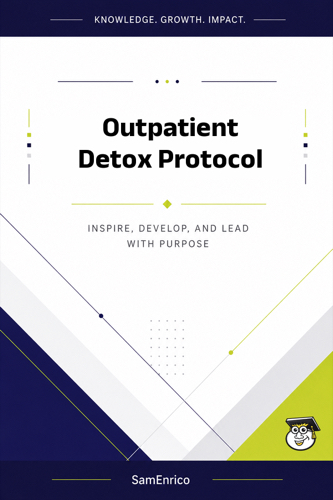
Non-FictionHealth & WellnessOutpatient Detox
Outpatient Detox Protocol eBook
Withdraw safely at home with daily clinic visits.
by Ivory Maudie
Withdraw safely at home with daily clinic visits.
Formats
Free sample
Chapter 1: The Invisible Cage...--–- The fluorescent lights of the waiting room hummed a steady, indifferent drone. Across from me sat a man in a business suit, his leg bouncing uncontrollably, sweat beading on his upper lip despite the aggressive air conditioning. Next to him, a young woman clutched a plastic bag containing everything she owned, her eyes fixed on a spot on the floor as if it held the secrets of the universe. We were all there for the same reason, yet none of us would make eye contact. The shame was a physical presence in the room, thick as smoke.I was there because I had finally admitted I couldn’t stop drinking on my own.
My doctor had given me a referral and a grim look. "You need to detox," she said. "But the nearest bed is 200 miles away. The waitlist is three weeks. Or, you can try the outpatient program at the clinic downtown."Three weeks.
I had three hours of sobriety under my belt and the shakes were already starting. The idea of waiting three more weeks, of driving 200 miles, of telling my boss I needed a "medical leave of absence"—which everyone knew meant rehab—felt less like a treatment plan and more like a punishment.That morning, I had stood in my kitchen, staring at the half-empty bottle of vodka on the counter. Every instinct screamed to pour it down the sink. Another instinct, louder and more desperate, screamed to drink it. I didn't want to be the person in the waiting room with the bouncing leg.
I didn't want to be the person who "went away." I wanted to be the person who handled it, who was strong enough to fix this without disappearing from my own life.The nurse finally called my name. I stood up, walked through the door, and discovered a truth that the multi-billion-dollar addiction treatment industry doesn't want you to know: for the vast majority of people with mild-to-moderate substance use disorder, the locked door of an inpatient facility is not a medical necessity. It is an invisible cage.This book is the key to that cage.The Great Lie of the Locked Door For decades, the cultural narrative around addiction has been monolithic and unforgiving. We have been told that the only path to sobriety is through a dramatic, disruptive, and humiliating removal from society. Check yourself into a facility, surrender your phone, wear a plastic bracelet, sleep in a communal room, and emerge thirty days later—if you're lucky—as a new person.
This narrative is reinforced by reality television, celebrity memoirs, and even well-meaning family interventions.It is also, for the majority of people seeking help, medically unnecessary and counterproductively expensive.The "locked door" model, formally known as inpatient or residential detoxification, was designed for the sickest of the sick. It was created for individuals with a history of severe withdrawal seizures, Delirium Tremens (DTs), acute psychosis, or unstable home environments where substances are ever-present. For these individuals, 24/7 medical supervision is a life-saving necessity. The cage is, for them, a life raft.But somewhere along the way, a perverse inversion occurred. Inpatient became the default, not the exception.
Insurance companies, desperate to control costs, began requiring "medical necessity" justifications that often pushed patients toward cheaper (or so they thought) outpatient care. Simultaneously, a booming private treatment industry discovered that the profit margins on a $30,000 residential stay were far more attractive than a $2,000 outpatient protocol. They marketed the locked door as the only "serious" option, conflating discomfort with efficacy, suffering with virtue.The result is a system that deters precisely the people it should be helping.Consider the math. A 2023 analysis of substance use disorder treatment patterns found that the single greatest barrier to seeking care was not denial, not lack of motivation, and not even cost—though that was a close second. It was practical impossibility.
"I can't leave my job." "I can't tell my children I'm going away for two weeks." "I can't afford to disappear from my life." These are not excuses. They are rational assessments made by functional individuals who have built lives that, while damaged by substance use, are still worth protecting.The inpatient model asks you to burn your life down in order to save it. The outpatient model, by contrast, asks you to heal within the structure of the life you already have.The Hybrid Model: A Third Way What I am calling the "hybrid model" in this book is not a compromise. It is a superior clinical approach for a specific, large, and underserved population: individuals with mild-to-moderate withdrawal who have stable housing, a reliable support person, and the motivation to engage in daily medical care without 24/7 supervision.Here is what the hybrid model looks like in practice.You wake up in your own bed. You drink coffee from your own mug.
You kiss your children goodbye as they head to school. Then you drive—or your support person drives you—to a clinic. For fifteen to thirty minutes, you are assessed by a medical professional. Your vital signs are checked. You complete a short, standardized questionnaire called the CIWA-Ar if you are withdrawing from alcohol, or the COWS if you are withdrawing from opioids.
These tools, which we will explore in depth in Chapter 3, transform the subjective experience of "feeling terrible" into an objective score that guides medication decisions.You receive your medication. In the model this book assumes—daily observed dosing—you take that first dose under the watchful eye of a nurse. You wait to ensure there are no adverse reactions. Then you go home.You spend the rest of the day managing your symptoms with non-medical interventions: hydration, nutrition, gentle movement, sleep hygiene. Your support person checks on you hourly.
You record your symptoms, your cravings, your sleep quality in a log book. If something goes wrong—if you cannot keep down your medication, if you become confused, if your anxiety spirals—you call the nurse hotline. If it is a true emergency, you call 911 and the support person tells the dispatcher, "My partner is undergoing medically supervised outpatient detox."The next day, you return to the clinic. And the next. And the next.By Day 3 or Day 4, for most people, the acute withdrawal symptoms peak and begin to recede.
By Day 5 to Day 7, you are medically stable. You have not missed a week of work. You have not explained your absence to curious neighbors. You have not slept in a stranger's bed. You have not paid $20,000.You have, however, done something perhaps more difficult: you have faced your withdrawal in the environment where you will have to live the rest of your life.
You have not hidden from your triggers; you have learned, with medical support, to sit with them and watch them pass. You have not escaped your responsibilities; you have fulfilled them while sick, which is a profoundly empowering experience.This is not the easy way out. It is the smart way through.The Three Promises Before we go any further—before you turn to the decision guide in Chapter 2, before you read the medication protocols in Chapter 4, before you…
This is the end of the free sample. Get the eBook to keep going. Buy now
About this book
Details
- Author
- Ivory Maudie
- Publisher
- SamEnrico
- Language
- English
- Genre
- Non-Fiction, Health & Wellness, Outpatient Detox
- Released
- 2026-06-07
- Pages (approx.)
- 145
- Available as
- eBook, Audiobook

Read better in the ZLOADR app
Your eBooks on your phone or tablet. Sign in with your SamEnrico account and start reading.
More by Ivory Maudie
 Internal Distraction ControlIvory Maudie$11.99
 Cocaine and Bipolar DisorderIvory Maudie$11.99
 Long Term Regulation for ParentsIvory Maudie$11.99
 Gambling Addiction Relapse Prevention PlanIvory Maudie$11.99
 Teen Brain Rewiring GuideIvory Maudie$11.99
 Role Playing Calm ResponsesIvory Maudie$11.99
 Grief and Sleep After Baby LossIvory Maudie$11.99
 The Spice Lords of Amsterdam: How the Dutch Built a Global EmpireIvory Maudie$11.99
 The Penny Dreadfuls of Victorian England: How Soap Operas Conquered the MassesIvory Maudie$11.99
 Growing AstilbeIvory Maudie$11.99
 Freemium Progressive Enhancement GuideIvory Maudie$12.99
 Portuguese Student Jobs GuideIvory Maudie$12.99
You may also like
 Hong Kong Handover 1997Dunn Johnnie$11.99
 Zumba For Postnatal Recovery CourseNeal Christian$11.99
 Zumba for BeginnersLadner Nikia$11.99
 YouTube Comment Mining GuideHumes Pandora$12.99
 Worry Box MeditationCarlin Rudy$11.99
 Workplace Stress MeditationNguyen Lynn$11.99
 Workplace Stress and Sleep RepairHawley Ivory$11.99
 Workplace Perfectionism CureDelaney Jeffry$11.99
 Workplace Injustice Anger GuideWallen Isabelle$11.99
 Work Addiction and Burnout LinkGreenwood Ester$11.99
 Women in Yoga and WellnessBeattie Galina$11.99
 Women in Stand Up ComedyChun Evangeline$11.99