
Non-FictionSelf-HelpOutlook Skills
Outlook Calendar Memory Guide eBook
Integrate tasks and calendar for professional memo
Integrate tasks and calendar for professional memory management using this guide.
Formats
Free sample
Chapter 1: The Memory Hoax--–- You are not forgetful. You are overworked in a way your brain never evolved to handle.Every morning, millions of professionals sit down at their desks, open their calendars, and feel a familiar wave of anxiety. The day ahead looks manageable—a few meetings, some blocked time for email, a task list that seems reasonable. And yet, by 2 PM, everything has unraveled. Deadlines have been missed.
A critical follow-up has slipped through the cracks. A colleague asks about something you distinctly remember doing, but you cannot find any record of it. You end the day exhausted, defeated, and convinced that your memory is failing you.Here is the truth that will change everything you believe about productivity: your memory is not failing. You are using it for something it was never designed to do.This chapter will dismantle the most dangerous myth in professional life—the belief that your brain is a reliable storage system for tasks, commitments, and deadlines. You will learn why unfinished tasks hijack your attention, why multitasking destroys your ability to remember, and why the solution is not a better memory but a better external system.
By the end of this chapter, you will see your calendar and task list not as simple scheduling tools but as a Memory Exoskeleton—an external structure that holds what your mind should release.The Weight of Unfinished Business In the 1920s, a young Russian psychologist named Bluma Zeigarnik made an observation that would fundamentally change our understanding of memory and motivation. While sitting in a busy Vienna café, she noticed something peculiar: the waiters seemed to have perfect recall of unpaid orders but could barely remember the same orders once the bills were settled. Zeigarnik, a student of the famous Gestalt psychologist Kurt Lewin, designed a series of experiments to test this phenomenon.Her findings, now known as the Zeigarnik effect, revealed something profound about the human mind: uncompleted tasks are held in a privileged memory state. They remain active, accessible, and intrusive, while completed tasks are rapidly forgotten. Your brain treats an unfinished task as a threat—an open loop that demands resolution.
Every incomplete email draft, every promised follow-up, every delegated task that has not yet returned to you—these items consume mental bandwidth whether you are aware of it or not.Think about the last time you sent an important email and did not receive a reply. How many times did that non-reply cross your mind over the following days? Each intrusion was the Zeigarnik effect in action. Your brain was not malfunctioning; it was doing exactly what evolution designed it to do: keep threats active until they are resolved. The problem is that in the modern workplace, threats are not saber-toothed tigers.
They are email threads, project deadlines, and meeting action items. And there are dozens of them, not one or two.Research has quantified the cost of these open loops. A study published in the Journal of Experimental Psychology found that people who were interrupted during a task and prevented from completing it showed significantly higher physiological arousal—elevated heart rate, increased skin conductance, and higher cortisol levels—than those who were allowed to finish. Even more striking, the interrupted participants continued to think about the incomplete task during subsequent activities, their attention fragmenting like light through a cracked lens.This is the first great lie of professional memory: that you can "just remember" to do something later. Every task you hold in your head is not being remembered—it is being rehearsed.
And rehearsal consumes energy that could otherwise be used for creative thinking, strategic planning, and genuine problem-solving.The Forty Percent Tax If the Zeigarnik effect is the cost of holding tasks in memory, multitasking is the cost of switching between them. And the cost is staggering.For decades, productivity advice has celebrated the ability to juggle multiple tasks simultaneously. The modern professional wears the ability to answer emails during a meeting, update a spreadsheet while listening to a podcast, and draft a report while messaging a colleague as a badge of honor. This is not a skill. It is a cognitive tax of approximately forty percent of your productive capacity.The research on task-switching is among the most replicated findings in cognitive psychology.
In a landmark study from the University of Michigan, researchers measured the time cost of switching between simple tasks—sorting shapes, solving math problems, categorizing letters. The results were consistent: each switch incurred a "switch cost" of anywhere from a few tenths of a second to several seconds, depending on task complexity. When you switch from email to a spreadsheet, your brain must disengage from one set of rules, goals, and contexts, then re-engage with another. This process is not instantaneous. And it leaves residue.The real-world implications are sobering.
Gloria Mark, a researcher at the University of California, Irvine, studied knowledge workers in their natural environments and found that the average professional switches tasks every three minutes and five seconds. After each switch, it takes an average of twenty-three minutes to fully return to the original task. This means that a single two-minute interruption—checking an email that just arrived—can cost you nearly half an hour of focused work.But the cost of multitasking is not merely about time. It is about memory encoding. When you switch tasks frequently, your brain never enters the state of deep focus required to move information from short-term to long-term memory.
You are constantly overwriting your own mental cache. This is why you can spend an entire day answering emails, attending meetings, and responding to messages, yet at 5 PM have almost nothing to show for it and no clear memory of what you actually did.The myth of multitasking persists because it feels productive. The dopamine hit of clearing a small task, the relief of responding to a message, the satisfaction of crossing an item off a list—these rewards are immediate and tangible. The cost—fragmented attention, poor memory encoding, incomplete deep work—is diffuse and delayed. Your brain is wired to prefer the immediate reward, even when it leads to long-term failure.Why Your Brain Is Not a Task Manager To understand why traditional approaches to memory and productivity fail, we must understand what the human brain actually evolved to do.
The answer is not "manage to-do lists."The brain evolved over hundreds of thousands of years in environments of extreme scarcity and immediate threat. Our ancestors needed to remember where water sources were located, which plants were poisonous, and which animal tracks indicated danger. They needed to maintain social bonds and track who had shared food and who had been hostile. These are fundamentally different cognitive demands than those faced by a modern knowledge worker with two hundred unread emails, six project deadlines, and a calendar full of back-to-back meetings.The brain is exceptionally good at certain types of memory. It is good at autobiographical memory—recalling events that were emotionally significant, surprising, or personally relevant.
It is good at procedural memory—remembering how to ride a bike, type on a keyboard, or drive a car. It is good at recognition memory—knowing that…
This is the end of the free sample. Get the eBook to keep going. Buy now
About this book
Details
- Author
- Herrick Ashley
- Publisher
- SamEnrico
- Language
- English
- Genre
- Non-Fiction, Self-Help, Outlook Skills
- Released
- 2026-06-07
- Pages (approx.)
- 153
- Available as
- eBook, Audiobook

Read better in the ZLOADR app
Your eBooks on your phone or tablet. Sign in with your SamEnrico account and start reading.
More by Herrick Ashley
 Manager Employee Empathy GuideHerrick Ashley$11.99
 Nicotine Withdrawal Sleep AidHerrick Ashley$11.99
 Pomodoro For Decision MakingHerrick Ashley$11.99
 Governor's National Guard CallHerrick Ashley$11.99
 Product Hunt Launch EnvyHerrick Ashley$11.99
 Sleep Apnea PodcastsHerrick Ashley$11.99
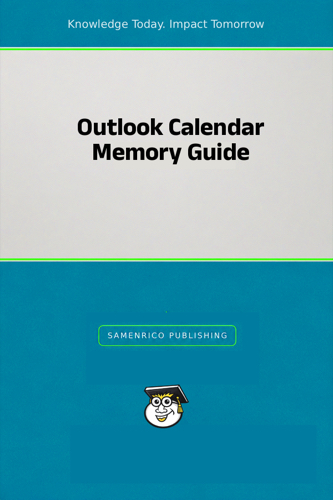 Outlook Calendar Memory GuideHerrick Ashley$11.99
 The Financial Emergency ToolkitHerrick Ashley$11.99
 Fellini CircusHerrick Ashley$11.99
 The 1968 East L.A. Walkouts: Chicano Youth vs. The SystemHerrick Ashley$11.99
 The DNA of Conquest: Napoleon’s Genetic Gambit at AusterlitzHerrick Ashley$11.99
 Silent Bargains: The Vatican’s Forgotten LedgerHerrick Ashley$11.99
You may also like
 Hong Kong Handover 1997Dunn Johnnie$11.99
 Zumba For Postnatal Recovery CourseNeal Christian$11.99
 Zumba for BeginnersLadner Nikia$11.99
 YouTube Comment Mining GuideHumes Pandora$12.99
 Worry Box MeditationCarlin Rudy$11.99
 Workplace Stress MeditationNguyen Lynn$11.99
 Workplace Stress and Sleep RepairHawley Ivory$11.99
 Workplace Perfectionism CureDelaney Jeffry$11.99
 Workplace Injustice Anger GuideWallen Isabelle$11.99
 Work Addiction and Burnout LinkGreenwood Ester$11.99
 Women in Yoga and WellnessBeattie Galina$11.99
 Women in Stand Up ComedyChun Evangeline$11.99