
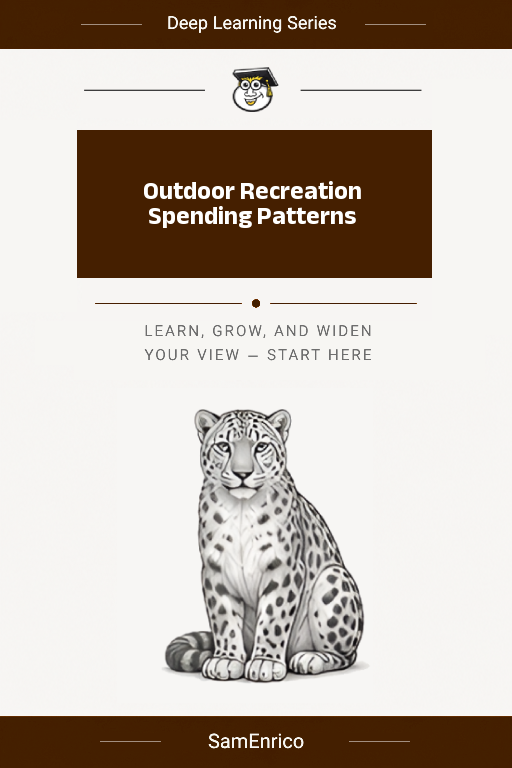
Non-FictionConsumer Mind ReportOutdoor Recreation
Outdoor Recreation Spending Patterns eBook
Analyzes camping, hiking, skiing, and water sports
by Breen Jame
Analyzes camping, hiking, skiing, and water sports spending recovery, including gear purchases, park visits, and guided tours.
Formats
Free sample
Chapter 1: The $1,000 Receipt--The email arrived on a Tuesday in May 2020. Subject line: “Your REI order has shipped.” Sixteen items. Total: $1,042.18. A tent, two sleeping bags, a camp stove, fuel canisters, a water filter, headlamps, a first aid kit, hiking boots, trail runners, rain jackets for two, a portable coffee press, and something called a “backpacking trowel” which the buyer—a 34-year-old marketing manager named Sarah who had never camped a single night in her adult life—would later discover was a fancy shovel for digging catholes.Sarah was not an outlier. She was a statistic.In the eight weeks between mid-March and mid-May 2020, more than 18 million Americans bought outdoor gear for the first time.
REI’s online sales grew 167% year over year. Kayaks became as scarce as toilet paper. Tents sold out so completely that manufacturers in China, Vietnam, and Bangladesh began running three shifts instead of one. Dick’s Sporting Goods reported that camping equipment sales rose faster than any consumer goods category except home office furniture—which is to say, Americans were simultaneously buying desks to work from home and tents to escape from those desks.This chapter is about that moment. But it is not a nostalgia piece.
It is an autopsy and a diagnosis. Because the gear rush of 2020–2021 did not just change what Americans bought. It changed who they believed themselves to be. And that identity shift—millions of people suddenly seeing themselves as “outdoor people”—would reshape the $1.1 trillion outdoor recreation economy in ways that the industry is still struggling to understand.The paradox of the pandemic was this: when global travel ground to a halt, Americans did not stop moving. They just moved closer to home.
International borders closed. Gyms shuttered. Team sports canceled. Cruise ships became floating petri dishes. And millions of people looked out their windows and thought: what is in my backyard?What followed was not a bubble.
It was a revelation.The Numbers That Changed Everything Let us begin with the cold, hard data. Because the story of outdoor recreation spending cannot be told in anecdotes, no matter how satisfying the $1,000 REI receipt might be.According to the Bureau of Economic Analysis, outdoor recreation contributed to 1.8% of U.S. GDP in 2019—approximately 778billion.By2024,thatfigurehadrisento2.7778 billion. By 2024, that figure had risen to 2.7% of GDP, or 778billion.By2024,thatfigurehadrisento2.71.1 trillion. In nominal dollars, the sector grew 41% in five years.
To put that in perspective, that is faster than healthcare, faster than education, and faster than construction. Only technology and e-commerce grew more quickly.But the headline numbers hide the real story. The growth was not linear. It was a spike followed by a plateau followed by a slow, steady climb.Phase 1: The Spike (March 2020 – December 2021)Gear sales exploded. REI’s 2020 revenue hit 3.8billion,a223.8 billion, a 22% increase over 2019 despite stores being closed for two months.
Camping equipment sales rose 61%. Bicycle sales rose 75%. Kayak sales rose 85%. The North Face, Patagonia, and Columbia all reported record direct-to-consumer sales. Supply chains, already strained by pandemic shutdowns, collapsed under the weight of demand.
A tent that cost 3.8billion,a22200 in January 2020 was selling for 450one Bayby August.Kayaksthatnormallyretailedfor450 on e Bay by August. Kayaks that normally retailed for 450one Bayby August.Kayaksthatnormallyretailedfor600 were listed at $1,200 on Facebook Marketplace.Phase 2: The Plateau (January 2022 – December 2023)Gear sales flattened. REI’s 2022 revenue was $3.9 billion—barely above 2020. Outdoor brands that had ramped up production found themselves with warehouses full of inventory and consumers who had already bought everything they needed. The industry panicked.
Stock prices fell. Layoffs began. The narrative shifted from “boom” to “bust” almost overnight.Phase 3: The Maturation (January 2024 – Present)Gear sales stabilized at approximately 205billionannually.Buttravelandlodgingspending—themoneyspent∗gettingto∗outdoorplaces—jumpedto205 billion annually. But travel and lodging spending—the money spent *getting to* outdoor places—jumped to 205billionannually.Buttravelandlodgingspending—themoneyspent∗gettingto∗outdoorplaces—jumpedto315 billion. Consumers were no longer buying things.
They were buying trips.This is the critical insight that most industry observers missed. The gear rush was not the main event. It was the down payment. The $1,000 REI receipt was not an end in itself. It was the cost of admission to a new identity.The Psychology of the $1,000 Receipt Why 1,000?Whynot1,000?
Why not 1,000?Whynot200? Why not $5,000?There is a concept in behavioral economics called the “sunk cost fallacy.” The basic idea is that people are more likely to follow through on an activity if they have already invested money in it. A $1,000 gear purchase is not a transaction. It is a commitment device.Sarah, our 34-year-old marketing manager, did not wake up one morning and decide to become an outdoors person. She woke up in a small apartment in Chicago, three weeks into a lockdown, with a refrigerator full of food and a brain full of anxiety.
Her gym was closed. Her yoga studio was closed. Her friends were scattered across Zoom squares. She needed something—anything—that felt like forward movement.The gear purchase was not rational. She could have borrowed a tent.
She could have rented a kayak. She could have started with a 50usedsleepingbagandapairofsneakers.Butthatisnotwhatshedid.Shespent50 used sleeping bag and a pair of sneakers. But that is not what she did. She spent 50usedsleepingbagandapairofsneakers.Butthatisnotwhatshedid.Shespent1,042.18 because the act of spending money was itself a form of commitment. By spending heavily, she was telling herself: this is real.
I am serious about this. I am the kind of person who owns a backpacking trowel.This psychological mechanism is not new. Skiers have been doing it for decades—buying 800boots,800 boots, 800boots,1,200 skis, $400 jackets—long before they ever touched snow. Golfers do it. Cyclists do it.
The gear becomes a prosthetic identity. You buy the hat before you join the club.What was new in 2020 was the scale. Millions of people simultaneously performed the same psychological ritual. They spent money not because they needed the gear but because they needed the identity that the gear signified.The Supply Chain That Could Not Keep Up The industry was not ready.In March 2020, as Sarah was clicking “add to cart” on her REI order, most outdoor gear manufacturers were shutting down factories in Asia. China had gone into lockdown in January.
Vietnam followed in April. Bangladesh, Cambodia, and Indonesia—the world’s primary sources for tents, sleeping bags, and backpacks—all experienced manufacturing stoppages.The result was a perfect storm. Demand spiked at the exact moment that supply collapsed.Consider the kayak market. In 2019, the global kayak market produced approximately 2.5 million units per year. In April 2020, demand for kayaks increased 400% over the previous April.
But factories were running at 30% capacity. The kayaks simply did not exist. Retailers sold out their entire 2020 inventory by June. Manufacturers rushed to increase production, ordering new molds, hiring new workers, adding second shifts. By the time those new kayaks reached stores in March 2021, demand had already cooled.
The industry had overcorrected.The same pattern played out in tents, sleeping bags, backpacks, hiking boots, trail runners, camp stoves, water filters, headlamps, and every other category of outdoor gear. Brands spent 2021 scrambling to catch up to 2020 demand. By the time they caught up, it was 2022, and demand had changed.This is what economists call a “bullwhip effect.” Small changes in…
This is the end of the free sample. Get the eBook to keep going. Buy now
About this book
Details
- Author
- Breen Jame
- Publisher
- SamEnrico
- Language
- English
- Genre
- Non-Fiction, Consumer Mind Report, Outdoor Recreation
- Released
- 2026-06-01
- Pages (approx.)
- 152
- Available as
- eBook, Audiobook

Read better in the ZLOADR app
Your eBooks on your phone or tablet. Sign in with your SamEnrico account and start reading.
More by Breen Jame
 Workplace Anger Accommodation RequestBreen Jame$11.99
 Audience Reframing TechniqueBreen Jame$11.99
 Naltrexone Relapse PreventionBreen Jame$11.99
 Indian Escalation Matrix GuideBreen Jame$11.99
 The hCG Testosterone TreatmentBreen Jame$11.99
 The Iron Architects: How the Meroitic Engineers Built the Nile’s Greatest DamsBreen Jame$11.99
 Understanding Polycystic Ovarian SyndromeBreen Jame$17.99
 YouTube for Service Brands GuideBreen Jame$12.99
 Brand Storytelling and PositioningBreen Jame$11.99
 How to Become a ObstetricianBreen Jame$11.99
You may also like
 Hong Kong Handover 1997Dunn Johnnie$11.99
 Zumba For Postnatal Recovery CourseNeal Christian$11.99
 Zumba for BeginnersLadner Nikia$11.99
 YouTube Comment Mining GuideHumes Pandora$12.99
 Worry Box MeditationCarlin Rudy$11.99
 Workplace Stress MeditationNguyen Lynn$11.99
 Workplace Stress and Sleep RepairHawley Ivory$11.99
 Workplace Perfectionism CureDelaney Jeffry$11.99
 Workplace Injustice Anger GuideWallen Isabelle$11.99
 Work Addiction and Burnout LinkGreenwood Ester$11.99
 Women in Yoga and WellnessBeattie Galina$11.99
 Women in Stand Up ComedyChun Evangeline$11.99