
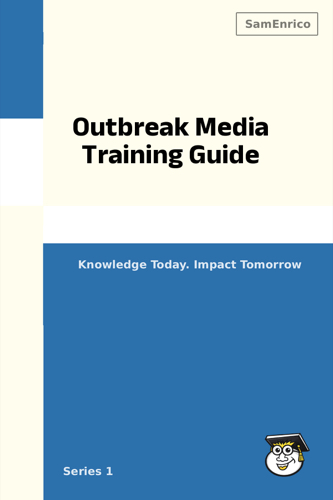
Non-FictionCrisis ManagementMedia
Outbreak Media Training Guide eBook
Answer tough questions about safety failures witho
Answer tough questions about safety failures without admitting liability.
Formats
Free sample
Chapter 1: The Billion-Dollar Word--–- The word feels harmless. Four letters. One syllable. It spills out of our mouths dozens of times a day—when we bump into someone, when we arrive late, when we make a small mistake. "Sorry." It is the social lubricant of modern life, the verbal bandage for a thousand minor transgressions.
But in the minutes following a safety failure—a contaminated product, a workplace fatality, a chemical release, a preventable outbreak—that same word transforms from a courtesy into a confession. It becomes the single most expensive syllable a spokesperson can utter.This chapter will teach you why "sorry" is the billion-dollar word, how a spontaneous apology can nullify your insurance coverage, and why the L'Aquila earthquake trial of 2012 changed crisis communication forever. You will learn the critical distinction between an apology (which admits fault) and sympathy (which expresses sorrow without liability). By the end of this chapter, you will never say "I'm sorry" on camera again—and you will know exactly what to say instead.The Trial That Changed Everything At 3:32 AM on April 6, 2009, a 6.3 magnitude earthquake struck the medieval city of L'Aquila in central Italy. The ground shook for twenty seconds.
When the dust settled, 309 people were dead, more than 1,500 were injured, and tens of thousands were homeless. The ancient city's buildings—many centuries old—had collapsed like sandcastles.But the earthquake was not the only event that would send shockwaves through the world. Three years later, in October 2012, an Italian court convicted six scientists and one government official of manslaughter. Their crime? Failing to adequately warn the population before the earthquake struck.
They were sentenced to six years in prison.The verdict sent a chill through every boardroom, every government agency, and every crisis communication team on the planet. For the first time in modern history, experts who had attempted to communicate about risk were criminally prosecuted for getting it wrong.Here is what most news reports got wrong: The L'Aquila defendants were not convicted for failing to predict the earthquake. No one can predict earthquakes with certainty. They were convicted for what they said—and how they said it—in the days leading up to the disaster.In the week before the earthquake, L'Aquila experienced a series of small tremors. The population was nervous.
In response, the defendants—members of the Major Risks Committee—held a meeting and subsequently gave reassuring public statements. One official told residents not to worry and that the seismic situation was "normal." Another advised that the small tremors were actually "favorable" because they released energy. A scientist said there was "no reason to believe" a major earthquake was imminent.When the earthquake hit, those statements were entered into evidence. The prosecution argued that the defendants had provided "inexact, incomplete and contradictory" information that led residents to remain in their homes rather than sleeping outside. The court agreed.The L'Aquila case established a terrifying new precedent for spokespersons everywhere: if you communicate about risk and you get it wrong—even with the best intentions—you can go to jail.Why "Sorry" Is Different from "We Grieve"The L'Aquila defendants never said "sorry." They said something arguably worse: "Don't worry." But the lesson for crisis communication is the same.
In the aftermath of a safety failure, every word you utter will be scrutinized by three audiences simultaneously: the public (seeking reassurance), the media (seeking a headline), and plaintiff's attorneys (seeking a confession).The word "sorry" occupies a unique and dangerous position in this triangle. In ordinary conversation, "I'm sorry" expresses regret, empathy, and social bonding. In a courtroom, "I'm sorry" is an admission of fault. It says: "I did something wrong. I am responsible for your harm.
I should have acted differently."Once those words leave your mouth, your insurance company may invoke a "voluntary admission" exclusion in your policy, refusing to cover the resulting judgment. Plaintiff's attorneys will play the clip on loop for the jury. And any chance of a negotiated settlement—where liability is not admitted—evaporates.But here is the nuance that separates master communicators from disasters: there is a way to express sorrow, compassion, and human connection without ever saying "sorry" as an admission of fault. This is the distinction between apology and sympathy.Apology (Dangerous)Sympathy (Safe)"We are sorry for what happened.""We grieve with those who suffered.""We apologize for the failure.""Our hearts are broken by this event.""We regret our mistake.""We are devastated by the impact.""We take full blame.""We are committed to understanding what happened."Notice the pattern. Apologies accept agency.
They contain a subject performing an action toward an object: We are sorry for. Sympathy expresses shared emotion without assigning causation. It says: "This terrible thing occurred, and we feel it with you." It does not say: "We caused it."The training goal of this chapter—and this entire book—is to rewire your instinctive response. When a reporter puts a microphone in your face and asks, "What do you say to the families who lost loved ones?" your natural human impulse is to say, "I'm sorry." That impulse is wrong. It is dangerous.
It will cost you millions. The correct response is: "We are devastated by this tragedy. Every family affected is in our thoughts."Same sentiment. Zero liability.The Liability Spectrum: A New Framework To help spokespersons navigate the dangerous terrain between empathy and admission, this chapter introduces the Liability Spectrum—a three-tier framework that will appear throughout this book. Memorize it.
Post it in your crisis war room. Train every spokesperson on it until it becomes reflex.Green Zone: Always Safe These words and phrases express human emotion without any legal exposure. They are your default vocabulary in any crisis."We grieve""We are devastated""Our hearts are broken""We are thinking of the families""This is a tragedy""We are committed to understanding what happened""We will cooperate fully with investigators""Safety is our highest priority"Notice what Green Zone language does not do. It does not admit causation. It does not assign blame.
It does not speculate. It simply acknowledges the emotional reality of the event and expresses a forward-looking commitment.Yellow Zone: Say Only After Legal Review These words and phrases can be safe—or catastrophic—depending on context. They should never exit a spokesperson's mouth without prior approval from legal counsel."Responsibility" (as in "We take responsibility for the response")"Accountability" (as in "We are accountable for fixing this")"Cleanup" (as in "We are leading the cleanup effort")"We have learned" (as in "We have learned from this experience")"We will do better"Why the caution? Because plaintiff's attorneys will attempt to twist Yellow Zone language into admissions. "You said you were 'responsible for the response,'" they will argue.
"Doesn't that mean you were responsible for the cause?" The answer is no—but the argument will cost you in legal fees and jury confusion. Always run Yellow Zone language past counsel before using it publicly.Red Zone: Never Say — Ever These words and phrases are admissions of fault. Once spoken, they cannot be unsaid. They will be used against you in court."Sorry""Apologize" / "Apology""Blame" / "Fault" /…
This is the end of the free sample. Get the eBook to keep going. Buy now
About this book
Details
- Author
- Woodley Carson
- Publisher
- SamEnrico
- Language
- English
- Genre
- Non-Fiction, Crisis Management, Media
- Released
- 2026-06-10
- Pages (approx.)
- 150
- Available as
- eBook, Audiobook

Read better in the ZLOADR app
Your eBooks on your phone or tablet. Sign in with your SamEnrico account and start reading.
More by Woodley Carson
 Preferred Stock Dividend GuideWoodley Carson$11.99
 My Foster Care TattooWoodley Carson$11.99
 Opioid Naloxone TrainingWoodley Carson$11.99
 Memory Palace for LawWoodley Carson$11.99
 Perfectionism Academic DelayWoodley Carson$11.99
 First Year Without My ChildWoodley Carson$11.99
 The Laughing Satirists: How 18th-Century British Wits Shaped Modern ComedyWoodley Carson$11.99
 Return To Work After BurnoutWoodley Carson$11.99
 The Great Gorilla Breakout: The Night the Bronx Zoo Lost Its MindWoodley Carson$11.99
 How to Produce Window and SidingWoodley Carson$11.99
 A Collector's Handbook to the Moskvich 427Woodley Carson$11.99
 OKR vs SMART Goals GuideWoodley Carson$12.99
You may also like
 Hong Kong Handover 1997Dunn Johnnie$11.99
 Zumba For Postnatal Recovery CourseNeal Christian$11.99
 Zumba for BeginnersLadner Nikia$11.99
 YouTube Comment Mining GuideHumes Pandora$12.99
 Worry Box MeditationCarlin Rudy$11.99
 Workplace Stress MeditationNguyen Lynn$11.99
 Workplace Stress and Sleep RepairHawley Ivory$11.99
 Workplace Perfectionism CureDelaney Jeffry$11.99
 Workplace Injustice Anger GuideWallen Isabelle$11.99
 Work Addiction and Burnout LinkGreenwood Ester$11.99
 Women in Yoga and WellnessBeattie Galina$11.99
 Women in Stand Up ComedyChun Evangeline$11.99