
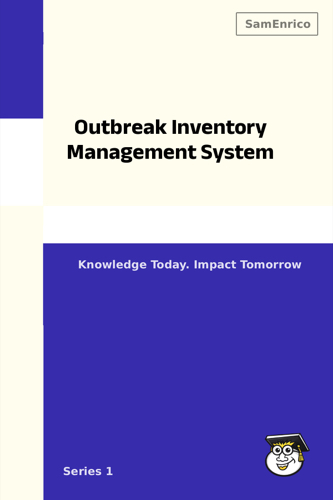
Non-FictionCrisis ManagementInventory
Outbreak Inventory Management System eBook
Track dwindling stock in real-time and automate re
Track dwindling stock in real-time and automate reorder alerts before shelves empty.
Formats
Free sample
Chapter 1: The $2.2 Million Empty Box--The ventilator circuit was supposed to be there. The hospital’s inventory system said twelve units were on hand. A respiratory therapist walked to the supply cart. Empty. She walked to the central supply room.
Empty. She checked the warehouse—a cavernous space filled with pallets of adult circuits, IV bags, and surgical drapes. Somewhere, buried behind three pallets of supplies that hadn’t been touched in months, were those twelve ventilator circuits. A six-year-old child waited. Forty-seven minutes passed while a nurse drove to a sister hospital.
The child survived. But the hospital’s risk manager later calculated the cost of those forty-seven minutes: a $2.2 million settlement.This is not a story about medical malpractice. It is a story about inventory. Specifically, it is a story about what happens when the cost of an empty shelf is treated as an afterthought—when inventory management is delegated to spreadsheets, good intentions, and the vague hope that nothing will go wrong.The hospital did not have an inventory problem. It had an outbreak problem.
A sudden, unpredictable spike in pediatric respiratory cases created demand that no one had anticipated. The system, designed for normal operations, failed catastrophically under pressure. And that failure cost real money, real reputation, and nearly cost a child’s life.You are reading this book because you have felt the dread of the last box. You have stood in a warehouse, or a stockroom, or behind a retail counter, holding the final unit of something your customers need, your production line requires, or your patients depend on. You have asked yourself: How did we not see this coming?
Why did the system say we had stock when the shelf was empty? And most importantly—how do I make sure this never happens again?This chapter answers the first and most fundamental question: Why do traditional inventory models fail during outbreaks? More importantly, it establishes the core vocabulary and measurement framework that will be used throughout this book—including the operational definition of an outbreak, the concept of V-Factor (Velocity Factor), and the true cost of a stockout. By the end of this chapter, you will be able to calculate, for your top ten most critical SKUs, exactly what it costs you every time you run out.But first, we must dismantle a dangerous myth.The Myth of Inventory as Waste For the past three decades, the dominant philosophy in operations management has been Lean. Lean thinking, derived from the Toyota Production System, teaches that inventory is a form of waste—muda.
Inventory hides problems. It covers up inefficiencies. It ties up capital that could be used elsewhere. The goal, in its purest form, is zero inventory: goods arrive just in time to be used, with no buffer, no safety stock, no redundancy.This philosophy has produced remarkable results in stable, predictable supply chains. Toyota itself runs on JIT.
But there is a secret that Lean consultants rarely discuss: Toyota also keeps a hidden inventory of critical spares—components that, if missing, would stop production. They do not advertise this. It contradicts the purity of the message. But it is true, and it is wise.The problem is not JIT itself. The problem is applying JIT indiscriminately to every item in your inventory.Let us be clear: Just-in-Time is not evil.
It is situational. For commoditized, non-critical items with multiple suppliers—office paper, cleaning supplies, standard fasteners—JIT works beautifully. Holding zero inventory on these items frees up capital and space. But for outbreak-prone items—the ones that can stop production, lose customers, or, in a hospital, cost lives—standard JIT is deadly.This book will teach you how to distinguish between these categories. Chapter 10 will provide the complete framework for classifying every item in your inventory into three buckets: JIT-eligible (zero safety stock), Standard Buffer (calculated static safety stock), and Critical Spares (the Goldilocks Zone of intelligent redundancy).
But before we can classify, we must understand the nature of the enemy.The Stockout Cascade: How One Empty Shelf Multiplies into a Disaster When a stockout occurs—when a customer asks for something and you do not have it—the cost is rarely limited to the lost sale. Instead, the stockout triggers a cascade of escalating costs. Understanding this cascade is the first step toward preventing it.Consider a simple example: a manufacturer of industrial pumps. One critical seal, costing eight dollars, runs out. The stockout cascade looks like this:Level one: The immediate cost.
The production line stops. Fifty workers stand idle for two hours while someone drives to a competitor to buy seals at triple the price. Direct cost: $8,000 in labor and expediting.Level two: The customer cost. The delayed shipment misses a contractual delivery window. The customer invoices a late penalty: $15,000.Level three: The reputation cost.
The customer, now uncertain about reliability, splits future orders between you and a competitor. Estimated lost future revenue: $200,000 over three years.Level four: The systemic cost. The expediter who solved the problem is rewarded. He learns that bypassing the system works. Next time, he will order even earlier, creating a demand spike that corrupts the reorder calculations.
The system, now polluted with false demand, will over-order for months.The eight-dollar seal created a cascade of costs exceeding $223,000. This is not an outlier. It is the norm.The hospital ventilator circuit followed the same pattern: immediate patient risk, a settlement, lost trust from physicians, and a risk management review that consumed hundreds of staff hours.The key insight is this: The cost of a stockout is almost never the cost of the item. It is the cascade. And the cascade is driven not by the item’s price, but by its criticality.Inventory as Asset vs.
Liability: The Accounting Trap Standard accounting treats inventory as an asset. It appears on the balance sheet under current assets. This is technically correct—inventory has value. But accounting’s asset classification creates a dangerous psychological trap. Managers who see inventory as an asset are incentivized to hold more of it.
Yet inventory also carries costs: storage, insurance, obsolescence, theft, and the opportunity cost of capital tied up in goods that are not yet sold.The truth is more nuanced. Inventory is an asset when it is moving. It is a liability when it is sitting.Consider two companies. Company A holds $10 million in inventory that turns over twelve times per year. That inventory generates $120 million in annual revenue.
Company B holds the same $10 million in inventory but turns it over only four times per year, generating $40 million in revenue. Company A’s inventory is working. Company B’s inventory is suffocating.But the inverse is equally dangerous. Company C holds so little inventory that it runs out of key items twice per month. The lost sales, expediting fees, and customer penalties consume any savings from reduced holding costs.
Company C’s inventory is also a liability—not because it is sitting, but because there is not enough of it.The goal is not to minimize inventory. The goal is to optimize inventory. And optimization requires understanding the trade-off between the cost of holding stock and the cost of running out.This trade-off is…
This is the end of the free sample. Get the eBook to keep going. Buy now
About this book
Details
- Author
- Giroux Selina
- Publisher
- SamEnrico
- Language
- English
- Genre
- Non-Fiction, Crisis Management, Inventory
- Released
- 2026-06-11
- Pages (approx.)
- 135
- Available as
- eBook, Audiobook

Read better in the ZLOADR app
Your eBooks on your phone or tablet. Sign in with your SamEnrico account and start reading.
More by Giroux Selina
 Accountability For ProcrastinatorsGiroux Selina$11.99
 Macros for PregnancyGiroux Selina$11.99
 OKR for Sales TeamsGiroux Selina$12.99
 Workplace Journey Memory PathGiroux Selina$11.99
 The Foster Care College DreamGiroux Selina$11.99
 DEAR MAN Skill GuideGiroux Selina$11.99
 Career Monthly Review GuideGiroux Selina$11.99
 Grief and Cooking AloneGiroux Selina$11.99
 Loki’s Shadow: The Trickster’s African TrialGiroux Selina$11.99
 Service Providers Guide to Video TapingGiroux Selina$11.99
 A Collector's Handbook to the Morris Minor Mm TourerGiroux Selina$11.99
 Disaster Recovery for Offshore SupportGiroux Selina$12.99
You may also like
 Hong Kong Handover 1997Dunn Johnnie$11.99
 Zumba For Postnatal Recovery CourseNeal Christian$11.99
 Zumba for BeginnersLadner Nikia$11.99
 YouTube Comment Mining GuideHumes Pandora$12.99
 Worry Box MeditationCarlin Rudy$11.99
 Workplace Stress MeditationNguyen Lynn$11.99
 Workplace Stress and Sleep RepairHawley Ivory$11.99
 Workplace Perfectionism CureDelaney Jeffry$11.99
 Workplace Injustice Anger GuideWallen Isabelle$11.99
 Work Addiction and Burnout LinkGreenwood Ester$11.99
 Women in Yoga and WellnessBeattie Galina$11.99
 Women in Stand Up ComedyChun Evangeline$11.99