
Non-FictionSelf-HelpSleep TrackingWellness
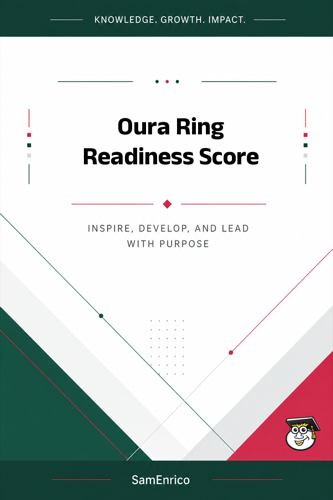
Oura Ring Readiness Score eBook
Use biometric data for self insight rather than so
by Culp Zetta
Use biometric data for self insight rather than social competition.
Formats
Free sample
Chapter 1: The Morning Mirror--–- Sarah’s eyes opened at 6:47 AM, exactly three minutes before her alarm. This was not unusual. What was unusual was the tiny, smooth ceramic ring on her right ring finger—a ring that had, over the past six months, become the first thing she thought about every morning.She reached for her phone on the nightstand, thumb hovering over the Oura app icon. Her heart rate ticked up slightly. She could feel it.
Not because she was ill, but because she had learned to anticipate the small spike of anxiety that came before the number appeared.The app opened. The Readiness Score loaded.68.Sarah exhaled. Her shoulders, which had been relaxed a moment ago, now felt tight. A wave of fatigue washed over her—not the kind that comes from poor sleep, but the kind that follows bad news. She lay in bed for another twenty minutes, scrolling mindlessly, before finally dragging herself to the bathroom.She felt fine.
Objectively, she felt fine. She had slept seven and a half hours. She had no aches, no congestion, no unusual tiredness. But the number had spoken. And the number had said: You are not ready.By 9:00 AM, Sarah had canceled her morning run, postponed a difficult work call, and texted her friend to reschedule their lunch.
She spent the morning on her couch, watching television and feeling vaguely guilty. At noon, she realized she hadn't eaten. She wasn't hungry. She was just… off.Nothing in her body had changed between 6:47 AM and 9:00 AM. Only one thing had changed: she had seen a number.The Trojan Horse This book begins with Sarah not because her story is unusual, but because it is ordinary.
Millions of Oura Ring users wake up to the same ritual, feel the same spike of anxiety, and make the same quiet adjustments to their days based on a single three-digit number. The ring was marketed as a tool for self-insight. For many, it has become a source of self-doubt.This is the Trojan Horse of wellness.The term “Trojan Horse” refers to a gift that appears benign but conceals something dangerous. The Oura Ring—sleek, minimalist, backed by peer-reviewed research—certainly looks like a gift. It promises better sleep, more energy, and a deeper understanding of your body.
And it delivers on many of those promises. But hidden inside that elegant ceramic shell is something the marketing materials do not advertise: a quiet, insidious pressure to perform.Not to perform physically. The ring does not yell at you like a fitness instructor. It does not shame you like a missed deadline. It does something more subtle and, in some ways, more powerful.
It hands you a mirror every morning and invites you to judge what you see.The problem is not the mirror. The problem is that most of us have never been taught how to look at ourselves without criticism.A Brief History of the Quantified Self To understand how we arrived at this moment—where a $300 ring can shape your mood for an entire day—we need to rewind fifteen years.In 2010, the “quantified self” movement was born from a small group of technologists, biohackers, and early adopters who believed that data could unlock human potential. They tracked everything: steps taken, hours slept, calories consumed, heartbeats per minute, even the number of times they blinked. The motto was simple: You cannot improve what you do not measure.For a time, this felt liberating. Instead of vague goals like “get healthier,” quantified selfers had precise targets.
Instead of guessing whether they had slept well, they had graphs. Instead of wondering why they felt tired, they had data on caffeine intake, workout timing, and bedroom temperature.But something unexpected happened around 2015. Researchers began noticing a pattern among early adopters. The people who tracked the most data were not the healthiest. They were often the most anxious.
They had not outsourced guesswork; they had outsourced intuition. They would ignore their own felt sense of restfulness if the data disagreed. They would feel guilty about a “bad” night of sleep even when they woke up refreshed. They had stopped listening to their bodies and started listening to spreadsheets.One quantified self pioneer, reflecting on years of obsessive tracking, wrote: “I had become a scientist studying a specimen that I no longer recognized as myself.”The fitness tracker industry learned from this but did not solve it. Fitbit, Jawbone, and later Apple and Garmin, doubled down on the same premise: more data, more graphs, more “insights.” But they added a new feature borrowed directly from social media: the dopamine loop.The Dopamine Loop Social media platforms are designed to exploit a fundamental feature of your brain’s reward system: intermittent variable rewards.
When you check Instagram and see likes, your brain releases a small amount of dopamine—the neurotransmitter associated with pleasure and anticipation. But here is the cruel trick: you get the same dopamine hit from anticipating likes as you do from receiving them. That is why you check your phone fifty times an hour. The anticipation itself is addictive.Wearable technology adopted the same architecture. Checking your Readiness Score in the morning produces a small dopamine hit if the number is high (validation) or a cortisol spike if the number is low (stress).
Both are chemically reinforcing. A high score makes you want to check again tomorrow. A low score makes you want to check again tomorrow to see if it improved.The problem is biological: human mood, energy, and performance vary naturally by 15–20 percent day to day due to circadian rhythms, digestion, hormonal cycles, and random physiological variation. Most of that variation is meaningless noise. But the app presents each daily score as a meaningful signal.
It cannot do otherwise. The interface has no way to say, “This fluctuation is probably just your digestive system doing its thing.”So you wake up. You check the score. The score is 68. You feel disappointed.
You adjust your entire day. And nothing in your body actually changed.Data Versus Insight Before we go any further, we need to establish a distinction that will guide this entire book. It is the single most important concept you will learn.Data is raw numbers. “HRV: 35ms.” “RHR: 62bpm.” “Temperature: +0.3°C.” Data is what the ring measures. Data is objective, precise, and abundant.Insight is meaning.
“My nervous system is under-recovered today.” “My immune system is likely fighting something.” “I should prioritize sleep over intensity.” Insight is what you do with the data. Insight is subjective, contextual, and rare.Most Oura Ring users are drowning in data and starving for insight.Here is the difference in practice:Data Insight Example“HRV = 35ms”“My nervous system needs recovery”Frequency Every morning Weekly or monthly trends Emotion Anxiety or validation Curiosity or acceptance Action“I must fix this”“I will adjust my day”Data demands an immediate response. Insight invites a patient inquiry. Data turns the ring into a judge. Insight turns the ring into a mirror.The goal of this book is to move you from the left column to the right column.
Not by discarding the ring—it is a remarkable tool—but by changing your relationship with it. You will learn to see…
This is the end of the free sample. Get the eBook to keep going. Buy now
About this book
Details
- Author
- Culp Zetta
- Publisher
- SamEnrico
- Language
- English
- Genre
- Non-Fiction, Self-Help, Sleep Tracking, Wellness
- Released
- 2026-06-09
- Pages (approx.)
- 125
- Available as
- eBook, Audiobook

Read better in the ZLOADR app
Your eBooks on your phone or tablet. Sign in with your SamEnrico account and start reading.
More by Culp Zetta
 Remote Company Retreats Insurance GuideCulp Zetta$11.99
 The Ayurvedic Ghee GuideCulp Zetta$11.99
 Patty Loveless Mountain SoulCulp Zetta$11.99
 Pilot Morning Routine GuideCulp Zetta$11.99
 Hippocrates: The Father of MedicineCulp Zetta$11.99
 How to Start a Dresses for Women and Girls Business (Beginners Guide)Culp Zetta$11.99
 Interest Only Loan PeriodsCulp Zetta$12.99
 Fixed Price Contracts GuideCulp Zetta$12.99
 Smart Home and Security Alarm TechnicianCulp Zetta$11.99
 Understanding Short Stature Mental Retardation Eye DefectsCulp Zetta$17.99
You may also like
 Hong Kong Handover 1997Dunn Johnnie$11.99
 Zumba For Postnatal Recovery CourseNeal Christian$11.99
 Zumba for BeginnersLadner Nikia$11.99
 YouTube Comment Mining GuideHumes Pandora$12.99
 Worry Box MeditationCarlin Rudy$11.99
 Workplace Stress MeditationNguyen Lynn$11.99
 Workplace Stress and Sleep RepairHawley Ivory$11.99
 Workplace Perfectionism CureDelaney Jeffry$11.99
 Workplace Injustice Anger GuideWallen Isabelle$11.99
 Work Addiction and Burnout LinkGreenwood Ester$11.99
 Women in Yoga and WellnessBeattie Galina$11.99
 Women in Stand Up ComedyChun Evangeline$11.99