
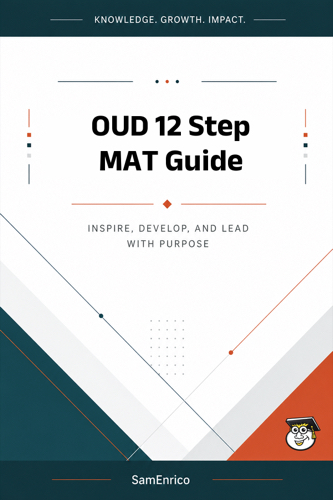
Non-FictionHealth & Wellness12 Step
OUD 12 Step MAT Guide eBook
Navigate NA and AA meetings that may stigmatize me
by Keyes Gavin
Navigate NA and AA meetings that may stigmatize medication.
Formats
Free sample
Chapter 1: Two Worlds Collide--The first time someone told me I wasn't really sober, I was forty-seven days into recovery and holding a coffee cup in a church basement.I had done everything right. I had found a doctor who understood opioid use disorder. I had gotten a prescription for buprenorphine. I had stopped using fentanyl. I had started sleeping through the night.
I had told my family the truth. I had gone to ninety meetings in ninety days—or close to it, anyway. And on day forty-seven, after a meeting about step one, an older man with thirty years of sobriety pulled me aside and said, "I hear you're on Suboxone. You know that's not clean, right?"I did not know that. Or rather, I knew some people believed that, but I had not expected to hear it from a man who had just spent forty-five minutes talking about how the program had saved his life.
I had not expected to hear it while I was holding a coffee cup, wearing a key tag that said "30 Days," and feeling, for the first time in years, like I might actually survive.That was the moment I learned the central, unspoken truth of recovery for millions of people: the medical world and the fellowship world are not the same world. And when they collide, the person standing in the middle often gets crushed.This book is for everyone who has ever stood in that church basement, or a community center, or a Zoom room, holding a prescription that keeps them alive and wondering if they belong. The answer is yes. You belong. But belonging requires navigation, and navigation requires a map.
This chapter is the first landmark on that map.The Two Frameworks That Are Fighting Over Your Recovery Before we can talk about how to navigate the tension between Medication for Opioid Use Disorder (MAT/MOUD) and twelve-step fellowships, we have to understand what the tension actually is. Most people experiencing this conflict cannot name it clearly. They just know they feel wrong—like they are cheating, or lying, or failing. That feeling is not a moral failing. It is the predictable result of standing between two powerful, contradictory frameworks that each claim to know what recovery means.The first framework is the medical model.
This is the framework your doctor uses. It says that Opioid Use Disorder (OUD) is a chronic brain disease, similar to diabetes, hypertension, or asthma. It is not a moral failure. It is not a character defect. It is a medical condition that responds to medical treatment.
The goal of treatment is remission—a sustained state in which you no longer meet the diagnostic criteria for OUD. Remission does not require abstinence from all medications. It requires the absence of compulsive opioid use, craving, and the life-destroying behaviors that come with active addiction.The medical model is supported by decades of research, thousands of peer-reviewed studies, and every major health organization in the world, including the National Institute on Drug Abuse (NIDA), the Substance Abuse and Mental Health Services Administration (SAMHSA), the World Health Organization (WHO), and the American Medical Association (AMA). The data is overwhelming: MAT reduces opioid overdose mortality by fifty percent or more. It reduces illicit opioid use.
It reduces criminal activity. It improves retention in treatment. It saves lives. There is no serious debate about this in the medical community.The second framework is the cultural abstinence model. This is not the official position of Alcoholics Anonymous or Narcotics Anonymous—we will get to that important distinction in a moment—but it is the dominant interpretation you will encounter in many twelve-step rooms.
This framework says that addiction is primarily a spiritual and moral problem. The solution is complete abstinence from all "mind-altering substances," including prescribed medications like methadone and buprenorphine. In this framework, being "clean" means having no foreign substances in your body that affect your mood, perception, or consciousness. Any ongoing use of medication—even medication prescribed by a doctor and taken exactly as directed—is seen as a compromise, a crutch, or, in the harshest rooms, a form of active addiction.The cultural abstinence model has no scientific basis. It is not supported by any major health organization.
It has never been tested in a randomized controlled trial. It is, instead, a set of beliefs passed down through generations of twelve-step members, often with good intentions but without medical training. The people who hold these beliefs are not bad people. Many of them have decades of recovery and genuinely want to help. But they are repeating what they were told, and what they were told is often wrong.The problem is not that one framework is entirely right and the other entirely wrong.
The problem is that both frameworks claim authority over your recovery, and they give you opposite instructions. The medical model says: take your medication every day, as prescribed, for as long as it helps. The cultural abstinence model says: you are not really clean until you stop taking that medication. You cannot follow both instructions. You have to choose.Or do you?What AA Actually Says vs.
What Happens in the Basement Here is where we have to be very careful. Many people who have been hurt by twelve-step stigma will tell you that AA and NA are fundamentally anti-medication. That is not entirely accurate. It is also not entirely inaccurate. The truth is more complicated, and understanding that complication is the first step to navigating it without losing your mind.Alcoholics Anonymous has an official position on outside issues, articulated in its Tenth Tradition: "Alcoholics Anonymous has no opinion on outside issues; hence the A.A.
name ought never be drawn into public controversy." This tradition was written to keep AA focused on recovery from alcoholism rather than politics, religion, or medicine. The Tenth Tradition is why AA does not endorse political candidates, take positions on legislation, or weigh in on medical debates. It is also why AA has an official pamphlet titled "The A.A. Member—Medications and Other Drugs," which states, in plain language, that no AA member should "play doctor" and that prescribed medications are an "outside issue" that should be left to medical professionals.That pamphlet is worth quoting directly: "No A.A. member should 'play doctor'; all medical advice and treatment should come from a qualified physician." It continues: "It is important to remember that the decision to take any medication is a decision between a member and his or her physician.
It is not something that should be decided by other A.A. members." And perhaps most importantly: "A.A. members should not attempt to pressure a member into discontinuing the use of any prescribed medication."Let me repeat that last sentence: AA members should not attempt to pressure a member into discontinuing the use of any prescribed medication.That is the official position of Alcoholics Anonymous. Written down. Published.
Distributed to groups. Available for free on their website.Now, here is the reality: most twelve-step members have never read that pamphlet. Many have never heard of it. And among those who have, many dismiss it as "politically correct" or…
This is the end of the free sample. Get the eBook to keep going. Buy now
About this book
Details
- Author
- Keyes Gavin
- Publisher
- SamEnrico
- Language
- English
- Genre
- Non-Fiction, Health & Wellness, 12 Step
- Released
- 2026-06-07
- Pages (approx.)
- 157
- Available as
- eBook, Audiobook

Read better in the ZLOADR app
Your eBooks on your phone or tablet. Sign in with your SamEnrico account and start reading.
More by Keyes Gavin
 The New Mother Self Esteem GuideKeyes Gavin$11.99
 Therapist Imposter SyndromeKeyes Gavin$11.99
 Creator Crisis ManagementKeyes Gavin$11.99
 GLBA Safeguards Rule UpdateKeyes Gavin$11.99
 The Silk Road's Shield: Ban Chao's Iron Will (AD 89-101)Keyes Gavin$11.99
 How to Start a Ballet Shoe Business (Beginners Guide)Keyes Gavin$11.99
 Corporate Marketing ManagerKeyes Gavin$11.99
 Executive Summary for Internal ReportsKeyes Gavin$12.99
 Costco Membership PlaybookKeyes Gavin$12.99
 Understanding Primerose SyndromeKeyes Gavin$17.99
You may also like
 Hong Kong Handover 1997Dunn Johnnie$11.99
 Zumba For Postnatal Recovery CourseNeal Christian$11.99
 Zumba for BeginnersLadner Nikia$11.99
 YouTube Comment Mining GuideHumes Pandora$12.99
 Worry Box MeditationCarlin Rudy$11.99
 Workplace Stress MeditationNguyen Lynn$11.99
 Workplace Stress and Sleep RepairHawley Ivory$11.99
 Workplace Perfectionism CureDelaney Jeffry$11.99
 Workplace Injustice Anger GuideWallen Isabelle$11.99
 Work Addiction and Burnout LinkGreenwood Ester$11.99
 Women in Yoga and WellnessBeattie Galina$11.99
 Women in Stand Up ComedyChun Evangeline$11.99