
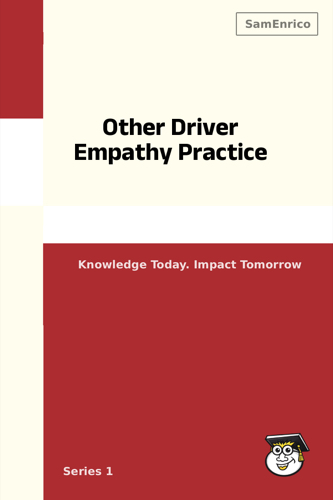
Other Driver Empathy Practice eBook
Imagine possible emergencies or stress behind othe
Imagine possible emergencies or stress behind other drivers' bad behavior.
Formats
Free sample
Chapter 1: The Metal Bubble--–- Every morning, you step into a metal bubble. So does everyone else. The bubble has windows tinted just darkly enough that you cannot see the person inside clearly. It has a horn that sounds like anger even when you don’t mean it that way. It has a gas pedal that translates impatience into aggression and a brake pedal that turns fear into a sudden stop.
Inside your bubble, you are anonymous, protected, and strangely powerful. Outside your bubble, every other car is not a person with a name, a history, or a crisis. It is an obstacle. A threat. An idiot.This is the empathy deficit on asphalt, and it is not your fault.
It is your brain doing exactly what evolution programmed it to do when faced with faceless, fast-moving objects. But here is the promise of this chapter: what your brain has learned to do automatically, your brain can learn to undo. Not by becoming weak, not by tolerating dangerous driving, but by understanding the hidden machinery that turns kind people into road monsters. Once you see that machinery, you can begin to take it apart, one driver at a time.The Neuroscience of Dehumanization When you sit behind the wheel, your brain enters a state that neuroscientists call low mirror-neuron engagement. Mirror neurons are the tiny neural circuits that fire both when you perform an action and when you observe someone else performing that same action.
They are the biological basis of empathy. When you see someone smile, your mirror neurons fire as if you smiled. When you see someone flinch in pain, your mirror neurons simulate that pain. This is why you cringe when you watch someone stub their toe. Your brain does not distinguish completely between their experience and your own.But mirror neurons require facial expressions, body language, and eye contact to activate fully.
A car provides none of those. The driver behind the windshield is reduced to a silhouette. Their hands are hidden on the steering wheel. Their face is obscured by glare or shadow. Their posture is invisible.
Your mirror neurons receive almost no signal. As far as your brain is concerned, the other car is not a person. It is an object.This is not a character flaw. This is a design flaw in the human brain for the modern environment. Evolution never prepared us to share the road with two-ton metal boxes moving at seventy miles per hour.
Our brains are still calibrated for small tribal groups where every face was familiar and every gesture carried meaning. When that system encounters anonymity, it defaults to a defensive posture. The amygdala—your brain’s threat detection center—activates. The prefrontal cortex, responsible for reasoning and impulse control, gets partially suppressed. You become quicker to anger and slower to reflect.Consider what happens when the same event occurs on foot versus behind the wheel.
If someone bumps into you on a crowded sidewalk and keeps walking, your first thought is often charitable: they are in a hurry, they did not see you, they have somewhere important to be. Your mirror neurons catch their hurried posture, their apologetic glance, their breathlessness. You fill in the story automatically. Now imagine the same event in traffic. Someone merges into your lane with minimal space.
You cannot see their face. You cannot see if they are apologizing. You cannot see if their child is choking in the back seat. Your brain, starved of social data, invents the worst possible story: they are selfish, they are careless, they did it on purpose to spite you.That invention happens in less than a second. And it feels like truth.The Amygdala Hijack The most dangerous moment in any drive is not when another driver makes a mistake.
It is the split second between that mistake and your reaction. In that gap, your amygdala can hijack your entire nervous system.Psychologists call this an amygdala hijack, a term popularized by Daniel Goleman in his work on emotional intelligence. Here is how it works. Your thalamus, the brain’s relay station, receives sensory input—a car swerving, brake lights flashing, a horn blaring. It sends that information along two pathways.
The fast pathway goes directly to the amygdala. The slow pathway goes to the cortex for rational processing. The fast pathway is ancient, automatic, and designed for survival. It does not ask questions. It assumes threat and prepares your body for fight or flight.
Your heart rate spikes. Your muscles tense. Your pupils dilate. Cortisol and adrenaline flood your system. You are now physiologically ready to honk, to swerve, to roll down your window and scream.All of this happens before your cortex has even finished asking, “Wait, is this actually dangerous?”By the time your rational brain catches up, you are already angry.
And here is the cruel irony: your brain now interprets that physiological arousal as evidence that the threat was real. You feel angry, therefore there must be a reason to be angry. Your brain hunts for that reason and finds it in the other driver’s imagined malice. The anger justifies itself. This is why road rage feels so compelling in the moment and so absurd five minutes later.
The physiology came first. The story came second.This chapter is not asking you to suppress that生理反应. Suppression rarely works and often backfires. What this chapter offers instead is understanding. Once you recognize the amygdala hijack for what it is—a neural false alarm, not a moral truth—you gain the ability to pause.
Not to eliminate the feeling, but to stop it from driving your actions.Road Rage Is Not Who You Are If you have ever honked in rage, tailgated, made an angry gesture, or shouted at another driver, you are not a bad person. You are a normal person with a normal brain responding to an abnormal environment. The fact that you feel ashamed afterward is proof that your cortex is working. The shame means your rational brain knows the reaction was disproportionate. That shame is not a weakness.
It is the beginning of wisdom.Let us distinguish carefully between two very different things: road rage as a temporary state and road rage as a chronic condition. Almost every driver experiences momentary anger behind the wheel. That is not pathological. It is inconvenient, uncomfortable, and counterproductive, but it is not a diagnosis. Chronic road rage—the kind that leads to following someone home, getting out of the car to confront them, or using the vehicle as a weapon—is a different category entirely.
That requires professional intervention. This book addresses the former, the everyday flash of fury that most drivers know too well. If you suspect you fall into the latter category, please seek help from a qualified therapist who specializes in anger management.For everyone else, here is the liberating truth: your momentary anger is not evidence that you are an angry person. It is evidence that you are a human driver. The goal of this book is not to make you feel guilty for getting angry.
The goal is to give you tools to shorten the anger, reduce its intensity, and prevent it from becoming action.…
This is the end of the free sample. Get the eBook to keep going. Buy now
About this book
Details
- Author
- Bible Louanne
- Publisher
- SamEnrico
- Language
- English
- Genre
- Non-Fiction, Self-Help, Empathy
- Released
- 2026-06-09
- Pages (approx.)
- 125
- Available as
- eBook, Audiobook

Read better in the ZLOADR app
Your eBooks on your phone or tablet. Sign in with your SamEnrico account and start reading.
More by Bible Louanne
 Cooperative Traceability SystemBible Louanne$11.99
 Titanic's Wireless Room DebatesBible Louanne$11.99
 Pomodoro for Backup RoutinesBible Louanne$11.99
 The Atypical Depression Subtype GuideBible Louanne$11.99
 The Lost Treasures of Nanking: The Art Heist That Shocked a NationBible Louanne$11.99
 Optician Dispensing (Licensed)Bible Louanne$11.99
 How to Become a Shank InspectorBible Louanne$11.99
 Understanding Oral Facial Digital Syndrome Type 4Bible Louanne$17.99
 Prestige Degree AdvantageBible Louanne$12.99
 Pricing Resilience ScorecardBible Louanne$12.99
You may also like
 Hong Kong Handover 1997Dunn Johnnie$11.99
 Zumba For Postnatal Recovery CourseNeal Christian$11.99
 Zumba for BeginnersLadner Nikia$11.99
 YouTube Comment Mining GuideHumes Pandora$12.99
 Worry Box MeditationCarlin Rudy$11.99
 Workplace Stress MeditationNguyen Lynn$11.99
 Workplace Stress and Sleep RepairHawley Ivory$11.99
 Workplace Perfectionism CureDelaney Jeffry$11.99
 Workplace Injustice Anger GuideWallen Isabelle$11.99
 Work Addiction and Burnout LinkGreenwood Ester$11.99
 Women in Yoga and WellnessBeattie Galina$11.99
 Women in Stand Up ComedyChun Evangeline$11.99