
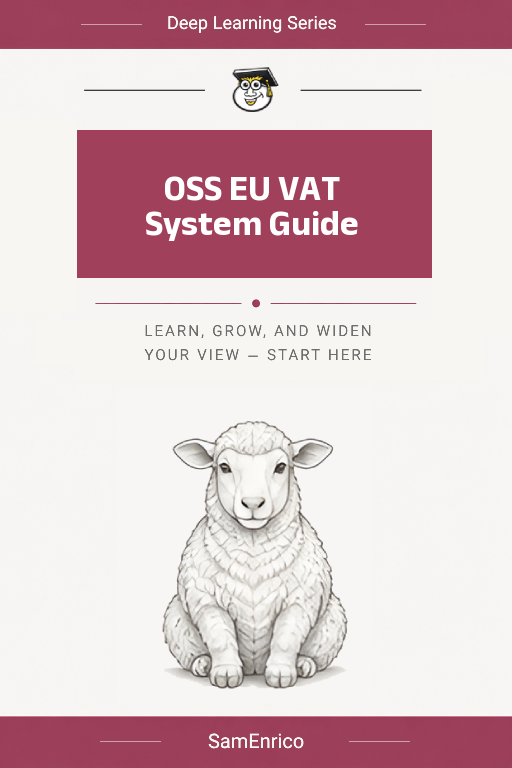
Non-FictionBusiness BriefTax Strategy
OSS EU VAT System Guide eBook
Use One Stop Shop (OSS) for EU cross-border VAT. S
by Queen Stacee
Use One Stop Shop (OSS) for EU cross-border VAT. Simplify registration and filing across member states.
Formats
Free sample
Chapter 1: The VAT Maze--–- Imagine waking up to find that you owe €47,000 in penalties, back taxes, and accounting fees—not because you tried to cheat the system, but because you tried to follow it. That is exactly what happened to Henrik, a Danish seller of organic baby clothing, in the spring of 2021. Henrik had done everything right. He registered for VAT in Germany when his sales passed €35,000. He registered in France at €100,000.
He registered in Italy at €35,000, in Spain at €35,000, and in the Netherlands at €100,000. By the time his small business was generating €600,000 annually, he had five separate VAT registrations, five different filing deadlines, five different languages to navigate, and a monthly ritual of panic that his accountant charged €400 per hour to manage. Then came the audit. A German tax inspector questioned whether Henrik's warehouse in Denmark counted as "establishment" for threshold purposes. A French inspector demanded proof of every delivery address for the past four years.
Henrik's accountant discovered that he had missed a deadline in Italy by three days—a €2,000 fine that had accrued interest to €5,800. The total bill: €47,000. Henrik's story is not unusual. It is the reason the One Stop Shop exists. And it is the reason you are holding this book.The Nightmare Before OSSBefore July 1, 2021, selling goods or digital services to consumers across EU borders was logistically insane.
Not complicated. Not challenging. Insane. The European Union had spent decades building a single market where goods, people, and capital could move freely—but VAT remained stubbornly national. Each member state set its own rules, its own rates, its own deadlines, and its own enforcement mechanisms.
For a business selling to consumers in multiple EU countries, this meant playing a game where the rules changed every time you crossed a border.The Distance Selling Thresholds The core mechanism of the old system was the "distance selling threshold." Each member state set a limit on how much a foreign seller could sell to consumers in that country before being required to register for VAT locally. These thresholds were wildly inconsistent. Germany set its threshold at €35,000. France and the Netherlands set theirs at €100,000. Italy used €35,000.
Spain used €35,000. Poland used €35,000 but with different reporting requirements. The United Kingdom, before Brexit, used £70,000—which converted to an unpredictable euro amount. A seller based in Sweden selling to German consumers could send €34,999 worth of goods without registering in Germany. The €35,001st sale triggered a registration requirement, a local VAT number, a German tax return, and all the compliance obligations that came with it.The problem was not just the thresholds themselves.
It was the monitoring. A business had to track its sales to each EU country in real time, calculate running totals, and register the moment any threshold was crossed. Miss the trigger by one day, and you faced penalties for late registration. Register too early, and you wasted administrative effort. And because thresholds reset annually, the game started over every January.Twenty-Seven Registrations, Twenty-Seven Nightmares In theory, a business could register for VAT in all 27 member states.
In practice, this was almost impossible for small and medium enterprises. Each registration required submitting forms in the local language, often through portals that assumed you had a local address and bank account. Many countries required a "fiscal representative"—a local business that accepted joint liability for your VAT debt—which cost thousands of euros per year per country. Some countries, like Italy, required a physical address for service of legal documents. Others, like Germany, required a specific format for invoices that differed from French requirements.The filing calendars were equally chaotic.
Germany required monthly returns for the first year of registration, then quarterly. France required quarterly returns but with a different cutoff date. Italy required monthly returns for some businesses and quarterly for others. Spain required returns within 20 days of the end of the quarter, while Germany allowed 25 days. Missing a deadline meant fines, interest, and in some cases, expulsion from the simplified filing scheme, forcing you into even more onerous monthly filings.The result was a system that actively discouraged cross-border trade.
Small businesses capped their sales to avoid triggering new registrations. Medium businesses hired expensive compliance staff or outsourced to accounting firms that charged premiums for multi-country work. Large businesses survived, but only because they could afford the tax departments required to manage 27 different VAT regimes. The European Commission estimated that cross-border e-commerce was 60 percent smaller than it would have been in a truly unified market. The VAT maze was costing the EU economy billions in lost growth.The Digital Services Loophole That Changed Everything While goods sellers suffered under the distance selling regime, digital services sellers faced an even stranger problem.
Before 2015, digital services—streaming, software downloads, e-books, online courses—were technically covered by the same distance selling rules. But digital services have no physical delivery address. How do you determine where a customer is located for a software download? The answer was a patchwork of "customer location" rules that varied by country. Some used IP address.
Some used bank account location. Some used the address the customer provided at checkout, with no verification.The European Commission recognized that digital services were exploding in volume and that the old rules were unworkable. In 2015, they introduced the Mini One Stop Shop (MOSS) specifically for digital, telecommunications, and broadcasting services. MOSS allowed a seller to register for VAT in a single EU country and report all cross-border B2C digital service sales on one return. The destination VAT rate still applied—you charged the customer's country rate—but you paid it to your home country, which distributed it to the other member states.MOSS was a revelation.
For the first time, a simplification scheme actually simplified things. Digital sellers who had been struggling with multiple registrations could now file one quarterly return. The system worked so well that the European Commission decided to expand it. The 2017 e-commerce VAT package, which took effect on July 1, 2021, replaced MOSS with the One Stop Shop (OSS) and extended it to cover goods. The distance selling thresholds were abolished for cross-border B2C sales within the EU.
Instead of tracking 27 different limits, a seller could use OSS for all cross-border sales, regardless of volume.The Birth of the One Stop Shop The One Stop Shop is not a physical place. It is a digital portal system that allows a business to register for VAT in one EU member state (the "member state of identification") and report all cross-border B2C sales to consumers in other member states on a single quarterly return. The business charges the VAT rate of the customer's country, collects the VAT, and then pays it through the OSS return. The member state of identification then distributes the VAT to the other 26 countries automatically.The benefits are enormous. A single registration replaces up to 27 local registrations.
One quarterly return replaces up to 27 returns with different formats and deadlines. One set of record-keeping rules applies to all transactions. The administrative burden of cross-border e-commerce dropped by an estimated 80 percent for businesses that adopted OSS in the first year.But—and this is a critical but—OSS is not automatic. You must register. You must understand the…
This is the end of the free sample. Get the eBook to keep going. Buy now
About this book
Details
- Author
- Queen Stacee
- Publisher
- SamEnrico
- Language
- English
- Genre
- Non-Fiction, Business Brief, Tax Strategy
- Released
- 2026-06-01
- Pages (approx.)
- 149
- Available as
- eBook, Audiobook

Read better in the ZLOADR app
Your eBooks on your phone or tablet. Sign in with your SamEnrico account and start reading.
More by Queen Stacee
 Mindful Walking For CreativityQueen Stacee$11.99
 International Franchise Currency HedgingQueen Stacee$11.99
 Sleepon Ring GuideQueen Stacee$11.99
 ABCDE Goal Setting IntegrationQueen Stacee$11.99
 The Black Dahlia Medical Examiner ReportsQueen Stacee$11.99
 Quetzalcoatl’s Feathered Serpent: The Fifth Sun’s AwakeningQueen Stacee$11.99
 Understanding Rheumatoid VasculitisQueen Stacee$17.99
 Marketing and Sales CoordinatorQueen Stacee$11.99
 Study in Rwanda Excellence GuideQueen Stacee$12.99
 How to Become a DumperQueen Stacee$11.99
You may also like
 Hong Kong Handover 1997Dunn Johnnie$11.99
 Zumba For Postnatal Recovery CourseNeal Christian$11.99
 Zumba for BeginnersLadner Nikia$11.99
 YouTube Comment Mining GuideHumes Pandora$12.99
 Worry Box MeditationCarlin Rudy$11.99
 Workplace Stress MeditationNguyen Lynn$11.99
 Workplace Stress and Sleep RepairHawley Ivory$11.99
 Workplace Perfectionism CureDelaney Jeffry$11.99
 Workplace Injustice Anger GuideWallen Isabelle$11.99
 Work Addiction and Burnout LinkGreenwood Ester$11.99
 Women in Yoga and WellnessBeattie Galina$11.99
 Women in Stand Up ComedyChun Evangeline$11.99