
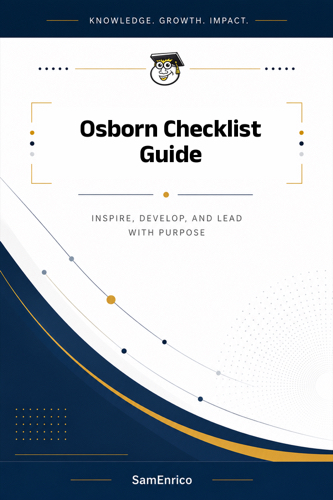
Non-FictionSelf-HelpClassic Methods
Osborn Checklist Guide eBook
Apply Alex Osborn s original question checklist fo
Apply Alex Osborn s original question checklist for idea generation.
Formats
Free sample
Chapter 1: The Creativity Lie--–- Every year, millions of professionals sit through meetings that waste billions of dollars. They gather in sterile conference rooms with whiteboards and markers. A manager says, "Let's brainstorm." People stare at the floor. Someone offers a safe, predictable idea. Someone else builds on it slightly.
Within twenty minutes, the group has produced exactly what they walked in with: the obvious solutions, dressed in slightly different words. Then they go back to their desks, believing they are simply "not the creative type."This belief is a lie. And it is the most expensive lie in business today.The truth, which this entire book will prove chapter by chapter, is that creativity is not a personality trait. It is not a mystical gift bestowed upon a lucky few. It is not correlated with IQ, education, or artistic talent.
Creativity is a process. More specifically, creativity is a sequence of questions that force your brain to look where it normally refuses to look.The man who discovered this sequence was not a psychologist or a neuroscientist. He was an advertising executive who was terrible at his job—until he stopped waiting for inspiration and started building a machine for it.The Frustrated Ad Man Who Changed the World Alex Osborn joined the advertising firm BBDO in the 1930s, and by every conventional measure, he should have failed. He was not a naturally gifted writer. He struggled to generate catchy slogans.
His early campaigns were forgettable. But Osborn noticed something that his more talented colleagues missed: the teams that produced the best ideas were not the teams with the most brilliant individuals. They were the teams that followed a hidden structure.In 1938, Osborn was desperate. A client needed a new campaign, and his team had spent three days producing nothing but tired variations of old ideas. On the fourth day, Osborn tried something radical.
He told his team, "For the next hour, no one is allowed to criticize anything. Every idea, no matter how ridiculous, gets written down. And we don't stop until we have at least fifty ideas."The team thought he had lost his mind. But they played along. For the first ten minutes, the ideas were terrible—the kind of suggestions you would expect from people who had been told to say anything.
Then something shifted. Around idea number twenty, the obvious answers were exhausted. Around idea number thirty, people started making strange connections. Around idea number forty, someone said something that made the whole room go quiet.That idea became the campaign. It ran for seven years and doubled the client's sales.Osborn spent the next fifteen years obsessively studying what had happened in that room.
He ran hundreds of experiments with thousands of participants. He documented which conditions produced more ideas and which conditions killed creativity. In 1953, he published his findings in a book titled Applied Imagination. The book introduced two concepts that would fundamentally change how we think about creative work: brainstorming and the creative checklist.The 73 Questions That Became a Revolution Most people who have heard of Alex Osborn know him as the inventor of brainstorming. But Osborn himself considered brainstorming a distant second to his true breakthrough.
That breakthrough was a list of questions.Osborn analyzed thousands of successful inventions, advertisements, and solutions. He asked: What did the creators actually do when they had their best ideas? He found patterns. Again and again, creative breakthroughs came from asking the same small set of questions. Osborn identified seventy-three such questions in his original research—a comprehensive but overwhelming toolkit.He then did something brilliant.
He realized that no one would actually use a seventy-three-question checklist. So he distilled his list down to nine core verbs. He instructed his teams to ignore the long list and instead ask: Put to other uses? Adapt? Modify?
Magnify? Minify? Substitute? Rearrange? Reverse?
Combine?These nine questions, Osborn discovered, could unlock in twenty minutes what might otherwise take weeks of trial and error.The checklist worked because it attacked the fundamental limitation of the human brain: our inability to see what is right in front of us.Why Your Brain Refuses to Be Creative Neuroscientists have known for decades that the brain is a pattern-matching machine. It evolved to recognize threats and opportunities quickly, not to generate novel possibilities. When you see a chair, your brain does not ask, "What else could this be used for?" It labels the object "chair" and moves on. This efficiency is why you can walk through the world without analyzing every object you encounter. It is also why you cannot simply "try harder" to be creative.The technical term for this is functional fixedness.
It is the cognitive bias that limits a person to using an object only in the way it is traditionally used. In one famous experiment, psychologists gave participants a candle, a box of thumbtacks, and a book of matches. They were asked to attach the candle to the wall so that it would not drip wax on the table below. Most participants could not solve the problem because they saw the thumbtack box only as a container for thumbtacks. The solution required emptying the box, tacking it to the wall, and using it as a platform for the candle.
Only participants who were prompted to "think about the box differently" solved the problem easily.Osborn's checklist is that prompt. Each question forces your brain to break its automatic labeling and consider new possibilities. "Put to other uses?" forces you to ask what else the thumbtack box could be. "Combine?" forces you to ask what happens when you merge the box with something else. The checklist does not make you smarter.
It makes your brain look where it normally refuses to look.The Science of Deliberate Creativity For decades, psychologists dismissed Osborn's work as pop psychology. Then the research caught up. In the 1990s, a series of studies tested whether structured checklists actually improved creative output. The results were unambiguous.In one landmark study, researchers gave two groups the same creative problem. One group was told to "brainstorm" without any structure.
The other group was given a checklist similar to Osborn's and instructed to apply each question systematically. The checklist group generated twice as many ideas, and independent judges rated their best ideas as significantly more original and useful.A 2011 meta-analysis reviewed over seventy studies on structured creativity techniques. The conclusion: any structured method outperforms unstructured brainstorming. But the most effective methods share a common feature—they ask specific, verb-driven questions that force cognitive reorganization. Osborn's checklist, in its various forms, remains one of the most studied and validated creativity tools in existence.More recent research in neuroscience has revealed why the checklist works at the neural level.
Functional MRI studies show that when people are asked to generate ideas without structure, the brain's default mode network activates—the same network associated with mind-wandering and daydreaming. This network produces ideas, but they tend to be associative and familiar, drawing on recent experiences.When people apply a structured checklist, a different network activates: the executive control network, which is associated with deliberate problem-solving and cognitive flexibility. This network can override automatic…
This is the end of the free sample. Get the eBook to keep going. Buy now
About this book
Details
- Author
- Purnell Pearlie
- Publisher
- SamEnrico
- Language
- English
- Genre
- Non-Fiction, Self-Help, Classic Methods
- Released
- 2026-06-06
- Pages (approx.)
- 152
- Available as
- eBook, Audiobook

Read better in the ZLOADR app
Your eBooks on your phone or tablet. Sign in with your SamEnrico account and start reading.
More by Purnell Pearlie
 Dream Journaling for ScientistsPurnell Pearlie$11.99
 De escalate Angry Parent GuidePurnell Pearlie$11.99
 Hinton Meeting His HeroesPurnell Pearlie$11.99
 Sepoy Grievances ListPurnell Pearlie$11.99
 Medical Procedure Dream PrepPurnell Pearlie$11.99
 British Army Imperial PolicingPurnell Pearlie$11.99
 Procrastination and Imposter SyndromePurnell Pearlie$11.99
 Guernica: The Sky That BurnedPurnell Pearlie$11.99
 Nefertiti's Veil: The Lost Pharaoh's SecretPurnell Pearlie$11.99
 Grape: Table Grape HarvestingPurnell Pearlie$11.99
 Transition Overload Reset WorkbookPurnell Pearlie$12.99
 Grant Writing Acronyms GlossaryPurnell Pearlie$12.99
You may also like
 Hong Kong Handover 1997Dunn Johnnie$11.99
 Zumba For Postnatal Recovery CourseNeal Christian$11.99
 Zumba for BeginnersLadner Nikia$11.99
 YouTube Comment Mining GuideHumes Pandora$12.99
 Worry Box MeditationCarlin Rudy$11.99
 Workplace Stress MeditationNguyen Lynn$11.99
 Workplace Stress and Sleep RepairHawley Ivory$11.99
 Workplace Perfectionism CureDelaney Jeffry$11.99
 Workplace Injustice Anger GuideWallen Isabelle$11.99
 Work Addiction and Burnout LinkGreenwood Ester$11.99
 Women in Yoga and WellnessBeattie Galina$11.99
 Women in Stand Up ComedyChun Evangeline$11.99