
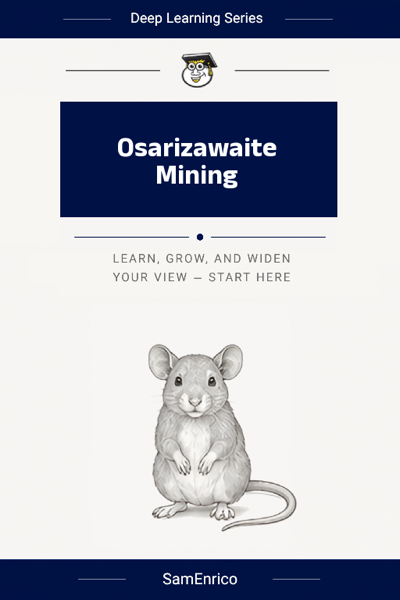
Non-FictionInformativeEducational
Osarizawaite Mining eBook
A Coursebook on Osarizawaite Mining
A Coursebook on Osarizawaite Mining
Formats
Free sample
Chapter 1: The Green Enigma--In the autumn of 1961, a Japanese mineralogist named Matsuo Nambu scraped a dull green crust off a fractured rock face deep within the Osarizawa mine in Akita Prefecture. The specimen was unremarkable to the naked eye—just another oxidized coating in a mine famous for its complex copper-lead-zinc ores. Nambu almost discarded it. But something held him back. Under magnification, the green crust revealed itself not as common malachite or brochantite, but as something the world had never seen.
Within months, X-ray diffraction confirmed the impossible: a new mineral species, one that should have been discovered decades earlier, had been hiding in plain sight. That green crust was osarizawaite, and its story begins not with a eureka moment, but with a quiet scrape that would eventually open a window into one of mining's most overlooked opportunities.For the better part of a century, the global mining industry has chased the easy metals—chalcopyrite, galena, sphalerite—leaving behind the complex, the weathered, and the misunderstood. Osarizawaite, a lead-aluminum-copper sulfate hydroxide belonging to the alunite supergroup, sits squarely in that overlooked category. It is not a primary ore mineral in the traditional sense. It does not form in thick, continuous veins or massive sulfide lenses.
Instead, it precipitates slowly, grain by grain, in the acidic, oxygen-rich environments where pyrite has rotted and aluminum-rich gangue has dissolved. It is a secondary mineral, a child of supergene alteration, and for generations, metallurgists considered it a nuisance—a source of copper that resisted conventional flotation and a source of aluminum that complicated smelting.But the world has changed. Copper prices have climbed. Critical minerals have become geopolitical chess pieces. And the abandoned mines of the American West, the Atacama Desert, and the Australian outback—the very places where supergene alteration produces minerals like osarizawaite—have suddenly become attractive again.
The green crust that Nambu scraped in 1961 now represents not just a mineralogical curiosity, but a potential resource. Understanding osarizawaite is no longer an academic exercise. It is a practical requirement for any geologist or mining engineer working in oxidized base-metal deposits.This chapter introduces osarizawaite on its own terms: its chemistry, its crystal structure, its physical properties, and its global distribution. By the end, you will be able to identify osarizawaite in hand sample, distinguish it from its look-alikes, and understand where on Earth it occurs. More importantly, you will understand why this obscure mineral matters now, six decades after its discovery.The Chemical Identity of Osarizawaite Osarizawaite belongs to the alunite supergroup, a family of minerals sharing the general formula AB₃(SO₄)₂(OH)₆.
In this structure, the A site typically accommodates a monovalent or divalent cation—potassium in jarosite, lead in osarizawaite and beaverite. The B site hosts trivalent cations, most commonly aluminum or iron, in octahedral coordination with oxygen atoms from both hydroxyl groups and sulfate tetrahedra. The sulfate groups sit between the B-site octahedra, bridging the structure into a framework that resembles stacked sheets.The specific formula of osarizawaite is Pb(Al,Cu)₃(SO₄)₂(OH)₆. This notation indicates that the A site is occupied almost entirely by lead (Pb²⁺), while the B site contains a mixture of aluminum (Al³⁺) and copper (Cu²⁺) substituting for one another. The comma between Al and Cu signifies that these two cations can replace each other in variable proportions, a phenomenon known as solid solution.The Al:Cu ratio in natural osarizawaite specimens varies considerably depending on the geochemical environment of formation.
In general, aluminum dominates, with typical Al:Cu ratios ranging from 2:1 to 5:1. Copper-poor varieties—with Al:Cu exceeding 10:1—occur where the oxidizing solutions were relatively depleted in copper, while copper-rich specimens approach the theoretical endmember composition where aluminum and copper share the B site equally. No natural specimen has ever achieved pure copper endmember composition; the crystal structure appears to require a minimum of approximately 20% aluminum to maintain stability.The presence of copper in the B site distinguishes osarizawaite from most other alunite-group minerals. It also explains the mineral's diagnostic green color—copper ions in octahedral coordination produce characteristic absorption bands in the visible spectrum. The specific shade, ranging from yellow-green to olive-green, depends on the Al:Cu ratio and the presence of minor iron impurities.
Fresh surfaces exhibit the most intense coloration; weathered surfaces may appear dull green or even brownish as surface oxidation alters the copper coordination environment.The Alunite Supergroup Family Tree Understanding osarizawaite requires situating it within its mineralogical family. The alunite supergroup comprises more than forty minerals sharing the same basic structure but differing in their A-site and B-site cations. The most common members include:Jarosite (KFe₃(SO₄)₂(OH)₆): The potassium-iron endmember, ubiquitous in acid mine drainage environments and oxidized sulfide deposits worldwide.Alunite (KAl₃(SO₄)₂(OH)₆): The potassium-aluminum endmember, common in hydrothermal alteration zones associated with porphyry copper deposits.Beaverite (Pb(Fe,Cu)₃(SO₄)₂(OH)₆): The lead-iron-copper endmember and the closest relative to osarizawaite.The relationship between osarizawaite and beaverite is particularly instructive. Both minerals share the same lead-dominated A site. Both accommodate copper in the B site.
The critical difference lies in the dominant B-site cation: aluminum in osarizawaite, iron in beaverite. This Al-Fe substitution is continuous, meaning that intermediate compositions exist where aluminum and iron share the B site in roughly equal proportions. These intermediate phases are sometimes termed "alumino-beaverite" or "ferroan osarizawaite," though the International Mineralogical Association (IMA) has not formally recognized them as distinct species.The practical implication for mineral identification is straightforward: any lead-copper sulfate hydroxide in the alunite supergroup must be tested for its Al:Fe ratio to determine whether it is osarizawaite (Al-dominant), beaverite (Fe-dominant), or an intermediate. This determination cannot be made by visual inspection alone. As Chapter 4 will detail, X-ray diffraction provides the definitive diagnostic through analysis of the c/a lattice parameter ratio.Structural Crystallography At the atomic scale, osarizawaite adopts a rhombohedral crystal system with space group R\bar{3}m, the same space group as jarosite and beaverite.
The unit cell parameters for aluminum-dominant compositions are approximately a = 7.22 Å and c = 17.11 Å at standard temperature and pressure. As iron substitutes for aluminum, both lattice parameters increase because the iron ion is slightly larger than aluminum. This expansion forms the basis for the c/a ratio discrimination method mentioned above: osarizawaite (Al-dominant) exhibits c/a > 2.95, while beaverite (Fe-dominant) exhibits c/a < 2.93.The crystal structure can be visualized as sheets of corner-sharing B-site octahedra [B(OH)₆] connected by sulfate tetrahedra (SO₄). The A-site cations occupy large cavities between these sheets, coordinated by twelve oxygen atoms from the sulfate groups. This layered architecture explains several of the mineral's physical properties.
The imperfect cleavage on {0001} occurs along the planes between sheets, where the bonding is weakest. The low hardness (3-4 Mohs) reflects the ease with which this sheet structure can be disrupted by mechanical stress.Physical Properties for Identification For field geologists and exploration teams, the ability to identify osarizawaite quickly and reliably is essential. The following properties should be memorized and applied systematically.Color and Streak The most distinctive property of fresh osarizawaite is its color. Yellow-green to olive-green specimens are strongly suggestive of the mineral, particularly when the green hue has a yellowish cast rather than the blue-green of malachite…
This is the end of the free sample. Get the eBook to keep going. Buy now
About this book
Details
- Author
- Mcfall Alishia
- Publisher
- SamEnrico
- Language
- English
- Genre
- Non-Fiction, Informative, Educational
- Released
- 2026-05-04
- Pages (approx.)
- 151
- Available as
- eBook, Audiobook

Read better in the ZLOADR app
Your eBooks on your phone or tablet. Sign in with your SamEnrico account and start reading.
More by Mcfall Alishia
 Reddit Compulsive Check WorkbookMcfall Alishia$11.99
 Parent Teen Anger GuideMcfall Alishia$11.99
 Incubation Period MethodMcfall Alishia$11.99
 Senior Balance and Fall PreventionMcfall Alishia$11.99
 Smoking Relapse Prevention CourseMcfall Alishia$11.99
 The Bitcoin Laundromat: How a Tech Startup Became a Money Mule EmpireMcfall Alishia$11.99
 Seeds of the Sky: The Forgotten Farmers of the AndesMcfall Alishia$11.99
 Student Discounts Europe GuideMcfall Alishia$12.99
 Oman B2B Sales GuideMcfall Alishia$12.99
 Understanding CarcinophobiaMcfall Alishia$17.99
 How to Start a Hobby in MetrophileMcfall Alishia$11.99
You may also like
 Hong Kong Handover 1997Dunn Johnnie$11.99
 Zumba For Postnatal Recovery CourseNeal Christian$11.99
 Zumba for BeginnersLadner Nikia$11.99
 YouTube Comment Mining GuideHumes Pandora$12.99
 Worry Box MeditationCarlin Rudy$11.99
 Workplace Stress MeditationNguyen Lynn$11.99
 Workplace Stress and Sleep RepairHawley Ivory$11.99
 Workplace Perfectionism CureDelaney Jeffry$11.99
 Workplace Injustice Anger GuideWallen Isabelle$11.99
 Work Addiction and Burnout LinkGreenwood Ester$11.99
 Women in Yoga and WellnessBeattie Galina$11.99
 Women in Stand Up ComedyChun Evangeline$11.99