
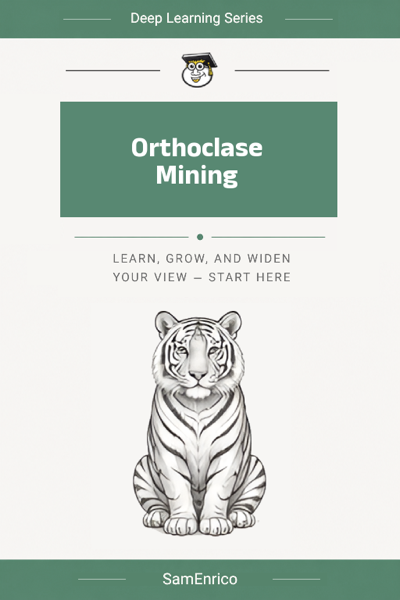
Non-FictionInformativeEducational
Orthoclase Mining eBook
A Coursebook on Orthoclase Mining
A Coursebook on Orthoclase Mining
Formats
Free sample
Chapter 1: The Pink Mineral--–- The cargo ship MV Emerald Sea had been waiting off the coast of Savannah for eleven days. Below deck, 8,000 tons of orthoclase—mined in Turkey, processed in Italy, and destined for a ceramic tile factory in Tennessee—sat in sealed containers, growing no more valuable with each hour of demurrage. The ship’s captain, a weathered Greek named Nikos, had stopped apologizing to the buyers. He simply sent daily updates: “Still waiting. Port congestion.
No berth.”Three hundred miles inland, the plant manager at American Standard Ceramics watched his orthoclase bin drop to fourteen percent. At ten percent, the kiln would slow. At five percent, it would stop. At zero, seventy-two thousand tiles per day would become zero tiles per day. The plant employed 340 people.
The town was called Tullahoma, and the orthoclase in that ship was the only orthoclase within a thousand miles that met their spec: K₂O above twelve percent, Fe₂O₃ below one-tenth of one percent, and that particular salmon-pink color that told the quality control lab the material came from the right pegmatite.No one in Tullahoma had ever heard of orthoclase. They called it “feldspar” when they called it anything at all. But they were about to learn.This is the story of the most important industrial mineral you have never heard of. It is the hidden ingredient in every smartphone screen, every wine bottle, every bathtub, every spark plug, and every ceramic tile on six continents. It is a mineral that has been mined for ten thousand years—first for pottery, then for porcelain, then for glass, now for the digital world—yet it has no lobbyists in Washington, no ETFs on Wall Street, and no documentaries on Netflix.By the time you finish this book, you will see it everywhere.
And you will understand why the ship outside Savannah mattered more than anyone realized.The Mineral That Built the Modern World Orthoclase (KAl Si₃O₈) is a framework silicate, which is a fancy way of saying its atoms are arranged in a three-dimensional cage of silicon, aluminum, and oxygen. Inside that cage sits a potassium ion, held loosely enough that it can wander out when heated—which is precisely why orthoclase is valuable. That wandering potassium acts as a flux, a chemical lubricant that makes things melt at lower temperatures.Without orthoclase, glass would require temperatures above 1700°C (3100°F) to melt silica sand into a workable liquid. With orthoclase, the melting point drops to 1500°C (2700°F)—a difference of 200 degrees that saves billions of dollars in energy every year. Without orthoclase, ceramic tiles would crack during firing because the clay body would shrink unevenly.
With orthoclase, the mineral melts into a glass phase that flows between the clay particles, gluing everything together as it cools.This is not glamorous work. Orthoclase does not glitter. It does not conduct electricity. It does not catalyze chemical reactions. It sits quietly in the recipe, doing its job without complaint, and then disappears into the product.
You have never seen pure orthoclase. But you have seen what it makes possible.The name itself tells a story. “Orthoclase” comes from the Greek orthos (straight) and klasis (breaking), a reference to its perfect cleavage in two directions at right angles. Break a piece of orthoclase with a hammer, and it splits along flat, shiny surfaces like a miniature stairway. This property is a blessing and a curse: it makes the mineral easy to crush, but it also means that rough handling produces too many fine particles, which are worth less money.In the field, you identify orthoclase by several clues.
First, the color. Pure orthoclase is white—not gray, not beige, but a clean, chalky white. Most orthoclase, however, is salmon-pink. The pink comes from microscopic specks of hematite (iron oxide) trapped inside the crystal as it grew. A pink orthoclase is not inferior; it simply contains iron, which will need to be removed later if the buyer demands white glass or white ceramic.Second, the hardness.
Orthoclase sits at 6 on the Mohs scale, which means a steel knife blade will scratch it (steel is about 5.5) but a copper penny will not (copper is 3). This hardness is important because orthoclase must survive crushing and grinding without turning entirely to dust—a balance that requires careful engineering, as we will see in Chapter 7.Third, the cleavage. Those two right-angle planes are diagnostic. When you hold a piece of orthoclase up to the light and rotate it, the cleavage surfaces flash like mirrors. No other common mineral combines pink color, 6 hardness, and perfect right-angle cleavage in quite the same way.Fourth, the specific gravity.
Orthoclase weighs about 2.55 to 2.63 grams per cubic centimeter, which is lighter than steel (7.8) but heavier than most plastics. In your hand, it feels like a dense rock—not heavy like lead, but solid.These properties are not academic trivia. They determine every decision in the mining and processing chain. A geologist who cannot distinguish orthoclase from plagioclase (which has grooved striations on its cleavage surfaces) will misidentify ore bodies and waste millions. A plant manager who does not understand cleavage will design a crushing circuit that produces too many fines and loses revenue.
A quality control technician who ignores color will ship iron-contaminated material to a glass factory, which will reject the entire container and demand compensation.This is a coursebook, not a mineralogy text. We will not spend pages on crystal lattice parameters or optical properties under cross-polarized light. But we will spend exactly as much time on identification as you need to avoid costly mistakes. If you remember nothing else from this chapter, remember this: orthoclase is the white-to-pink feldspar with the two perfect cleavages, the steel-scratch hardness, and the potassium that melts the world.The Feldspar Family: Distinguishing Orthoclase from Its Relatives Orthoclase belongs to the feldspar group, which is the most abundant mineral family in the Earth’s crust—accounting for nearly sixty percent of all rocks. If you pick up a random piece of granite, you are almost certainly holding feldspar.
But which feldspar? The answer matters.Feldspars divide into two subgroups: the potassium feldspars (K-feldspars) and the plagioclase feldspars. Orthoclase is a K-feldspar. Its chemical formula is KAl Si₃O₈, with potassium as the dominant cation. Microcline is also a K-feldspar, with the exact same chemical formula but a different crystal structure—microcline is triclinic (meaning its crystal axes are not perpendicular), while orthoclase is monoclinic (two axes perpendicular, one oblique).
In hand sample, you cannot see the difference without a microscope. Microcline displays a distinctive “tartan twinning” pattern under cross-polarized light, while orthoclase shows simple twinning or none at all. For mining purposes, the distinction rarely matters; both are sold as “potash feldspar” if the K₂O grade is high enough.The plagioclase feldspars are a solid solution between albite (Na Al Si₃O₈, sodium) and anorthite (Ca Al₂Si₂O₈, calcium). Plagioclase is important because it looks similar to orthoclase—white to gray, similar hardness, similar cleavage—but it has a diagnostic feature: fine parallel grooves called striations on its cleavage surfaces. If you see striations under a hand lens, you are looking at plagioclase.…
This is the end of the free sample. Get the eBook to keep going. Buy now
About this book
Details
- Author
- Dickey Sierra
- Publisher
- SamEnrico
- Language
- English
- Genre
- Non-Fiction, Informative, Educational
- Released
- 2026-06-02
- Pages (approx.)
- 145
- Available as
- eBook, Audiobook

Read better in the ZLOADR app
Your eBooks on your phone or tablet. Sign in with your SamEnrico account and start reading.
More by Dickey Sierra
 Artist Creative Sleep GuideDickey Sierra$11.99
 Elevator Conversation Scripts CourseDickey Sierra$11.99
 Meditation For Overthinkers GuideDickey Sierra$11.99
 Parent Death and Substance AbuseDickey Sierra$11.99
 Implementation Intentions DietDickey Sierra$11.99
 Silent Echoes: The Lost Broadcasts of the TitanicDickey Sierra$11.99
 The Crown and the Code: How a Teenage Queen Hacked the MonarchyDickey Sierra$11.99
 Health Grant Writing GuideDickey Sierra$12.99
 One Page Content Calendar WorkbookDickey Sierra$12.99
 Understanding Glycogenosis Type IiDickey Sierra$17.99
 How to Start a Cellulose Paint Business (Beginners Guide)Dickey Sierra$11.99
You may also like
 Hong Kong Handover 1997Dunn Johnnie$11.99
 Zumba For Postnatal Recovery CourseNeal Christian$11.99
 Zumba for BeginnersLadner Nikia$11.99
 YouTube Comment Mining GuideHumes Pandora$12.99
 Worry Box MeditationCarlin Rudy$11.99
 Workplace Stress MeditationNguyen Lynn$11.99
 Workplace Stress and Sleep RepairHawley Ivory$11.99
 Workplace Perfectionism CureDelaney Jeffry$11.99
 Workplace Injustice Anger GuideWallen Isabelle$11.99
 Work Addiction and Burnout LinkGreenwood Ester$11.99
 Women in Yoga and WellnessBeattie Galina$11.99
 Women in Stand Up ComedyChun Evangeline$11.99