
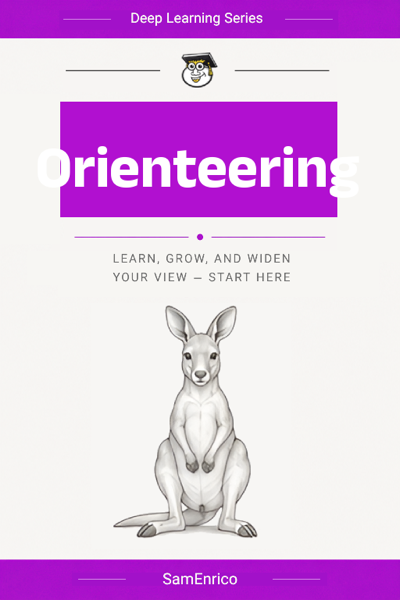
Orienteering eBook
A Coursebook on Orienteering
A Coursebook on Orienteering
Formats
Free sample
Chapter 1: The Ten-Minute Mistake...--–- The first time I got lost, I was standing on a marked trail with a map in my hands and absolutely no idea where I was. It took me ten minutes to walk three hundred meters back to a road I had passed twenty minutes earlier. Ten minutes does not sound like much, but in those ten minutes, I learned more about navigation than in the previous twenty years of my life.The trail was wide, well-trodden, and clearly marked on my map as a solid red line. Behind me, I could still hear the distant murmur of the car park where I had started. Ahead, the forest thickened into a cathedral of oak and beech, with shafts of afternoon light cutting through the canopy.
According to the map, the trail continued straight for another four hundred meters, crossed a small stream, then bent left toward a viewpoint. I had checked my compass at the last junction. I had set the map to north. I was doing everything right.Then the trail forked.The map showed no fork. It showed a single, unambiguous line.
Yet there before me were two paths, equally worn, diverging at a gentle angle. One climbed slightly to the right. One dropped gently to the left. Neither was marked on my map. I stopped, looked at the map, looked at the ground, looked back at the map.
I felt the first small crease of uncertainty, the kind that starts in your stomach and works upward. I chose the right-hand path because it seemed to head toward higher ground, and higher ground matched the contour lines I had vaguely registered.Three minutes later, the path narrowed. The tree cover thickened. The light dimmed. I stopped again, turned the map, tried to find a feature I recognized.
There was none. No stream, no distinct boulder, no change in vegetation that matched the map’s green density symbols. I had walked into a blank space on my mental model of the world. For the next ten minutes, I wandered in an uncomfortable loop, trying to force the terrain to fit the map instead of reading what was actually there. Eventually, I heard traffic.
I walked toward the sound, emerged onto a paved road, and recognized a bend I had driven past earlier. I was four hundred meters from where I had started, on the opposite side of the hill.What I did not know then—what this book will teach you—is that my ten-minute mistake was not a failure of equipment or intelligence. It was a failure of system. I had the right tools. I had a decent map and a functional compass.
What I lacked was a structured way to think about navigation. I did not know how to break a journey into manageable legs. I did not know how to identify the three or four critical features on a map that would keep me oriented. I did not know how to recognize the early signals of confusion before they became full disorientation. And I certainly did not know that the most important navigational skill is not reading a map or using a compass—it is knowing when to stop and reset.The Thinking Sport: Orienteering Defined Orienteering is often described as the “thinking sport,” and for good reason.
Unlike pure running, where the route is fixed and the only variable is speed, orienteering demands continuous decision-making under physical stress. You are not simply moving from A to B. You are solving a sequence of spatial problems while your heart rate is elevated, your breathing is heavy, and your attention is pulled between the map, the ground, and the clock.At its simplest, orienteering is the sport of navigating through unfamiliar terrain using a detailed map and a compass, visiting a series of control points in a specific order. The winner is the competitor who completes the course in the shortest time, but speed alone is never enough. A faster runner who takes a poor route or makes a navigational error will lose to a slower runner who reads the terrain more effectively.
This balance between physical exertion and mental precision is what makes orienteering unique among outdoor sports.But orienteering is not only a competitive activity. It is a life skill disguised as a sport. The ability to read a map, interpret the landscape, and maintain spatial awareness has kept hikers safe, saved lost hunters, and guided adventurers through remote wilderness. Every year, search and rescue teams are called out for people who became disoriented less than a mile from a trailhead—not because they lacked technology, but because they had never learned the fundamental principles of navigation. This book will teach you those principles, not as abstract theory but as a practical system you can apply anywhere, from a city park to a backcountry ridge.From Military Training to Global Sport The origins of modern orienteering lie in early twentieth-century Sweden.
In 1918, a Swedish military officer named Major Ernst Killander grew concerned that his troops lacked the ability to navigate efficiently across unfamiliar terrain. Traditional map reading was taught in classrooms, but Killander understood that navigation in the field—under fatigue, under time pressure, with the distraction of uneven ground and changing weather—required a different kind of training. He designed an exercise: soldiers would run cross-country, using a map and compass to find a series of checkpoints in sequence. The first documented orienteering competition was held in 1919 near Stockholm, and the sport spread rapidly through Scandinavia.By the 1930s, orienteering had become a popular recreational activity in Sweden, Norway, and Finland. The first national championships were held, and the sport began to attract civilian participants.
After World War II, orienteering expanded across Europe, then to North America, Australia, and Asia. The International Orienteering Federation (IOF) was founded in 1961, and the first World Championships were held in 1966. Today, orienteering is practiced in more than seventy countries, with hundreds of thousands of competitive participants and millions of recreational navigators.What accounts for this growth? Partly, it is the sport’s accessibility. You do not need expensive equipment or a specialized facility.
A map, a compass, and a patch of forest are sufficient. Partly, it is the intellectual challenge. Orienteering rewards cleverness as much as athleticism, making it appealing to people who might never consider traditional running or racing. But most of all, orienteering endures because it taps into something fundamental: the human desire to know where we are and to find our own way.Four Ways to Play: The Fields of Orienteering Orienteering is not a single activity but a family of related practices, each with its own emphasis and appeal. Understanding these different “fields of play” will help you decide how you want to engage with the sport, whether as a competitive racer, a weekend hiker, a teacher, or a parent.Competitive Orienteering Competitive orienteering is the sport’s most visible form, ranging from local club meets to the World Championships and the World Games.
Events are categorized by distance and technical difficulty. Sprint courses are short (2–4 kilometers) and fast, often held in urban parks or university campuses…
This is the end of the free sample. Get the eBook to keep going. Buy now
About this book
Details
- Author
- Agnew Lanette
- Publisher
- SamEnrico
- Language
- English
- Genre
- Non-Fiction, Informative, Educational
- Released
- 2026-05-07
- Pages (approx.)
- 133
- Available as
- eBook, Audiobook

Read better in the ZLOADR app
Your eBooks on your phone or tablet. Sign in with your SamEnrico account and start reading.
More by Agnew Lanette
 Gambling Addiction and Seasonal Affective DisorderAgnew Lanette$11.99
 WFH Team Time Zone CoordinationAgnew Lanette$11.99
 The Reality Check WorkbookAgnew Lanette$11.99
 Small Business Financial StressAgnew Lanette$11.99
 The Stone Pirates: Masters of the Gothic SkyAgnew Lanette$11.99
 How to Start a Boxes Made of Iron or Steel Business (Beginners Guide)Agnew Lanette$11.99
 Visuals in Technical Docs GuideAgnew Lanette$12.99
 Learn to Play the TheorboAgnew Lanette$11.99