

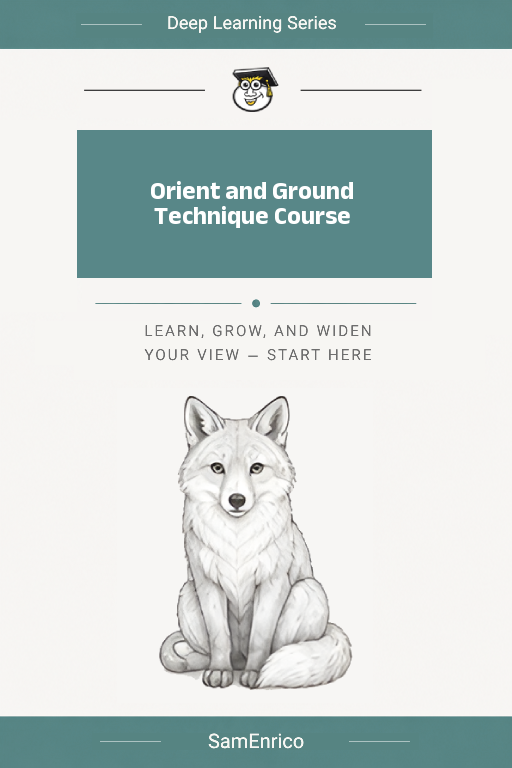
Non-FictionMental WealthGrounding Techniques
Orient and Ground Technique Course eBook
Use environmental orienting and feet grounding as
by Dion Marlin
Use environmental orienting and feet grounding as micro-breaks to exit dorsal shutdown or sympathetic hyperarousal.
Formats
Free sample
Chapter 1: The Autonomic Trap--–- Every morning at 7:23 a.m., the same thing happened. Your alarm would go off, and before you could even open your eyes, your heart would already be racing. Not from a nightmare. Not from caffeine. From nothing at all.
And yet, there it was—that familiar thudding in your chest, that tightness across your ribs, that sense that you had already failed the day before it had even begun.Some days, the opposite happened. You would wake up feeling nothing. Not peace—nothing. A heavy, gray blanket of numbness pressing you into the mattress. Your body felt like it weighed three hundred pounds.
Your mind felt like old television static. You knew you should get up, but your limbs wouldn't cooperate. Not because you were lazy. Because you were gone. And you didn't know how to come back.If either of these experiences sounds familiar, you have already taken the first step toward understanding why this book exists.
You have felt, in your own body, what happens when the nervous system gets stuck.Here is the truth that most self-help books will not tell you: you cannot think your way out of these states. You cannot positive-affirmation your way out of a panic attack. You cannot journal your way out of dorsal shutdown. When your nervous system has decided that you are in danger—or that you are already dead—your prefrontal cortex, the so-called "thinking brain," goes offline. It is not available to you.
And no amount of reasoning with yourself will bring it back online.What you can do, however, is speak directly to the brainstem. You can use your senses and your movements to send a different message. You can learn to reset your nervous system in sixty seconds or less. That is what this book teaches. But before we get to the how, you need to understand the what and the why.
You need to understand the trap.This chapter introduces two maps that will guide everything that follows: the Autonomic Ladder and the Window of Tolerance. These are not abstract theories. They are descriptions of your lived experience. By the end of this chapter, you will be able to name exactly where you are on the ladder at any given moment, and you will understand why traditional "calming down" techniques have failed you. More importantly, you will understand why the solution is not in your head—but in your feet and your eyes.The Three Rungs of the Autonomic Ladder Imagine a ladder with three rungs.
At the top rung is a state called Ventral Vagal. This is named after the ventral branch of the vagus nerve, one of the primary information highways between your brain and your body. When you are on the top rung, you feel safe, social, and connected. Your face is mobile and expressive. You can make eye contact without discomfort.
Your voice has natural rhythm and tone. You can listen to another person without planning your response. You can rest without guilt. You can play. You can be still without feeling trapped.
This is not a "perfect" state—it is simply the state in which your nervous system has decided that the world is safe enough for you to be a social mammal.The middle rung is the Sympathetic state. This is the fight-or-flight system. When you are on this rung, your body is mobilizing for action. Your heart rate increases. Your blood pressure rises.
Blood flows to your large muscle groups. Your pupils dilate. Your digestion slows or stops. Your breathing becomes shallow and fast. You feel anxious, agitated, irritable, or panicked.
You might feel rage. You might feel a sense of urgency without a clear target. You might feel "wired but tired"—exhausted but unable to sleep. This state is not bad. It is essential for survival when there is a real threat.
The problem arises when you live on this rung, when the sympathetic switch gets stuck in the "on" position.The bottom rung is the Dorsal Vagal state. This is the shutdown, collapse, dissociation system. When you are on this rung, your body is conserving energy for what it believes is the end. Your heart rate slows. Your blood pressure drops.
Your face goes blank. Your voice becomes flat or disappears. You feel numb, heavy, disconnected, or "spacy." You might feel like you are watching yourself from outside your body. You might feel like the world is not real. You might feel a crushing exhaustion that sleep does not fix.
You might feel nothing at all. Like the sympathetic state, this state is not bad—it is a survival response that makes sense when death is imminent. But when it becomes chronic, it is hell.Here is what most people do not understand: you cannot be on two rungs at the same time. Your nervous system is always on one rung, even if it switches rapidly between them. And when you are on the bottom two rungs—sympathetic or dorsal—your prefrontal cortex is partially or fully offline.
You cannot access your higher cognitive functions. You cannot reason with yourself. You cannot "just calm down."The Window of Tolerance: A Different Lens Now let us add a second map. The Window of Tolerance was originally developed by Dr. Dan Siegel, and it describes the range of arousal within which you can function effectively.
Think of it as a horizontal band. When you are inside your window, you can think clearly, regulate your emotions, connect with others, and respond to challenges rather than reacting to them. You might feel stressed, sad, or excited, but you are still in control of your actions.When you go above your window, you enter sympathetic hyperarousal. This is the fight-or-flight zone. You are too activated.
You might feel anxious, panicked, enraged, or overwhelmed. You cannot think clearly. You might pace, snap at people, or freeze with a racing heart.When you go below your window, you enter dorsal hypoarousal. This is the shutdown zone. You are too deactivated.
You might feel numb, collapsed, dissociated, or exhausted. You cannot think clearly. You might stare at the wall for hours, cancel all your plans, or feel like you are not really alive.Your window can be wide or narrow. Trauma, chronic stress, and certain personality factors can narrow your window dramatically, meaning you are easily pushed above or below. Healing is, in large part, the process of widening your window so that you can tolerate more arousal without losing function.The Critical Distinction: Alert Freeze vs.
True Dorsal Shutdown Here is where many books get it wrong. You have probably heard of the "freeze response." You have probably heard it described as a deer in headlights. The deer freezes when it sees the car. Then, if the car misses it, the deer runs away. That is not dorsal shutdown.
That is sympathetic arousal with motor inhibition. The deer's heart is racing. Its muscles are primed for action. It is not collapsed. It is waiting.True dorsal shutdown is different.
Imagine a possum. When a possum faces an inescapable threat, it does not freeze with a racing heart. It collapses.…
This is the end of the free sample. Get the eBook to keep going. Buy now
About this book
Details
- Author
- Dion Marlin
- Publisher
- SamEnrico
- Language
- English
- Genre
- Non-Fiction, Mental Wealth, Grounding Techniques
- Released
- 2026-05-29
- Pages (approx.)
- 141
- Available as
- eBook, Audiobook

Read better in the ZLOADR app
Your eBooks on your phone or tablet. Sign in with your SamEnrico account and start reading.
More by Dion Marlin
 The Reorder Point CalculatorDion Marlin$11.99
 British Empire In EgyptDion Marlin$11.99
 Oprah Hinton Interview ImpactDion Marlin$11.99
 Social Security Earnings RecordDion Marlin$11.99
 Cognitive Reframing For AngerDion Marlin$11.99
 Memory Palace For Multiplication TablesDion Marlin$11.99
 Overcoming Procrastination for StudentsDion Marlin$11.99
 Bullet Journal Dream LogDion Marlin$11.99
 The Cosmic Pioneer: How Yuri Gagarin Broke the SkyDion Marlin$11.99
 The Last Speakers of the Arctic: A Vanishing Language in a Warming WorldDion Marlin$11.99
 Mastering The Lower TrapeziusDion Marlin$11.99
 How to Produce PowderDion Marlin$11.99
You may also like
 Hong Kong Handover 1997Dunn Johnnie$11.99
 Zumba For Postnatal Recovery CourseNeal Christian$11.99
 Zumba for BeginnersLadner Nikia$11.99
 YouTube Comment Mining GuideHumes Pandora$12.99
 Worry Box MeditationCarlin Rudy$11.99
 Workplace Stress MeditationNguyen Lynn$11.99
 Workplace Stress and Sleep RepairHawley Ivory$11.99
 Workplace Perfectionism CureDelaney Jeffry$11.99
 Workplace Injustice Anger GuideWallen Isabelle$11.99
 Work Addiction and Burnout LinkGreenwood Ester$11.99
 Women in Yoga and WellnessBeattie Galina$11.99
 Women in Stand Up ComedyChun Evangeline$11.99