
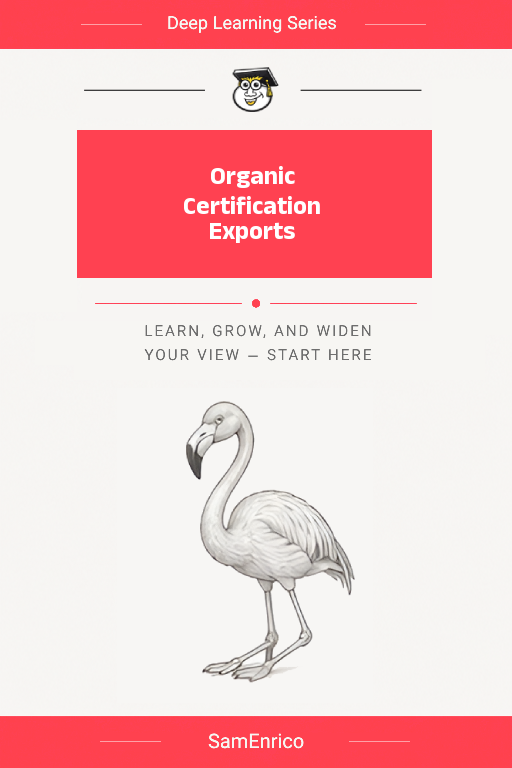
Non-FictionBusiness BriefOrganic
Organic Certification Exports eBook
Get USDA Organic or EU Organic certification for a
by Fair Dede
Get USDA Organic or EU Organic certification for agricultural products to export to North America and Europe.
Formats
Free sample
Chapter 1: The $80 Billion Gamble--–- The first time Maria saw the rejection letter, she thought it was a mistake. The second time, she thought it was a curse. The third time, she stopped thinking and started crying.Her container of organic snow peas—two thousand carefully hand-picked cartons, each bean inspected by her daughters, each box labeled with the USDA Organic seal she had paid $4,000 to obtain—sat at the Port of Long Beach, California, under a blistering January sun. The letter said: "Shipment rejected. Missing NOP Import Certificate.
Organic claim invalid."Maria had sold her family's second vehicle to afford the certification. She had taken a loan from her brother-in-law to cover the freight. She had promised her cooperative of forty-seven smallholder farmers in the highlands of Guatemala that this shipment would change everything: the premium price, the direct relationship with a US buyer, the end of exploitative middlemen.Instead, she was looking at $47,000 in losses. The snow peas would be sold at conventional prices—if anyone would buy them at all after three weeks on a dock. Her brother-in-law would ask about his money.
Her daughters would ask about school supplies. Her cooperative members would ask about their share of a profit that no longer existed.And here was the cruelest part: Juan, her neighbor twenty kilometers down the mountain, had shipped the exact same snow peas—same variety, same soil, same harvest week, same certification body—to the exact same buyer. Juan's container cleared customs in six hours. Juan's price per kilogram was three times higher. Juan's daughters were buying new uniforms.What did Juan know that Maria did not?He knew that certification is not the same as compliance.
He knew that the digital certificate matters more than the paper one. He knew that the US Department of Agriculture and the European Union do not talk to each other the way farmers assume they do. And he knew something that Maria learned only after her container was rejected: the global organic market is not a gentle invitation to fairness. It is an $136 billion arena with specific rules, ruthless enforcement, and enormous rewards for those who understand the game.This book is for the Marias of the world—and for the Juans who want to stay Juans.The Wealth Transfer You Did Not Know Existed Let us begin with a number that should shock you: 136billion.Thatisthesizeoftheglobalorganicfoodandbeveragemarketasof2024,accordingtothe Research Instituteof Organic Agriculture(Fi BL)andthe International Federationof Organic Agriculture Movements(IFOAM).By2028,industryanalystsprojectitwillexceed136 billion. That is the size of the global organic food and beverage market as of 2024, according to the Research Institute of Organic Agriculture (Fi BL) and the International Federation of Organic Agriculture Movements (IFOAM).
By 2028, industry analysts project it will exceed 136billion.Thatisthesizeoftheglobalorganicfoodandbeveragemarketasof2024,accordingtothe Research Instituteof Organic Agriculture(Fi BL)andthe International Federationof Organic Agriculture Movements(IFOAM).By2028,industryanalystsprojectitwillexceed200 billion.Now consider where that money goes. The United States, with 344 million consumers, buys more organic products than any other nation—approximately 65billionannually,or48percentoftheglobaltotal.Europe,with447millionconsumers,buysanother65 billion annually, or 48 percent of the global total. Europe, with 447 million consumers, buys another 65billionannually,or48percentoftheglobaltotal.Europe,with447millionconsumers,buysanother47 billion annually, or 35 percent. Combined, North America and Europe account for 83 percent of all organic consumption on Earth.But here is the number that matters to you, the producer in a non-EU, non-US country: less than 15 percent of the world's organic farmland is located in these two wealthy markets. The vast majority of organic production happens elsewhere—in Latin America, Africa, Asia, and Eastern Europe—and is exported to the consumers who can afford the premium.This is not charity.
This is not aid. This is trade. Wealthy consumers in New York, London, Berlin, and Toronto are willing to pay 20 to 200 percent more for food that carries the right certification label. That premium is not a gift; it is a transfer of wealth from consumers who care about how their food is grown to farmers who can prove they grew it correctly.The problem is that most smallholder farmers never see that transfer. They are blocked by a wall of paperwork, regulatory confusion, and certification costs that seem designed to exclude them.
Or they are like Maria—certified but not compliant, approved but not documented, organic on paper but rejected at the port.This book exists to tear down that wall.The Three Cs Framework: Compliance, Certification, Container Before we dive into the specific regulations of the USDA National Organic Program and the EU Organic Regulation 2018/848, we need a framework to organize everything that follows. Throughout this book, we will return to the Three Cs: Compliance, Certification, and Container.Compliance is what you do on your farm and in your processing facility. It is the soil management, the seed sourcing, the buffer zones, the prohibited substances, the pest control, the harvest practices, the storage conditions, and the transportation protocols. Compliance is about following the rules of organic production. It is the foundation.
Without it, nothing else matters.Certification is the formal recognition by an accredited third party that your operation complies with the relevant organic standards. It is the piece of paper, the certificate number, the seal that you can put on your product. Certification is what Maria paid $4,000 for. But certification alone does not guarantee that your container will clear customs.Container is everything that happens after your product leaves your farm gate: the documentation, the digital certificates, the customs declarations, the importer verification, the TRACES system for Europe, the Organic Integrity Database for the United States. The container is where most exports fail—not because the food is not organic, but because the paperwork is wrong or missing.Maria had all three Cs, but she failed on the third.
Her compliance was solid. Her certification was valid. But her container documentation lacked the mandatory NOP Import Certificate because she did not know that her certifier had to issue a digital certificate after the product shipped, not before.Juan knew. Juan waited for the email. Juan printed the certificate, attached it to the shipping manifest, and notified his importer before the ship left port.
Juan's container was pre-cleared.The difference between Maria and Juan was not farming skill. It was knowledge. This book will give you that knowledge.Why This Book Exists: The Information Gap Walk into any agricultural extension office in a developing country and ask for guidance on exporting organic products to the United States and Europe. What will you find? Perhaps a dusty three-ring binder from a donor-funded project that ended five years ago.
Perhaps a PDF of the EU Organic Regulation—all 234 pages of dense legal text—printed in a font so small it requires a magnifying glass. Perhaps a well-meaning but underinformed government officer who has never actually shipped a container.Now walk into the office of a large organic exporter in Argentina or India—a company that ships millions of dollars of organic soy, rice, or spices each year. What will you find there? A compliance department. A dedicated certification manager.
A customs broker who specializes in organic documentation. A lawyer who follows regulatory changes. A library of manuals, templates, and checklists.The large exporter succeeds because they have…
This is the end of the free sample. Get the eBook to keep going. Buy now
About this book
Details
- Author
- Fair Dede
- Publisher
- SamEnrico
- Language
- English
- Genre
- Non-Fiction, Business Brief, Organic
- Released
- 2026-06-01
- Pages (approx.)
- 160
- Available as
- eBook, Audiobook

Read better in the ZLOADR app
Your eBooks on your phone or tablet. Sign in with your SamEnrico account and start reading.
More by Fair Dede
 Accessory Dwelling Unit for RetirementFair Dede$11.99
 Sheppard Case Final Verdict HistoryFair Dede$11.99
 Party Quirks CharadesFair Dede$11.99
 Stress Management PerimenopauseFair Dede$11.99
 Lucid Dream Problem SolvingFair Dede$11.99
 Peter Cullen Optimus PrimeFair Dede$11.99
 Sleep Meditation For AnxietyFair Dede$11.99
 Morning Routine for FirefightersFair Dede$11.99
 The Stormy Love of Barbara Hepworth and Ben Nicholson: A Marriage of Modern ArtFair Dede$11.99
 The Troll King's Last Gamble: A Nordic Wager of Stone and ShadowFair Dede$11.99
 How to Produce Vehicle Door Lock ActuatorsFair Dede$11.99
 Part Time Work During Studies CountFair Dede$12.99
You may also like
 Hong Kong Handover 1997Dunn Johnnie$11.99
 Zumba For Postnatal Recovery CourseNeal Christian$11.99
 Zumba for BeginnersLadner Nikia$11.99
 YouTube Comment Mining GuideHumes Pandora$12.99
 Worry Box MeditationCarlin Rudy$11.99
 Workplace Stress MeditationNguyen Lynn$11.99
 Workplace Stress and Sleep RepairHawley Ivory$11.99
 Workplace Perfectionism CureDelaney Jeffry$11.99
 Workplace Injustice Anger GuideWallen Isabelle$11.99
 Work Addiction and Burnout LinkGreenwood Ester$11.99
 Women in Yoga and WellnessBeattie Galina$11.99
 Women in Stand Up ComedyChun Evangeline$11.99