
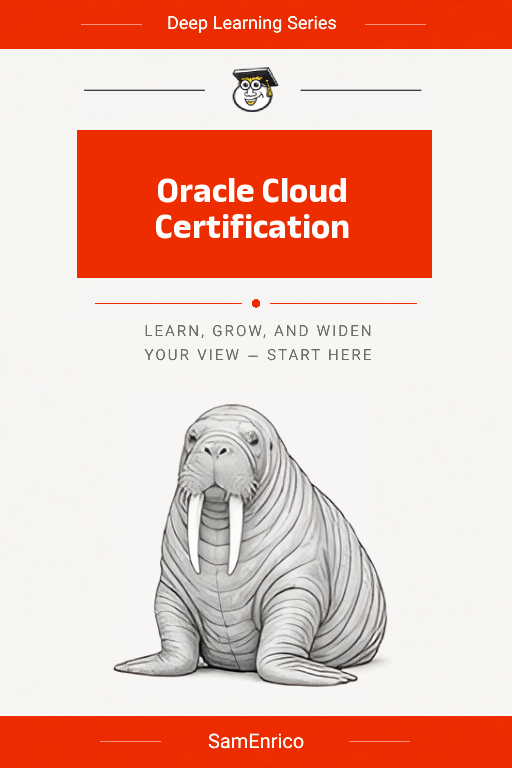
Non-FictionStudent's ShortcutOracle Cloud
Oracle Cloud Certification eBook
Earn Oracle Cloud Infrastructure certification for
by Loper Shan
Earn Oracle Cloud Infrastructure certification for enterprise cloud roles.
Formats
Free sample
Chapter 1: The Foundation Mandate--–- The first time you hear about Oracle Cloud Infrastructure, it might sound like just another cloud provider in a crowded market. AWS has the first-mover advantage, Azure has the enterprise relationships, and Google has the AI hype. So why should you invest your valuable time—and your organization's budget—into learning OCI? The answer lies not in marketing claims but in a fundamental architectural difference that Oracle bet on years ago, a difference that now shapes how the world's largest enterprises run their most critical workloads. This chapter is not about passing an exam, though it will help you do exactly that.
This chapter is about understanding the physical and logical skeleton of OCI so thoroughly that every certification question about regions, availability domains, or tenancy becomes not a memorized fact but an obvious deduction. By the time you finish these pages, you will see OCI not as a collection of services but as an integrated system designed from the ground up for enterprise resilience.Before you type a single command, before you launch your first compute instance, before you even create a compartment, you must understand where OCI lives. The global infrastructure of Oracle Cloud consists of three hierarchical layers: regions, availability domains, and fault domains. Each layer exists to solve a specific reliability problem, and together they form the backbone of every single service OCI offers.A region is the highest level of geographic separation. Think of a region as a completely independent data center cluster located in a specific metro area—Phoenix, Frankfurt, Tokyo, Mumbai, and so on.
As of this writing, OCI operates more than forty regions worldwide, with new ones opening quarterly. Each region is isolated from every other region by hundreds or thousands of kilometers. This isolation means that a catastrophic event in one region—a power grid failure, a natural disaster, a fiber cut—has absolutely no impact on any other region. For enterprise compliance teams, regions also provide data sovereignty: if you must store customer data inside Germany, you use the Frankfurt or Munich regions. If your contract requires data never leaves the United States, you choose Phoenix, Ashburn, or Chicago.Within each region, OCI deploys something far more sophisticated than a single data center.
Every region contains at least three availability domains, abbreviated as ADs. An availability domain is a physically separate, isolated data center within a region. Each AD has its own independent power supply, its own cooling infrastructure, its own network uplinks, and its own security perimeter. The distance between ADs in the same region is close enough to provide single-digit millisecond latency—meaning applications can communicate across ADs as if they were in the same building—but far enough apart that a fire, flood, or power outage in AD1 cannot spread to AD2 or AD3. This is the magic of OCI's architecture: you get the fault tolerance of geographically separated data centers with the performance of a local network.Oracle guarantees that no two ADs in the same region will experience a simultaneous failure.
This is not marketing hyperbole; it is an engineering specification baked into the physical design. Each AD sits on a different electrical grid feed, different telco central offices, and different flood plains. When you architect applications across multiple ADs within the same region, you achieve 99.995 percent availability—approximately twenty-six minutes of downtime per year, assuming the application itself is correctly designed.But OCI goes one level deeper. Within each availability domain, the infrastructure is further divided into fault domains. A fault domain is a logical grouping of hardware—racks of servers, storage arrays, network switches—that shares a single power supply and network switch.
A single AD contains multiple fault domains, typically three or more. The purpose of a fault domain is to protect against hardware failure within an AD. If you launch two compute instances in the same fault domain and that fault domain's power supply fails, both instances go down. But if you launch them in different fault domains within the same AD, a failure in one domain leaves the other instance untouched. For certification exams, remember this hierarchy: a region contains availability domains, each availability domain contains fault domains, and fault domains contain physical servers.The relationship between these three layers determines your application's theoretical maximum availability.
A single compute instance in a single fault domain has no built-in redundancy—if that hardware fails, you are down until OCI detects the failure and automatically recovers the instance (usually within minutes). An application distributed across multiple fault domains within one availability domain survives hardware failures. An application distributed across multiple availability domains within one region survives entire data center failures. An application distributed across multiple regions survives anything short of a global catastrophe.Now you understand why OCI architects talk constantly about "AD-aware" and "fault domain-aware" design. It is not academic pedantry.
It is the difference between an e-commerce site that stays up during Black Friday and one that sends thousands of customers to your competitors.With the physical infrastructure understood, we turn to the virtual. OCI's networking architecture contains a design choice that surprises many cloud engineers coming from other platforms: off-box virtualization. In most cloud providers, the virtualization layer that handles networking runs on the same physical server as your compute instance. This "on-box" model shares CPU cycles between your workload and the networking stack, leading to performance variability during high load. Oracle took a different path.
OCI implements networking entirely on dedicated hardware separate from compute servers. Smart network interface cards, or Smart NICs, offload all packet processing, security rule enforcement, and routing to purpose-built hardware. Your compute instance receives the full performance of the underlying CPU without any overhead from virtual switches. The result is predictable, bare-metal-equivalent networking performance even on shared virtual machines. For certification, remember the phrase "off-box virtualization" and associate it with consistent low latency and no noisy neighbors.Every OCI tenancy begins with a root compartment.
You can think of the root compartment as the top-most folder in a hierarchical file system, except that folder also has special security properties. The root compartment is created automatically when you sign up for OCI. It cannot be deleted, renamed, or moved. All resources in your tenancy ultimately live somewhere under the root compartment, though best practice is to never place resources directly in the root compartment. Instead, you create child compartments for different teams, projects, or environments.
Chapter 2 will devote dozens of pages to compartments, identity policies, and the zero-trust security model. For now, you need only understand that compartments are the fundamental unit of isolation and delegation in OCI. If you cannot compartmentalize, you cannot secure.Before you spend a single dollar on OCI, you must understand the free tier and the trial credits. Oracle offers two distinct free offerings that trip up many newcomers. The Always Free resources are exactly what the name promises: a set of services that never expire and incur no charges, provided you stay within usage limits.
As of this writing, Always Free includes two AMD-based virtual machines with 1/8 OCPU and 1 GB RAM each, up to four ARM-based Ampere A1 cores (configurable as…
This is the end of the free sample. Get the eBook to keep going. Buy now
About this book
Details
- Author
- Loper Shan
- Publisher
- SamEnrico
- Language
- English
- Genre
- Non-Fiction, Student's Shortcut, Oracle Cloud
- Released
- 2026-05-29
- Pages (approx.)
- 146
- Available as
- eBook, Audiobook

Read better in the ZLOADR app
Your eBooks on your phone or tablet. Sign in with your SamEnrico account and start reading.
More by Loper Shan
 The Vulnerability PracticeLoper Shan$11.99
 Spin Class Posture And Form ManualLoper Shan$11.99
 Condo Insurance Agency DatabaseLoper Shan$11.99
 Intermittent Fasting SeniorsLoper Shan$11.99
 Antwerp Diamond Heist Unsolved MysteriesLoper Shan$11.99
 The Lost Civilization of the Indian Ocean: Forensic Clues from the DepthsLoper Shan$11.99
 The Silk and the Spy: A Love Story in the Shadow of the Cold WarLoper Shan$11.99
 Ultimate Handbook Guide to Surat : (India) Travel GuideLoper Shan$11.99
 Software Support TechnicianLoper Shan$11.99
 Company Applicant DefinitionLoper Shan$12.99
 Understanding DermatophytidsLoper Shan$17.99
You may also like
 Hong Kong Handover 1997Dunn Johnnie$11.99
 Zumba For Postnatal Recovery CourseNeal Christian$11.99
 Zumba for BeginnersLadner Nikia$11.99
 YouTube Comment Mining GuideHumes Pandora$12.99
 Worry Box MeditationCarlin Rudy$11.99
 Workplace Stress MeditationNguyen Lynn$11.99
 Workplace Stress and Sleep RepairHawley Ivory$11.99
 Workplace Perfectionism CureDelaney Jeffry$11.99
 Workplace Injustice Anger GuideWallen Isabelle$11.99
 Work Addiction and Burnout LinkGreenwood Ester$11.99
 Women in Yoga and WellnessBeattie Galina$11.99
 Women in Stand Up ComedyChun Evangeline$11.99