
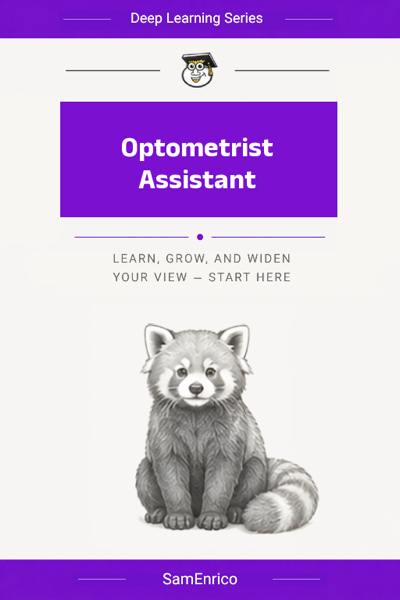
Non-FictionInformativeEducational
Optometrist Assistant eBook
A Coursebook on Optometrist Assistant
by Muniz Tess
A Coursebook on Optometrist Assistant
Formats
Free sample
Chapter 1: The Silent Gateway...--The phone rings at 7:45 AM. A 47-year-old woman named Carol is on the line. She tells you she has “a few new floaters” in her right eye. She sounds calm, almost bored. She asks if she can come in “sometime next week.” Most people would book the appointment for next Thursday at 11:00 AM and hang up.
But you are an Optometric Assistant. You know something Carol does not. You ask three questions: “How many floaters? Any flashes of light? Is there a curtain or shadow in your peripheral vision?” Carol pauses.
“Well, actually, yes. There’s a dark curtain coming from the side.” You tell her to come immediately. Three hours later, the doctor confirms a retinal detachment. Carol has surgery that afternoon. She keeps her vision.
Months later, she writes a letter to the clinic: “The person on the phone saved my eye. I didn’t even know her name.”This is the power of the Optometric Assistant. You are not a receptionist. You are not a clerk. You are the silent gateway between a patient’s symptom and a doctor’s diagnosis.
The top ten percent of optometric assistants do not just schedule appointments; they triage emergencies, comfort terrified children, translate medical jargon into plain language, and ensure the practice runs like a precision instrument. The bottom ten percent just answer phones. This chapter is about which group you will join.Most people enter optometry through the front door: they see the doctor, they appreciate the care, and they think, “I could do that.” But the assistant enters through a different door: the side door of clinical support, patient advocacy, and operational mastery. You will not write prescriptions. You will not perform surgery.
But you will be the first person a scared patient sees, the last person they thank, and the reason the doctor can focus on diagnosis instead of fixing the autorefractor.Let us begin with a truth that most training manuals avoid: the optometric assistant role is poorly defined in many practices. Some offices treat assistants as glorified secretaries. Others expect them to perform advanced diagnostic testing without proper training. And a few have realized that a well-trained assistant is the single most profitable employee in the practice – more profitable per hour than the doctor herself, because the assistant enables the doctor to see more patients without sacrificing quality.This book exists to define the role clearly, train you thoroughly, and prepare you for certification through the American Optometric Association (CPOA – Certified Paraoptometric Assistant) or the Canadian Association of Optometrists (CCOA – Certified Canadian Optometric Assistant). By the end of this chapter, you will understand not just what an optometric assistant does, but why it matters.
By the end of this book, you will be ready to walk into any optometric practice in North America and contribute from day one.The Anatomy of an Eye Care Practice To understand the optometric assistant, you must first understand the ecosystem in which you will work. An eye care practice is not a single organism; it is a collaborative team of distinct professionals, each with legally defined scopes of practice. Confusing these roles is not just unprofessional – in some jurisdictions, it is illegal.The Optometrist: The Primary Eye Doctor The optometrist (OD – Doctor of Optometry) completes four years of undergraduate study followed by four years of optometry school. They are licensed to perform comprehensive eye examinations, diagnose and manage ocular disease, prescribe corrective lenses, and in most states, prescribe topical medications for conditions like glaucoma and conjunctivitis. In some states, optometrists can also perform minor surgical procedures such as foreign body removal and laser therapy.
The optometrist is the captain of the ship. Everything you do serves their ability to diagnose and treat.The Ophthalmologist: The Medical and Surgical Specialist The ophthalmologist (MD or DO) completes four years of medical school, a one-year internship, and a three-year residency in ophthalmology. Many then complete an additional fellowship in a subspecialty such as retina, cornea, glaucoma, or pediatrics. Ophthalmologists diagnose and treat all eye diseases, perform surgery (cataract, LASIK, retinal detachment repair, corneal transplant), and manage systemic conditions with ocular manifestations such as diabetic retinopathy and hypertensive retinopathy. In many practices, optometrists and ophthalmologists work side by side, with optometrists handling primary care and comanaging surgical patients, while ophthalmologists handle advanced medical disease and surgery.The Optician: The Eyewear Expert The optician is trained to dispense, fit, and adjust eyeglasses and contact lenses based on a prescription written by an optometrist or ophthalmologist.
Opticians do not perform eye exams, diagnose disease, or prescribe correction. Their expertise lies in lens materials, frame selection, measurements (pupillary distance, segment height), and the physical adjustment of eyewear. In some practices, opticians are separate employees; in smaller practices, the optometric assistant may also perform optical dispensing. This book covers both roles, but the certification examinations treat them separately.The Optometric Assistant: Your Role The optometric assistant (OA) supports all of the above. You will perform preliminary testing (visual acuity, tonometry, autorefraction), assist with diagnostic imaging (OCT, fundus photography, visual fields), manage patient flow, handle telephone triage, verify insurance, maintain inventory, and educate patients on contact lens care and eyewear options.
You work under the supervision of the optometrist. You never diagnose, never prescribe, and never perform subjective refraction (“Which is better, 1 or 2?”). But within those boundaries, you are indispensable.A note on terminology: Some practices use “paraoptometric” instead of “optometric assistant.” The American Optometric Association certifies “Certified Paraoptometric Assistants” (CPOA). The Canadian Association of Optometrists certifies “Certified Canadian Optometric Assistants” (CCOA). This book uses “optometric assistant” (OA) for readability, but the content applies equally to both certification tracks.The Patient Journey: From Phone Call to Follow-Up Every patient who walks through your door follows a predictable arc.
Understanding this arc is the foundation of practice management. The optometric assistant touches every stage.Stage 1: The Phone Call The journey begins when the patient calls to schedule. Your job is not merely to book a time. Your job is to triage. Some calls require immediate escalation: flashes of light, sudden vision loss, a curtain in the visual field, severe eye pain with nausea, a chemical injury.
Other calls are routine: “I need an eye exam for new glasses.” The difference between a routine and an emergency call can literally save someone’s vision. Later in this chapter, we will cover telephone triage protocols in detail. For now, remember this rule: when in doubt, book the patient today. A same-day appointment that turns out to be unnecessary is a minor inconvenience. A delayed appointment that leads to permanent vision loss is malpractice.Stage 2: Check-In The patient arrives.
You verify their personal information, insurance eligibility, and medical history. You collect copayments. You hand them the necessary forms. But the best optometric assistants do something more: they look at the patient. Is the patient squinting?
Rubbing their eyes? Walking cautiously as if depth perception is impaired? Holding reading material at an unusual distance? These observations take two seconds and provide invaluable clinical clues.Stage 3: Preliminary Testing (Pretesting)Before the doctor enters the room, you perform a battery of tests. This chapter introduces the concept; later chapters provide detailed protocols.…
This is the end of the free sample. Get the eBook to keep going. Buy now
About this book
Details
- Author
- Muniz Tess
- Publisher
- SamEnrico
- Language
- English
- Genre
- Non-Fiction, Informative, Educational
- Released
- 2026-05-09
- Pages (approx.)
- 160
- Available as
- eBook, Audiobook

Read better in the ZLOADR app
Your eBooks on your phone or tablet. Sign in with your SamEnrico account and start reading.
More by Muniz Tess
 The Vagus Nerve Stress LinkMuniz Tess$11.99
 Cross Border Franchise Privacy PolicyMuniz Tess$11.99
 Dual Diagnosis in ElderlyMuniz Tess$11.99
 The Budget Creative ChallengeMuniz Tess$11.99
 Anger Management for Security GuardsMuniz Tess$11.99
 The Quantum Leap: How a 1989 Experiment Changed the Future of ComputingMuniz Tess$11.99
 Understanding Sacral AgenesisMuniz Tess$17.99
 Supply Chain Finance vs FactoringMuniz Tess$12.99
 Safe Harbor for CTAMuniz Tess$12.99
 How to Start a Circular or Reciprocating Saws Business (Beginners Guide)Muniz Tess$11.99
You may also like
 Hong Kong Handover 1997Dunn Johnnie$11.99
 Zumba For Postnatal Recovery CourseNeal Christian$11.99
 Zumba for BeginnersLadner Nikia$11.99
 YouTube Comment Mining GuideHumes Pandora$12.99
 Worry Box MeditationCarlin Rudy$11.99
 Workplace Stress MeditationNguyen Lynn$11.99
 Workplace Stress and Sleep RepairHawley Ivory$11.99
 Workplace Perfectionism CureDelaney Jeffry$11.99
 Workplace Injustice Anger GuideWallen Isabelle$11.99
 Work Addiction and Burnout LinkGreenwood Ester$11.99
 Women in Yoga and WellnessBeattie Galina$11.99
 Women in Stand Up ComedyChun Evangeline$11.99