
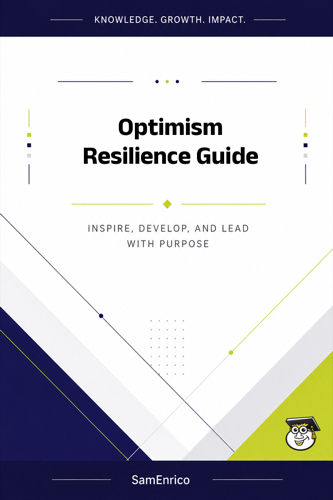
Free sample
Chapter 1: The Unspoken Lie--–- The belief that you are either born an optimist or you are not might be the single most expensive lie you have ever been sold. It has cost you promotions it never occurred to you to pursue, relationships you abandoned before they could fail, and a version of yourself that wakes up looking for possibility instead of bracing for impact. You have probably repeated this lie to yourself in language that felt like honesty. “I’m just a realist.” “I’d rather be pleasantly surprised than disappointed.” “That’s just how I’m wired.” These statements are not wisdom. They are the vocabulary of a brain that has mistaken its default settings for its permanent ones.This chapter exists to execute a single idea and execute it until it cannot be misunderstood: optimism is not a personality trait.
It is a skill. And like any skill—learning a second language, playing the piano, parallel parking a stick shift—it is acquired through deliberate practice, requires specific techniques, and changes the actual physical structure of the brain that performs it. The difference between you and the person you consider “naturally optimistic” is not a genetic lottery. It is a gap in training. That gap can be closed.Before we go any further, let me tell you a brief story about myself that I have not shared publicly before.
I was not an optimistic child. I was the kind of kid who read the weather report for fun and calculated the probability of rain on my birthday six months in advance. At twelve, I told my mother that hoping for a dog was illogical because dogs die, and I did not want to set myself up for that loss. She looked at me with an expression I now recognize as exhausted concern. At the time, I mistook it for respect for my intellectual rigor.
I had confused pessimism with intelligence. I had confused the safety of low expectations with the courage of genuine engagement. It took me until my late twenties to understand that my “realism” was not protecting me from disappointment. It was protecting me from life.The science that changed my mind came from a psychologist named Martin Seligman, who in the 1960s made a discovery that should have upended how we educate children, manage employees, and treat depression. He found that optimism could be taught.…
This is the end of the free sample. Get the Audiobook to keep going. Buy now
About this book
Details
- Author
- Graves Orlando
- Publisher
- SamEnrico
- Language
- English
- Genre
- Non-Fiction, Self-Help / Optimism
- Released
- 2026-06-07
- Pages (approx.)
- 144
- Available as
- eBook, Audiobook

Listen in the VoxFlicks app
Audiobooks and audio dramas wherever you go. Sign in with your SamEnrico account and press play.
More by Graves Orlando
 The Hoarder Household SurvivorGraves Orlando$11.99
 Social Media and Imposter SyndromeGraves Orlando$11.99
 Gambling Relapse Warning SignsGraves Orlando$11.99
 Rewiring Betrayal Self BlameGraves Orlando$11.99
 Prescription Pills TrapGraves Orlando$11.99
 The Cholera Vaccine GuideGraves Orlando$11.99
 Imposter Syndrome For ManagersGraves Orlando$11.99
 The Quantum Whisperer: How Schrödinger’s Cat Changed the WorldGraves Orlando$11.99
 Whispers of the Marid: The Djinn Who Drowned the MoonGraves Orlando$11.99
 The Frozen Gambit: Russia's Desperate Stand at Narva (1700)Graves Orlando$11.99
 The Dancer's Guide to RumbaGraves Orlando$11.99
 Franchise Technology TransferGraves Orlando$12.99
You may also like
 Hong Kong Handover 1997Dunn Johnnie$11.99
 Zumba For Postnatal Recovery CourseNeal Christian$11.99
 Zumba for BeginnersLadner Nikia$11.99
 YouTube Comment Mining GuideHumes Pandora$12.99
 Worry Box MeditationCarlin Rudy$11.99
 Workplace Stress MeditationNguyen Lynn$11.99
 Workplace Stress and Sleep RepairHawley Ivory$11.99
 Workplace Perfectionism CureDelaney Jeffry$11.99
 Workplace Injustice Anger GuideWallen Isabelle$11.99
 Work Addiction and Burnout LinkGreenwood Ester$11.99
 Women in Yoga and WellnessBeattie Galina$11.99
 Women in Stand Up ComedyChun Evangeline$11.99