
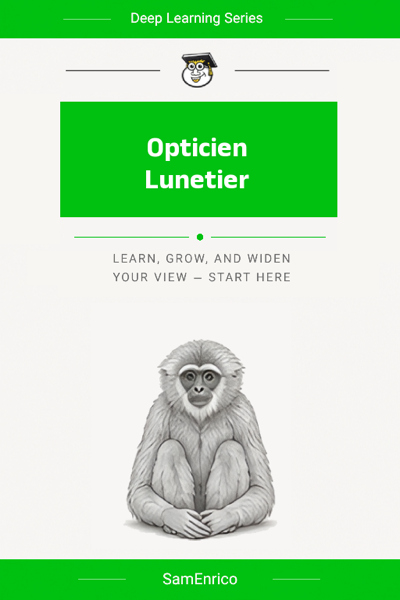
Non-FictionInformativeEducational
Opticien Lunetier
A Coursebook on Opticien Lunetier
A Coursebook on Opticien Lunetier
Formats
About this book
Free sample
Chapter 1: The Living Eye...--–- The human eye is not a camera. It is not a lens, not a machine, not a passive receiver of light. It is a living, breathing, pulsating organ—half biological marvel, half optical miracle—and every pair of spectacles you will ever prescribe must bow to its physiology. Before you calculate a single diopter, before you select a frame or measure a pupil distance, you must understand this truth: the eye does not see. The brain sees.
The eye merely gathers light, bends it, focuses it, and transforms it into electrical whispers that travel along a million tiny wires to the occipital cortex. Your job as an opticien lunetier is not to “fix” the eye. It is to place a piece of corrected glass in front of a biological system that will accept it, reject it, or—if you are careless—fight against it every waking moment.This chapter is the foundation upon which your entire career rests. You will learn the anatomy of the orbit, the three tunics of the eyeball, the crystalline lens that hardens with age, and the visual pathway that turns photons into perception. You will also learn why a patient with perfect optics can still see poorly—because the eye, like any living tissue, has limits, vulnerabilities, and pathologies that no lens can correct.
By the end of this chapter, you will never look at a pair of glasses the same way again. You will see the cornea, the iris, the lens, the retina. You will see the patient behind the prescription.The Orbit: The Bony Fortress The eye sits inside a protective cone of bone called the orbit. Seven bones form this fortress: frontal, zygomatic, maxillary, ethmoid, sphenoid, lacrimal, and palatine. Each has a specific role.
The frontal bone forms the roof—thin enough that a blow to the brow can fracture it, sending bone fragments into the superior rectus muscle. The zygomatic and maxillary bones form the floor—so fragile that a punch to the cheek can produce a “blowout fracture,” trapping the inferior rectus muscle and causing vertical…
This is the end of the free sample. Get the eBook to keep going. Buy now
Contents
- Chapter 1
- Chapter 2
- Chapter 3
- Chapter 4
- Chapter 5
- Chapter 6
- Chapter 7
- Chapter 8
- Chapter 9
- Chapter 10
- Chapter 11
- Chapter 12
Details
- Author
- Hendrickson Lavern
- Publisher
- SamEnrico
- Language
- English
- Genre
- Non-Fiction, Informative, Educational
- Released
- 2026-06-02
- Pages (approx.)
- 140
- Available as
- eBook, Audiobook

Read better in the ZLOADR app
Your eBooks on your phone or tablet. Sign in with your SamEnrico account and start reading.
More by Hendrickson Lavern
 Fear Of Failure In LeadershipHendrickson Lavern$11.99
 The Small Canvas Big Art GuideHendrickson Lavern$11.99
 Sports Nutrition for Martial ArtsHendrickson Lavern$11.99
 Dual Diagnosis in AdolescentsHendrickson Lavern$11.99
 Anger Management for JanitorsHendrickson Lavern$11.99
 Whispers in the Empty Quarter: The Djinn of the Endless SandsHendrickson Lavern$11.99
 Understanding Sackey–sakati–aur SyndromeHendrickson Lavern$17.99
 How to Start a Circuit Breaker (moulded Case) Business (Beginners Guide)Hendrickson Lavern$11.99
 AI Credit Scoring FactoringHendrickson Lavern$12.99
 CTA Corrected Filing GuideHendrickson Lavern$12.99
You may also like
 Hong Kong Handover 1997Dunn Johnnie$11.99
 Zumba For Postnatal Recovery CourseNeal Christian$11.99
 Zumba for BeginnersLadner Nikia$11.99
 YouTube Comment Mining GuideHumes Pandora$12.99
 Worry Box MeditationCarlin Rudy$11.99
 Workplace Stress MeditationNguyen Lynn$11.99
 Workplace Stress and Sleep RepairHawley Ivory$11.99
 Workplace Perfectionism CureDelaney Jeffry$11.99
 Workplace Injustice Anger GuideWallen Isabelle$11.99
 Work Addiction and Burnout LinkGreenwood Ester$11.99
 Women in Yoga and WellnessBeattie Galina$11.99
 Women in Stand Up ComedyChun Evangeline$11.99