

Non-FictionSelf-HelpBehavior Change
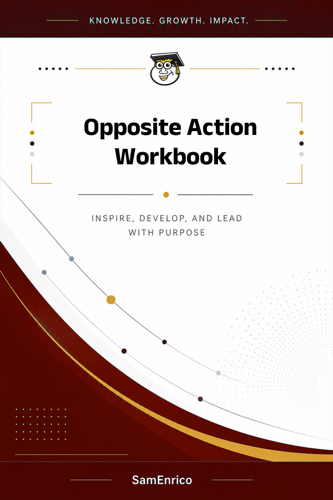
Opposite Action Workbook eBook
Act opposite to your emotional urge when the emoti
Act opposite to your emotional urge when the emotion doesn't fit the facts.
Formats
Free sample
Chapter 1: The Emotional Map...--–- You are driving through a city you have visited a hundred times before. The roads are familiar. The landmarks are predictable. But today, without warning, your GPS reroutes you onto a street you have never seen. The buildings look different.
The light feels different. A quiet panic rises in your chest because you realize something unsettling: you do not know exactly where you are.That feeling in your chest, that subtle shift in your breathing, that urge to either speed up or pull over entirely — that is an emotion. And for most of your life, you have treated that feeling as an unbreakable command. You feel anxious, so you leave. You feel angry, so you raise your voice.
You feel sad, so you retreat. You feel jealous, so you check his phone. You feel ashamed, so you disappear.This chapter is going to show you why that system has been lying to you — and what you can do about it without needing to feel better first.Most people believe that emotions are accurate reflections of reality. If you feel disrespected, the logic goes, you must have been disrespected. If you feel afraid, there must be danger nearby.
If you feel guilty, you must have done something wrong. This belief is so deeply ingrained that questioning it can feel almost disloyal, as if you are betraying your own inner compass.But here is the truth that changes everything: emotions evolved to prompt quick action, not to deliver accurate reports about reality.A fear response in the savanna kept our ancestors from wandering into tall grass where predators hid. That same fear response today makes you avoid a work presentation that has zero predators, zero physical threat, and zero chance of harm beyond mild embarrassment. The emotion is real. The urge is powerful.
But the interpretation — "I am in danger" — is often false.This chapter will give you the tools to separate the feeling from the fact. You will learn the anatomy of an emotional urge, the single question that determines whether you should trust it or oppose it, and a self-assessment that will reveal which emotions have been running your life without your permission.By the time you finish this chapter, you will never look at a strong emotion the same way again. And that is the point.The Lie Your Emotions Tell You Every Day Let us start with a simple experiment. Think about the last time you had a strong emotional reaction that you later regretted. Maybe you sent a text message in anger that you wished you could unsend.
Maybe you avoided a phone call out of fear and lost an opportunity. Maybe you ate an entire pint of ice cream to numb sadness and felt worse afterward. Maybe you stayed silent when you should have spoken up, or spoke up when you should have stayed silent.Now ask yourself this question: at the exact moment you acted on that urge, did it feel wrong?Almost certainly not. In that moment, the urge felt completely justified. It felt like the only reasonable response to the situation.
Your emotion was not whispering a suggestion — it was screaming a command. And you followed that command because you have been trained your entire life to trust your feelings.This is the lie. Not that emotions exist, but that they are always accurate guides to reality.Consider the mechanics of how an emotion works. When your brain perceives a trigger — a text message left on read, a critical comment from a boss, a memory of an old humiliation — it does not first ask for evidence. It does not weigh probabilities.
It does not consider alternative explanations. Instead, it activates a pre-programmed action tendency in a fraction of a second.Fear says: escape, avoid, hide, freeze.Anger says: attack, blame, punish, destroy.Sadness says: withdraw, rest, isolate, give up.Shame says: disappear, become small, self-destruct.Jealousy says: monitor, control, test, possess.Envy says: devalue, copy, resent.Disgust says: reject, distance, exclude.Love addiction says: merge, chase, text, cling.These urges are not thoughts. They are not choices. They are biological programs that evolved to solve specific problems in a world that no longer exists. And here is the most important sentence in this entire chapter: an urge is not an instruction.You can feel the urge to run without running.
You can feel the urge to scream without screaming. You can feel the urge to hide without hiding. The feeling and the action are not the same thing. But most people live as if they are.The Emotion-Urge-Action Loop Let me draw you a picture in words. Every emotional reaction follows the same four-step loop.
Understanding this loop is the foundation of everything else in this book.Step One: The Trigger Something happens. A person says something. A memory arises. A text arrives. A deadline approaches.
Your boss calls a meeting. Your partner comes home late. You see a photo on social media. The trigger can be external (something in the world) or internal (a thought, a memory, a physical sensation). Triggers are neutral until your brain interprets them.Step Two: The Emotion Your brain instantly interprets the trigger and generates an emotion.
This interpretation is not a rational process. It is a pattern match. Your brain asks: "Does this resemble a past situation where I felt threatened, wronged, abandoned, or shamed?" If yes, it fires the corresponding emotional program. This entire step happens in milliseconds.Step Three: The Urge The emotion produces an action urge. Fear says leave.
Anger says attack. Sadness says hide. You do not choose this urge. It arrives automatically, like a reflex. You can feel it in your body: tight chest, clenched jaw, shallow breathing, heavy limbs, burning face.Step Four: The Action This is the only step you control.
The first three steps are automatic. The fourth step is where your agency lives. You can follow the urge, or you can act opposite to it. Most people never realize there is a choice. They move from urge to action so quickly that the gap between them disappears entirely.The goal of this book is to widen that gap.
From a millisecond to a second. From a second to three seconds. From three seconds to two minutes. From two minutes to ten minutes. Each time you pause, you create space to ask the most important question in emotional regulation: does this emotion fit the facts?The Fit Check: The Only Question That Matters Here is where almost every self-help book gets it wrong.
They tell you to "trust your feelings" or "follow your heart" or "lean into your emotions." But those platitudes ignore a basic reality: sometimes your emotions are lying to you.Not because emotions are bad. Not because you are broken. But because your emotional brain evolved for survival, not for accuracy. It prioritizes speed over precision. It would rather flag a false threat than miss a real one.
That design worked beautifully on the savanna. It works terribly in a modern office, a marriage, a text conversation, or a grocery store.The Fit Check is a two-question test that tells…
This is the end of the free sample. Get the eBook to keep going. Buy now
About this book
Details
- Author
- Kelly Roderick
- Publisher
- SamEnrico
- Language
- English
- Genre
- Non-Fiction, Self-Help, Behavior Change
- Released
- 2026-06-10
- Pages (approx.)
- 143
- Available as
- eBook, Audiobook

Read better in the ZLOADR app
Your eBooks on your phone or tablet. Sign in with your SamEnrico account and start reading.
More by Kelly Roderick
 A1C InterpretationKelly Roderick$11.99
 Pelvic Floor Relaxation SkillsKelly Roderick$11.99
 Eisenhower Matrix Productivity GuideKelly Roderick$11.99
 Joe Dispenza EvolveKelly Roderick$11.99
 Liberating Mental ObjectsKelly Roderick$11.99
 Outsourcing Social Media ManagementKelly Roderick$11.99
 Antwerp Heist in Pop CultureKelly Roderick$11.99
 Voltaire's Enlightenment: The Pen That Enlightened a ContinentKelly Roderick$11.99
 The Vanishing of Marcel Lefèvre: A Prohibition-Era Mystery in ParisKelly Roderick$11.99
 How to Produce Storage and OrganizationKelly Roderick$11.99
 How to Produce Hair Removal ProductsKelly Roderick$11.99
 A Collector's Handbook to the Dutton MalagaKelly Roderick$11.99
You may also like
 Hong Kong Handover 1997Dunn Johnnie$11.99
 Zumba For Postnatal Recovery CourseNeal Christian$11.99
 Zumba for BeginnersLadner Nikia$11.99
 YouTube Comment Mining GuideHumes Pandora$12.99
 Worry Box MeditationCarlin Rudy$11.99
 Workplace Stress MeditationNguyen Lynn$11.99
 Workplace Stress and Sleep RepairHawley Ivory$11.99
 Workplace Perfectionism CureDelaney Jeffry$11.99
 Workplace Injustice Anger GuideWallen Isabelle$11.99
 Work Addiction and Burnout LinkGreenwood Ester$11.99
 Women in Yoga and WellnessBeattie Galina$11.99
 Women in Stand Up ComedyChun Evangeline$11.99