
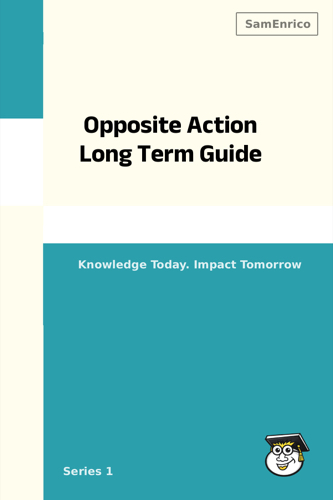
Non-FictionSelf-HelpBehavior Change
Opposite Action Long Term Guide eBook
Act opposite to emotional urges repeatedly until n
Act opposite to emotional urges repeatedly until new patterns form.
Formats
Free sample
Chapter 1: The Feeling Trap--–- Every time you trust your gut, you might be digging a deeper hole. That sentence sounds like heresy in a world that worships emotional authenticity. We are told to “follow our hearts,” “trust our instincts,” and “never apologize for how we feel.” These phrases roll off the tongue like universal truths, as unquestionable as gravity. But for millions of people struggling with anxiety, depression, anger, or shame, following emotional urges is precisely what keeps them trapped. The gut feeling that says “run” creates a smaller life.
The heart that says “attack” destroys relationships. The instinct that says “hide” turns shame into a prison cell with no door. This chapter dismantles the myth of emotional authenticity—not because emotions are bad, but because they are first drafts, not final commands.The problem is not that you feel. The problem is that you have learned to treat every feeling as a directive. This confusion between sensation and instruction is the single greatest obstacle to long-term emotional change.
Emotions evolved to keep your ancestors alive on the savanna—fast, crude, and often wrong for the complexities of modern life. Fear kept you from being eaten by a lion. Today, that same fear keeps you from speaking in a meeting, asking for a raise, or making a new friend. Anger helped your ancestors fight off rivals. Today, it makes you scream at your partner for leaving dishes in the sink.
Shame kept you from being expelled from the tribe—a death sentence 100,000 years ago. Today, it keeps you from asking for help, admitting a mistake, or showing up as your imperfect self.This book offers a radical alternative: act opposite to your emotional urges, repeatedly, until new neural pathways form. It is not about suppressing feelings or pretending to be happy. It is about choosing behaviors that align with your long-term values, even when—especially when—your emotions scream the opposite direction. This chapter introduces the core problem, the failed solutions most people try, and the foundational distinction that makes opposite action possible: valid emotions versus useful actions.The Case of the Shrinking World Let us begin with a story.
Call her Maya. At twenty-two, Maya graduated from college with a minor case of social anxiety. She felt nervous before parties, dreaded public speaking, and sometimes replayed conversations in her head for hours. But she managed. She went to interviews, dated, and had a small group of friends.
Her emotional urge when anxious was always the same: avoid, escape, postpone. And for the most part, she followed that urge. She skipped parties when she felt tired. She chose jobs with minimal public interaction. She let her friends initiate most plans.By twenty-five, Maya’s world had shrunk noticeably.
She had stopped dating entirely—the anxiety before a first date felt unbearable. She had declined two promotions because they required presentations. She spent most weekends alone, not because she wanted to but because reaching out to friends triggered a wave of “what if they reject me” thoughts. She told herself she was just being authentic to her feelings. “I’m an introvert,” she said.
“I’m just not a social person.”By thirty, Maya worked from home exclusively, had not made a new friend in five years, and had stopped answering her phone unless she knew exactly who was calling. Her emotional urge—avoid, escape, postpone—had become a self-fulfilling prophecy. Each act of avoidance strengthened the neural pathway that said “social situations are dangerous.” Each escape reinforced the belief that she could not cope. Each postponement taught her amygdala that she was right to be afraid.By thirty-two, Maya felt depressed. Not sad—dead.
The world had become her apartment, her laptop, and her growing sense of irrelevance. She finally saw a therapist who said something she had never considered: “What if you did the opposite of what your fear tells you?” Maya was confused. Wasn’t she supposed to trust her feelings? The therapist explained that her feelings were real but not reliable. Fear was telling her to run.
But running had shrunk her life to a single room. Maybe it was time to run toward the thing she feared.This book is not Maya’s story—you will meet her again in later chapters. But her trajectory illustrates the core problem: when you consistently follow emotional urges, you do not become more authentic. You become more trapped. Your world does not expand; it contracts.
Your emotional range does not deepen; it narrows to fear, anger, shame, and numbness. The myth of emotional authenticity says that your feelings are always trying to help you. The truth is that your feelings are always trying to help your ancestors. And you are not living on the savanna.Valid Emotions vs. Useful Actions The single most important distinction in this entire book is between a valid emotion and a useful action.
Get this wrong, and opposite action becomes either suppression (dangerous) or toxic positivity (delusional). Get this right, and you unlock the ability to change your emotional life from the outside in.A valid emotion is any feeling that arises from your perception of reality. All emotions are valid in the sense that they are real experiences. Fear is real. Anger is real.
Shame is real. You do not need to justify your feelings or earn the right to have them. When someone says “you shouldn’t feel that way,” they are wrong. You feel what you feel. Validity is not the issue.A useful action is any behavior that moves you toward your long-term values, given your current context and goals.
Usefulness is entirely separate from validity. You can feel completely justified in your anger—your partner really did forget your birthday—and yet acting on that anger (screaming, withdrawing, seeking revenge) might be completely useless for your goal of a healthy relationship. You can feel terrified of public speaking, and that fear is valid given your history of embarrassment, but avoiding every speaking opportunity is useless for your career goals.This distinction is the key that unlocks opposite action. You do not have to stop feeling what you feel. You do not have to convince yourself that your emotions are wrong or bad.
You simply have to ask one question: given what I feel right now, and given where I want to go in my life, what is the most useful action?Most people never ask this question because they have been trained to equate emotional validity with behavioral instruction. I feel afraid, so I should avoid. I feel angry, so I should attack. I feel ashamed, so I should hide. This equation feels natural because it is automatic.
But automatic is not the same as accurate. The equation is wrong. Emotions are first drafts—useful for information, terrible for final decisions.Why “Trust Your Gut” Fails for Anxious and Depressed People The popular self-help mantra “trust your gut” works reasonably well for people who already have well-calibrated emotional responses. If you grew up in a safe environment, learned healthy coping skills, and have not experienced significant trauma, your gut feelings are often roughly correct. You feel uneasy in a dark…
This is the end of the free sample. Get the eBook to keep going. Buy now
About this book
Details
- Author
- Cable Chelsie
- Publisher
- SamEnrico
- Language
- English
- Genre
- Non-Fiction, Self-Help, Behavior Change
- Released
- 2026-06-10
- Pages (approx.)
- 140
- Available as
- eBook, Audiobook

Read better in the ZLOADR app
Your eBooks on your phone or tablet. Sign in with your SamEnrico account and start reading.
More by Cable Chelsie
 Ethiopian Coffee RoasterCable Chelsie$11.99
 Stress Fibromyalgia GuideCable Chelsie$11.99
 Cybersex Addiction Digital DetoxCable Chelsie$11.99
 The Oracle of Delos: Geometry, Philosophy, and the Birth of Western ThoughtCable Chelsie$11.99
 Learn to Play the Alto GuitarCable Chelsie$11.99
 Labor & Employment CounselCable Chelsie$11.99
 Raise Negotiation Email TemplatesCable Chelsie$12.99
 How to Become a Steel-barrel ReamerCable Chelsie$11.99
You may also like
 Hong Kong Handover 1997Dunn Johnnie$11.99
 Zumba For Postnatal Recovery CourseNeal Christian$11.99
 Zumba for BeginnersLadner Nikia$11.99
 YouTube Comment Mining GuideHumes Pandora$12.99
 Worry Box MeditationCarlin Rudy$11.99
 Workplace Stress MeditationNguyen Lynn$11.99
 Workplace Stress and Sleep RepairHawley Ivory$11.99
 Workplace Perfectionism CureDelaney Jeffry$11.99
 Workplace Injustice Anger GuideWallen Isabelle$11.99
 Work Addiction and Burnout LinkGreenwood Ester$11.99
 Women in Yoga and WellnessBeattie Galina$11.99
 Women in Stand Up ComedyChun Evangeline$11.99