
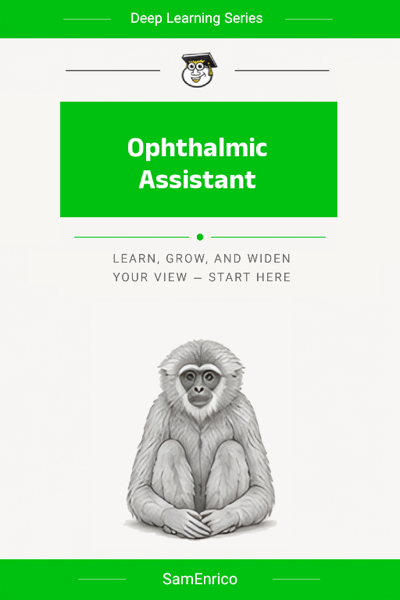
Non-FictionInformativeEducational
Ophthalmic Assistant eBook
A Coursebook on Ophthalmic Assistant
by Neel Issac
A Coursebook on Ophthalmic Assistant
Formats
Free sample
Chapter 1: Beyond the Waiting Room--–- The moment the automatic doors slide open, the journey begins. Not for you—you are already here, coffee in hand, scrubs pressed, ready for whatever walks through those doors. But for the patient, the person who has been dreading this appointment for weeks, maybe months, the journey starts right now. They are carrying something invisible: fear of blindness, frustration with progressive vision loss, guilt about neglecting their health, anxiety about the cost of care, or simply the confusion of aging eyes in a world that demands sharp focus. Your job, as an ophthalmic assistant, is to see what they are carrying before you ever touch their eyes.
That is what makes you far more than a pair of skilled hands. You are the first interpreter, the calm explainer, the steady presence that turns a cold medical appointment into a human interaction. This chapter is not about slit lamps or tonometers—those come later. This chapter is about who you are becoming: the professional who stands between the waiting room and the operating room, between fear and understanding, between symptom and solution. Welcome to the most underappreciated, overperformed, and deeply meaningful role in eye care.Let me tell you a story.
I once worked with a newly hired assistant named Maria. She had graduated from a six-month program with top marks. She could recite the layers of the cornea in her sleep. She could perform Goldmann tonometry faster than anyone in the clinic. But on her third day, an elderly man named Mr.
Henderson was brought in by his daughter. He had macular degeneration and had stopped taking his vitamins because, he said, “they didn’t seem to be doing anything.” His daughter was frustrated. Mr. Henderson was defensive. Maria jumped in with clinical precision: “Mr.
Henderson, the AREDS2 formula has been shown to reduce progression risk by 25 percent. You really should resume it.” The room went cold. The daughter felt dismissed. Mr. Henderson felt lectured.
The ophthalmologist had to smooth things over.Maria learned something that day, and so will you: clinical knowledge without human connection is not just ineffective—it is counterproductive. Patients do not care how much you know until they know how much you care. That is the hidden curriculum of ophthalmic assisting, and it is the subject of this opening chapter.The Eye Care Team: Who Does What and Where You Fit Before you can understand your role, you must understand the constellation of professionals around you. Eye care is a team sport, and every position has a distinct playbook. Confusing these roles is not merely awkward—it can lead to patients receiving incorrect information, scope-of-practice violations, and even legal liability.The Ophthalmologist (MD or DO): This is the captain of the ship.
An ophthalmologist has completed four years of college, four years of medical school, a one-year internship, and a minimum of three years of ophthalmology residency. Many pursue additional fellowship training in subspecialties such as retina (vitreoretinal surgery), glaucoma (advanced surgical and medical management), cornea (transplants and surface disease), pediatrics and strabismus (eye muscle surgery), oculoplastics (eyelid, orbit, and tear duct surgery), or neuro-ophthalmology (visual pathways and pupillary disorders). The ophthalmologist diagnoses and treats all eye diseases, performs surgery, prescribes medications, and manages systemic diseases with ocular manifestations like diabetic retinopathy, hypertensive retinopathy, and thyroid eye disease. In short, the ophthalmologist holds the highest level of responsibility and liability.The Optometrist (OD): This is a doctor of optometry, not a medical doctor, but a licensed primary eye care provider. Optometrists complete four years of college and four years of optometry school.
Their scope varies significantly by state law. In most states, optometrists perform comprehensive eye exams, prescribe glasses and contact lenses, diagnose and manage glaucoma, diabetic eye disease, dry eye, and conjunctivitis, and prescribe topical medications. In some states, optometrists can perform certain laser procedures or minor surgical procedures. However, optometrists do not perform major eye surgery, and they typically refer complex surgical cases (cataracts, retinal detachments, advanced glaucoma) to ophthalmologists. As an assistant, you may work for an ophthalmology practice that also employs optometrists, or you may work in a practice with both.
Treat them both with respect, but know that your supervising physician is the ophthalmologist.The Optician: The optician is the master of eyewear. Opticians design, verify, fit, and dispense eyeglass lenses and frames, contact lenses, and other optical devices. They interpret prescriptions written by ophthalmologists or optometrists. They do not perform eye exams, diagnose diseases, or test vision. Their expertise lies in lens materials (polycarbonate versus Trivex versus high-index versus glass), coatings (anti-reflective, blue-blocking, scratch-resistant, photochromic), frame adjustments (fitting temples, adjusting nose pads, bending end pieces), and helping patients choose eyewear that balances aesthetics, function, and budget.
In many clinics, opticians work in a separate optical shop. In smaller practices, you may be asked to perform basic optical dispensing—but check your scope of practice and your clinic's policy first.The Ophthalmic Assistant (You): This is the role you are preparing to fill. You are the clinical support professional who performs preliminary testing, diagnostic imaging, patient work-ups, instrument maintenance, and assists with in-office procedures and surgery. You work under the direct or indirect supervision of an ophthalmologist. You do not diagnose, you do not prescribe, you do not treat independently.
But you are the eyes and ears of the clinic. You will be the one who measures visual acuity, checks pupils, performs tonometry, runs OCTs and visual fields, assists with contact lens fittings, prepares patients for surgery, and educates them on post-operative care. You are the first line of data collection, and your accuracy and thoroughness directly impact the physician's diagnostic and treatment decisions.The Orthoptist (Specialized Role): In larger academic centers or pediatric ophthalmology practices, you may encounter an orthoptist. Orthoptists are allied health professionals who specialize in diagnosing and managing binocular vision disorders, strabismus (misaligned eyes), and amblyopia (lazy eye). Orthoptists do not perform surgery but work closely with pediatric ophthalmologists to perform detailed sensorimotor evaluations: cover testing at distance and near, prism measurements, Hess screen testing, and fusion range assessment.
If you work in pediatrics, you may collaborate with or learn from an orthoptist.The Ophthalmic Technician and Ophthalmic Medical Technologist (Your Career Path): As you gain experience and pursue additional certification through JCAHPO (the Joint Commission on Allied Health Personnel in Ophthalmology), you can advance from Certified Ophthalmic Assistant (COA) to Certified Ophthalmic Technician (COT) to Certified Ophthalmic Medical Technologist (COMT). Each level requires more advanced skills, deeper knowledge, and higher responsibility. COTs can perform more complex testing (e.g., biometry for cataract surgery, fluorescein angiography injection in some states, contact lens fitting for keratoconus). COMTs often take on supervisory roles, train new assistants, assist with higher-risk procedures, and may even have expanded scope in certain states. Chapter 12 maps this pathway in detail, including the specific skills, experience hours, and examination requirements for each certification.Scope of Practice: The Legal and Ethical Boundaries You Must Respect This section is not optional reading.
It is not merely academic. Understanding your scope of practice is the single most important legal concept in this entire book, because violating your scope can lead to…
This is the end of the free sample. Get the eBook to keep going. Buy now
About this book
Details
- Author
- Neel Issac
- Publisher
- SamEnrico
- Language
- English
- Genre
- Non-Fiction, Informative, Educational
- Released
- 2026-06-03
- Pages (approx.)
- 160
- Available as
- eBook, Audiobook

Read better in the ZLOADR app
Your eBooks on your phone or tablet. Sign in with your SamEnrico account and start reading.
More by Neel Issac
 The Electric Vehicle Talent RaceNeel Issac$11.99
 Bitter Melon Gut GuideNeel Issac$11.99
 The Parent Death Stroke GuideNeel Issac$11.99
 Intuitive Eating Satisfaction Factor ManualNeel Issac$11.99
 Cleopatra Father Daughter Political LegacyNeel Issac$11.99
 Echoes from the Cosmic Void: The Wow! Signal and Humanity's First Alien WhisperNeel Issac$11.99
 Chasing the Pacific's Fury: The Scientists Who Tame the Ocean's WrathNeel Issac$11.99
 Royalty Payment Automation CourseNeel Issac$12.99
 US Tax Obligations for Foreign LLCsNeel Issac$12.99
 Understanding Berdon SyndromeNeel Issac$17.99
 How to Start a Power-driven Lifting Jacks Business (Beginners Guide)Neel Issac$11.99
You may also like
 Hong Kong Handover 1997Dunn Johnnie$11.99
 Zumba For Postnatal Recovery CourseNeal Christian$11.99
 Zumba for BeginnersLadner Nikia$11.99
 YouTube Comment Mining GuideHumes Pandora$12.99
 Worry Box MeditationCarlin Rudy$11.99
 Workplace Stress MeditationNguyen Lynn$11.99
 Workplace Stress and Sleep RepairHawley Ivory$11.99
 Workplace Perfectionism CureDelaney Jeffry$11.99
 Workplace Injustice Anger GuideWallen Isabelle$11.99
 Work Addiction and Burnout LinkGreenwood Ester$11.99
 Women in Yoga and WellnessBeattie Galina$11.99
 Women in Stand Up ComedyChun Evangeline$11.99