
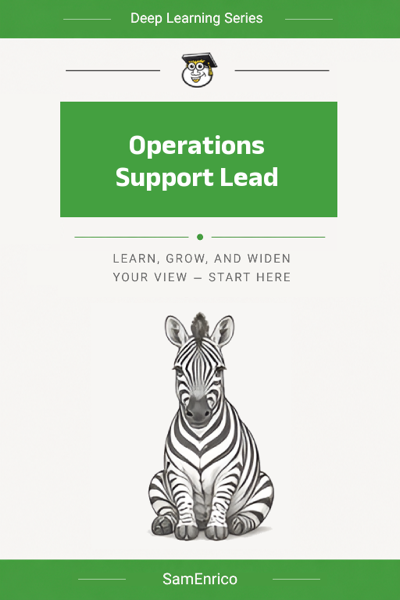
Non-FictionInformativeEducational
Operations Support Lead eBook
A Coursebook on Operations Support Lead
A Coursebook on Operations Support Lead
Formats
Free sample
Chapter 1: The Mode-Switching Mandate...--–- The first time I watched a seasoned Operations Support Lead break, it wasn't because of the crisis on her screen. It was because of the weight she had been carrying without realizing it. She had been promoted from Tier 2 support just four months earlier, celebrated as the hero who could untangle any technical knot and calm any furious customer. Her director had pulled her aside after the promotion and said, "You're our best agent. Now go make the rest of the team like you." No one told her that being the best agent was precisely the qualification that would make her fail as a lead.She spent her mornings answering escalations because they were faster than teaching someone else.
She spent her afternoons in back-to-back meetings because her calendar had been invaded without her permission. She spent her evenings writing SOPs that no one would read because she had no time to train anyone on them. And she spent her nights lying awake wondering why she felt more exhausted and less effective than when she was just an agent.When she finally resigned, her director shook his head in genuine confusion. "I don't understand," he said. "She was our best agent." That sentence, spoken with such innocent bewilderment, is the single greatest indictment of how most organizations misunderstand the Operations Support Lead role.
The best agent is not the best lead. The skills that make you exceptional at solving tickets are nearly the opposite of the skills required to build a team that solves tickets without you. And until someone explains this distinction clearly, brutally, and with a practical framework for action, talented people will continue to burn out, teams will continue to underperform, and the cycle of heroic failure will repeat itself endlessly.This chapter exists to break that cycle. It will give you the single most important framework in this entire book: the Mode-Switching Mandate. You will learn the three distinct modes every Operations Support Lead must master, the hidden costs of confusing them, and the practical rituals that allow you to move between them without losing your mind or your effectiveness.
By the time you finish these pages, you will understand exactly why your current role feels impossible, you will be able to diagnose which mode you are overusing, and you will have a concrete ninety-day plan to rebalance your time before the weight of the job crushes your spirit.The Three Modes That Will Save Your Career Let me read you a typical job description for an Operations Support Lead. I have pulled this from an actual posting at a well-funded Saa S company, though I have anonymized the details. "We are seeking an Operations Support Lead to manage our growing customer support team. Responsibilities include: resolving escalated customer issues, designing and implementing support processes, managing ticket queues and SLAs, coaching and developing team members, analyzing support metrics and creating reports, collaborating with product and engineering on bug fixes, maintaining knowledge base articles, and participating in an on-call rotation for after-hours emergencies."Read that list again. Notice what is happening here.
This single role is expected to be an individual contributor (resolving escalations), a process architect (designing processes), a people manager (coaching team members), a data analyst (analyzing metrics), a cross-functional liaison (collaborating with product and engineering), a technical writer (maintaining knowledge base), and an emergency responder (on-call rotation). These are not seven variations of the same job. These are seven fundamentally different jobs, each requiring different skills, different cognitive modes, and different relationships to time.The reason Operations Support Leads burn out at three times the rate of individual contributors is not because they are weaker. It is because they are being asked to be seven different people in the same eight-hour day, and no human being can do that sustainably. The only way to survive, let alone thrive, is to stop pretending that you can do all seven things at once.
You cannot. You must instead learn to recognize that these seven responsibilities cluster into three distinct modes of operation, and that your ability to succeed depends entirely on your ability to switch between these modes intentionally, rather than being yanked between them reactively.Let me name the three modes for you, because naming something is the first step toward controlling it.Design Mode: Building the Machine Design Mode is where you build systems that run without you. This is the mode that distinguishes a lead from an agent. In Design Mode, you are not answering tickets. You are not fighting fires.
You are not coaching agents. You are architecting the infrastructure that makes tickets less frequent, fires less common, and coaching more effective.When you are in Design Mode, you write Standard Operating Procedures that agents actually want to use. You configure the tech stack so that tickets route themselves to the right queue based on keywords and sentiment. You build dashboards that surface the metrics that matter before anyone has to ask for them. You design escalation matrices that clearly define when a ticket moves from Tier 1 to Tier 2 to Engineering.
You create feedback loops that turn closed tickets into knowledge base articles automatically.Design Mode is the only mode that scales. One hour spent in Design Mode can save your team a hundred hours of reactive work over the following quarter. A single automated triage bot can eliminate thousands of manual ticket classifications. A well-written SOP can turn a question that used to require a lead's judgment into a decision any agent can make in thirty seconds.But Design Mode has a fatal weakness: it produces no immediate reward. No one sends you a Slack celebration when you update a routing rule.
No one gives you a shout-out in the all-hands meeting for streamlining the escalation matrix. No customer writes a grateful email because your knowledge base article saved them five minutes. The rewards of Design Mode are delayed, invisible, and cumulative. That is why most leads abandon it after their first fire drill. The fire drill screams.
The SOP whispers. The whisper never wins unless you build walls to protect it.Crisis Mode: Fighting the Fires Crisis Mode is where you answer the P1 ticket at 11 PM because the payment gateway is failing. It is where you jump into a customer escalation that has already been through three agents and a manager, and the customer is threatening to cancel their enterprise contract. It is where you cover the queue because three agents called in sick and the backlog is climbing faster than anyone can handle.Crisis Mode is necessary, addictive, and dangerous. It is necessary because emergencies are real.
Systems fail. Customers get angry. People get sick. You cannot design your way out of every contingency, and pretending otherwise is the naivety of someone who has never worked a real operations shift.Crisis Mode is addictive because it produces immediate rewards. The solved ticket.
The grateful customer. The visible win. The Slack message that says "Thank goodness you were here." Your brain releases dopamine when you solve a crisis, just as it would if you won a video game or ate a piece of…
This is the end of the free sample. Get the eBook to keep going. Buy now
About this book
Details
- Author
- Corona Norberto
- Publisher
- SamEnrico
- Language
- English
- Genre
- Non-Fiction, Informative, Educational
- Released
- 2026-05-07
- Pages (approx.)
- 143
- Available as
- eBook, Audiobook

Read better in the ZLOADR app
Your eBooks on your phone or tablet. Sign in with your SamEnrico account and start reading.
More by Corona Norberto
 Self Talk for Relocation StressCorona Norberto$11.99
 Retirement Stress Relationship PlanCorona Norberto$11.99
 Metta for Loneliness GuideCorona Norberto$11.99
 Hydration for Healthy AgingCorona Norberto$11.99
 Beginner Mindfulness for EntrepreneursCorona Norberto$11.99
 The Lost Voyage of the Alaskan Castaway: 47 Days Adrift in the ArcticCorona Norberto$11.99
 Black Sunday: The Storm That Stole a GenerationCorona Norberto$11.99
 Turkish Grading SystemCorona Norberto$12.99
 Remote Patient Monitoring RulesCorona Norberto$12.99
 A Beginners Guide to Bagatelle (Volume 1)Corona Norberto$11.99
 Understanding Dementia, AlcoholCorona Norberto$17.99
You may also like
 Hong Kong Handover 1997Dunn Johnnie$11.99
 Zumba For Postnatal Recovery CourseNeal Christian$11.99
 Zumba for BeginnersLadner Nikia$11.99
 YouTube Comment Mining GuideHumes Pandora$12.99
 Worry Box MeditationCarlin Rudy$11.99
 Workplace Stress MeditationNguyen Lynn$11.99
 Workplace Stress and Sleep RepairHawley Ivory$11.99
 Workplace Perfectionism CureDelaney Jeffry$11.99
 Workplace Injustice Anger GuideWallen Isabelle$11.99
 Work Addiction and Burnout LinkGreenwood Ester$11.99
 Women in Yoga and WellnessBeattie Galina$11.99
 Women in Stand Up ComedyChun Evangeline$11.99