
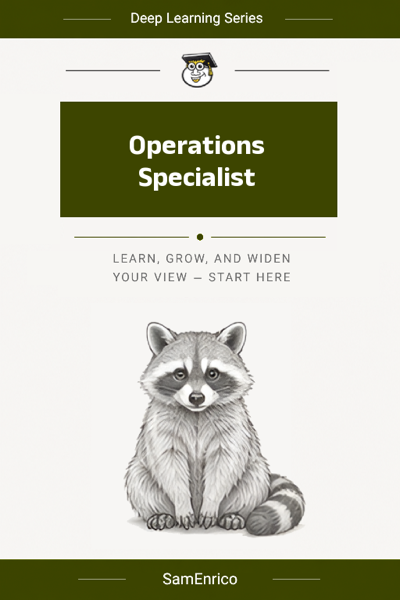
Non-FictionInformativeEducational
Operations Specialist eBook
A Coursebook on Operations Specialist
A Coursebook on Operations Specialist
Formats
Free sample
Chapter 1: The Busy Trap--–- Maria Vasquez had been an operations specialist for eleven years, and she had never felt less productive than she did right now.It was 3:47 PM on a Tuesday. She was standing in front of whiteboard covered in half-erased numbers, holding a printout of last month's production report, while her boss, David, gestured emphatically at a bar chart that someone had spent three hours formatting in Excel. The chart showed that the packaging line had increased its output by 12 percent. David was celebrating. Maria was worried."Twelve percent, Maria," David said, tapping the chart with his knuckle.
"That's what I call results."Maria looked at the bar chart. Then she looked past it, through the glass wall of the conference room, at the factory floor below. The packaging line was running at full speed, as always. But between the packaging line and the shipping dock, there was a mountain of half-finished product stacked on pallets—higher than she had ever seen it. The shipping team was working overtime, but the mountain wasn't shrinking.
It was growing."David," she said carefully, "do you know where that packaging output is going?"David blinked. "To customers?""Eventually," Maria said. "Right now, it's going to the floor. We have three weeks of work-in-progress sitting between packaging and shipping. The shipping team can only load two trucks a day.
Packaging is producing enough for three trucks. Every day, the pile grows by about a day's worth of production."David looked at the floor, then back at the chart. He didn't see the connection. "But packaging output is up twelve percent.""Yes," Maria said. "And nothing is shipping faster.
Customer lead times haven't changed. We're just building a bigger pile."This is the conversation that ends careers. Not because Maria was wrong—she was right—but because she had just told her boss that his favorite metric was meaningless. David had been celebrating the packaging line's efficiency improvements for three months. He had mentioned the 12 percent increase in three separate leadership meetings.
He had used it to justify a bonus for the packaging team manager. And now Maria was telling him that none of it mattered.David's face did something complicated. "So what are you suggesting?"Maria took a breath. "I'm suggesting that we don't have a packaging problem. We have a shipping problem.
Shipping is the bottleneck. Packaging is just filling the buffer.""Then we need to increase shipping capacity," David said."Maybe," Maria said. "But first, we need to understand why shipping is the bottleneck. Is it the dock doors? The truck schedule?
The loading process? The pallet configuration? We've been optimizing packaging for three months, and nobody has spent ten minutes watching the shipping dock."David was quiet for a long moment. Then he said: "Let me think about it."Maria knew what that meant. It meant "let me keep celebrating the metric that makes me look good, and let me ignore the problem that makes me look bad." It meant that tomorrow, the packaging line would run even faster, the pile would grow even higher, and nobody would ask why customers were still waiting the same amount of time for their orders.It meant that Maria was winning the efficiency game and losing the profitability game.
And she was exhausted.The Most Dangerous Word in Operations The word is "busy."In almost every organization, "busy" is treated as a virtue. People wear their exhaustion like a badge of honor. Teams measure their value by how many hours they worked, how many tasks they completed, how many emails they sent. The implicit assumption is that if everyone is busy all the time, the organization must be performing well.This assumption is wrong. And it is the single biggest barrier to operational excellence."Busy" is a measure of activity.
"Profitable" is a measure of outcome. They are not the same thing, and in most organizations, they are inversely correlated. The packaging line that ran twelve percent faster did not make the company one dollar more profitable. It just shifted inventory from raw materials to work-in-progress. Until that inventory becomes a finished product sitting on a customer's loading dock, it is not revenue.
It is just a very expensive pile of stuff that cost money to produce and has not yet generated a penny in return.This chapter will introduce the most important framework in this entire book: the Theory of Constraints. It is a way of seeing organizations not as collections of independent departments, but as systems of interdependent steps. And the most important insight of the Theory of Constraints is this: every system has exactly one constraint—one step that limits the total output of the entire system. Every other step in the system has excess capacity. Improving a non-constraint does not make the system more productive.
It only makes the non-constraint faster at producing something that cannot be used.If you are an operations specialist, the single most important question you can ask is not "How do I make this step faster?" It is "What is the constraint?"Most operations specialists never ask this question. They spend their days optimizing whatever problem happens to be loudest—the machine that broke down, the supplier that missed a delivery, the employee who made a mistake. They are busy. They are exhausted. And they are not moving the needle.This book is about becoming a different kind of operations specialist.
One who is not busy. One who is effective.The Three Metrics That Actually Matter Before we can identify the constraint, we need a common language for what we are trying to achieve. Eliyahu Goldratt, the physicist who developed the Theory of Constraints, proposed that every operational system can be measured by exactly three numbers. Everything else is a distraction.Throughput is the rate at which the system generates money through sales. Not production.
Not shipments. Sales. If you produce a thousand units and ship them to a warehouse, you have increased inventory, not throughput. Throughput happens when the customer pays. This distinction is crucial because it reveals the difference between being busy (producing) and being profitable (selling).Inventory is all the money that the system has invested in things it intends to sell.
Raw materials, work-in-progress, finished goods in a warehouse—all of it is inventory. Inventory is not an asset in the operational sense; it is money that is trapped, unable to be used for anything else until it becomes throughput.Operational Expense is all the money the system spends to turn inventory into throughput. Labor, utilities, rent, maintenance, logistics—everything required to run the operation.Here is the radical insight: throughput should go up. Inventory and operational expense should go down. But most organizations measure exactly the wrong things.
They celebrate when operational expense goes down (we cut costs!) without asking whether throughput went down even more. They celebrate when inventory goes down (we're lean!) without asking whether throughput suffered because of stockouts. They celebrate when production volume goes up (we're busy!) without asking whether that production actually turned into sales.The packaging line at Maria's company increased its output by twelve percent. Did throughput increase? No.
Did inventory increase? Yes. So the company spent more money (operational expense for the packaging line) to produce more stuff…
This is the end of the free sample. Get the eBook to keep going. Buy now
About this book
Details
- Author
- Beattie Shemika
- Publisher
- SamEnrico
- Language
- English
- Genre
- Non-Fiction, Informative, Educational
- Released
- 2026-06-02
- Pages (approx.)
- 134
- Available as
- eBook, Audiobook

Read better in the ZLOADR app
Your eBooks on your phone or tablet. Sign in with your SamEnrico account and start reading.
More by Beattie Shemika
 WFH Billable Hour TrackingBeattie Shemika$11.99
 The Career Comparison on SocialBeattie Shemika$11.99
 Veblen Goods Demand BriefBeattie Shemika$11.99
 Gambling Addiction and Chronic PainBeattie Shemika$11.99
 The Fall of Florence: A Renaissance LostBeattie Shemika$11.99
 Learn to Play the TAR (Lute)Beattie Shemika$11.99
 Simplify Technical Language GuideBeattie Shemika$12.99
 How to Start a Bit Stock Drill Business (Beginners Guide)Beattie Shemika$11.99
You may also like
 Hong Kong Handover 1997Dunn Johnnie$11.99
 Zumba For Postnatal Recovery CourseNeal Christian$11.99
 Zumba for BeginnersLadner Nikia$11.99
 YouTube Comment Mining GuideHumes Pandora$12.99
 Worry Box MeditationCarlin Rudy$11.99
 Workplace Stress MeditationNguyen Lynn$11.99
 Workplace Stress and Sleep RepairHawley Ivory$11.99
 Workplace Perfectionism CureDelaney Jeffry$11.99
 Workplace Injustice Anger GuideWallen Isabelle$11.99
 Work Addiction and Burnout LinkGreenwood Ester$11.99
 Women in Yoga and WellnessBeattie Galina$11.99
 Women in Stand Up ComedyChun Evangeline$11.99