
Non-FictionInformativeEducational
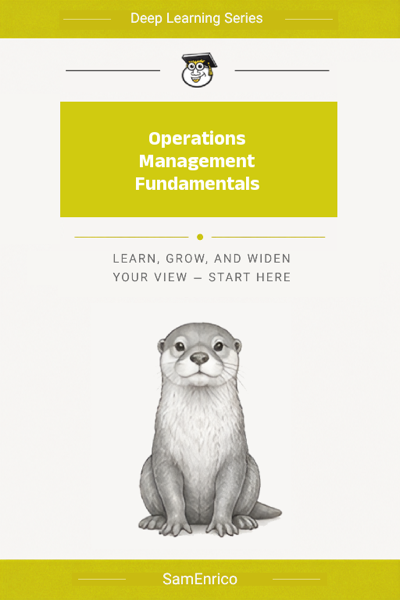
Operations Management Fundamentals eBook
A Coursebook on Operations Management Fundamentals
A Coursebook on Operations Management Fundamentals
Formats
Free sample
Chapter 1: The Value Factory--– Every organization on earth, from a one-person consulting firm to a multinational automobile manufacturer, operates a hidden factory. This factory does not appear on any org chart. It has no fancy lobby or brass nameplate. Yet it determines whether the organization thrives or barely survives. This hidden factory is the operations system—the collection of processes, people, technologies, and decisions that transform raw inputs into finished outputs of greater value.
When this factory runs well, customers receive quality products on time, costs stay under control, and employees take pride in their work. When it runs poorly, even the most brilliant marketing campaigns and generous budgets cannot prevent delays, defects, and disappointment.Operations management is the discipline of designing, running, and improving this hidden factory. It applies everywhere. A hospital administers medicine, a bank processes transactions, a restaurant cooks meals, a software company deploys code, and an airline moves passengers—all through operations. The tools and principles may vary by context, but the underlying logic remains constant: convert inputs into outputs efficiently and effectively, creating value for customers and prosperity for the organization.This opening chapter builds the foundation for everything that follows.
We will explore the core transformation model that underpins all operations. We will distinguish between goods, services, and the increasingly important hybrid offerings that blend both. We will introduce the 4 V’s framework—Volume, Variety, Variation, and Visibility—which explains why operations differ so dramatically across industries. We will examine how operations delivers competitive advantage through cost, quality, speed, flexibility, and sustainability. We will clarify the difference between a value chain and a supply chain, two concepts often confused but critically distinct.
We will tour the historical evolution of operations thinking, from craft production through scientific management, mass production, lean, and digital operations. Finally, we will learn how to measure productivity, the ultimate scorecard of operational effectiveness.By the end of this chapter, you will see every organization differently. Where others see products and services, you will see transformation processes. Where others see departments and titles, you will see flows of materials and information. Where others see problems, you will see opportunities to eliminate waste and create value.
This is the operations management mindset, and it begins here.The Transformation Model: The Engine of Value Creation Every operation, regardless of size or sector, can be understood through a simple yet powerful framework: the transformation model. At its core, the model states that operations take inputs, perform a transformation process, and produce outputs. Inputs enter the system, value is added during transformation, and outputs exit to customers. The difference between the value of outputs and the cost of inputs is the value created by the operation.Inputs fall into two categories. Transformed resources are the materials, information, or customers that undergo the transformation.
A factory transforms steel and plastic into cars. A call center transforms customer questions and agent knowledge into resolved issues. A hospital transforms sick patients and medical expertise into healthy individuals. Transforming resources are the assets that perform the transformation: facilities, equipment, technology, and people. Neither category can succeed without the other.
The most skilled surgeons cannot operate without an operating room; the most advanced robotic assembly line cannot function without trained technicians.The transformation process itself can take many forms. Physical transformation changes the shape, composition, or properties of materials—milling lumber, molding plastic, refining crude oil. Locational transformation moves goods or people from one place to another—trucking freight, flying passengers, shipping containers. Transactional transformation changes ownership or possession—ringing up a sale, settling a trade, transferring funds. Physiological transformation changes the condition of human bodies—performing surgery, administering physical therapy, delivering a baby.
Informational transformation processes data into knowledge—calculating credit scores, generating weather forecasts, analyzing medical images. Most real-world operations combine several transformation types simultaneously. A single hospital visit may involve physiological transformation (surgery), informational transformation (diagnostic imaging), and locational transformation (moving from emergency room to operating suite).Outputs are the finished products or services delivered to customers. Outputs must be valuable to the customer; otherwise, the operation has merely consumed resources without creating wealth. Value is subjective and context-dependent.
A luxury watch has high value to a collector but little value to someone who needs only to tell time. A rushed surgery that saves a life has immense value regardless of the small scar left behind. The operations manager’s task is to ensure that outputs provide sufficient value to justify the inputs consumed. When outputs exceed inputs in customer-perceived value, the operation can charge a price above its costs and generate profit. When outputs fall short, the operation destroys value regardless of how efficiently it ran.Consider a simple example: a coffee shop.
Inputs include coffee beans, milk, water, cups, lids, sugar, the espresso machine, the refrigerator, the counter space, the barista’s time and skill, and the cash register. Transformation includes grinding beans, tamping the grounds, extracting espresso, steaming milk, assembling the drink, and accepting payment. Outputs include a latte handed to a smiling customer. The value created is the difference between what the customer would pay for that latte (perhaps 5)andthecostofallinputs(perhaps5) and the cost of all inputs (perhaps 5)andthecostofallinputs(perhaps2). The coffee shop survives only as long as it consistently creates more value than it consumes.What makes the transformation model so powerful is its universality.
A supply chain manager uses the same framework to analyze raw material flows. A hospital administrator uses it to redesign patient intake. A software developer uses it to optimize code deployment. Once you learn to see operations through this lens, you can apply it anywhere.Goods, Services, and the New Hybrid Reality Traditional textbooks drew a sharp line between manufacturing and services. Manufacturers made tangible goods that customers could see, touch, and inventory.
Services delivered intangible experiences that were consumed at the moment of production. This distinction seemed clear and useful. A car was a good. A haircut was a service. End of story.The real world has become messier and more interesting.
Most organizations now deliver hybrid offerings that blend goods and services in complex ways. Apple sells i Phones (tangible goods) but also provides i OS updates, i Cloud storage, Apple Care support, and Genius Bar repairs (services). The value of the i Phone depends as much on the service ecosystem as on the hardware. Rolls-Royce no longer sells jet engines to airlines; it sells “power by the hour,” charging for engine uptime and maintenance services while retaining ownership of the physical asset. This shift, called servitization, transforms manufacturers into service providers and blurs the boundary between sectors.Understanding where an offering falls on the goods-services continuum matters for operations management.
Pure goods (a bag of cement, a kilogram of salt, a box of paper clips) can be produced in advance, stored in warehouses, shipped to customers, and inspected for quality before delivery. The customer never sees the production process, and the process does not require customer participation. Operational priorities center on cost, consistency, and throughput.Pure services (a psychotherapy session, a live concert, a legal consultation) cannot be stored, require customer presence during delivery, and are evaluated subjectively based on experience. Operational priorities center on…
This is the end of the free sample. Get the eBook to keep going. Buy now
About this book
Details
- Author
- Putnam Larraine
- Publisher
- SamEnrico
- Language
- English
- Genre
- Non-Fiction, Informative, Educational
- Released
- 2026-05-06
- Pages (approx.)
- 160
- Available as
- eBook, Audiobook

Read better in the ZLOADR app
Your eBooks on your phone or tablet. Sign in with your SamEnrico account and start reading.
More by Putnam Larraine
 Progressive Relaxation Audio GuidePutnam Larraine$11.99
 Stress Induced Lying FixPutnam Larraine$11.99
 Romania Remote Tax GuidePutnam Larraine$11.99
 Cannabis Withdrawal SleepPutnam Larraine$11.99
 Bipolar Parenting GuidePutnam Larraine$11.99
 Commensal Bacteria GuidePutnam Larraine$11.99
 Poetry Memorization LociPutnam Larraine$11.99
 Neuropathic Pain QuizPutnam Larraine$11.99
 Seams of Power: The Untold Story of Dior’s New Look and Post-War ParisPutnam Larraine$11.99
 The Enigma of the Zodiac Killer: Cracking the Code of FearPutnam Larraine$11.99
 Orpheus Unchained: The Lyre That Defied DeathPutnam Larraine$11.99
 The Mineral Guide to EnstatitePutnam Larraine$11.99
You may also like
 Hong Kong Handover 1997Dunn Johnnie$11.99
 Zumba For Postnatal Recovery CourseNeal Christian$11.99
 Zumba for BeginnersLadner Nikia$11.99
 YouTube Comment Mining GuideHumes Pandora$12.99
 Worry Box MeditationCarlin Rudy$11.99
 Workplace Stress MeditationNguyen Lynn$11.99
 Workplace Stress and Sleep RepairHawley Ivory$11.99
 Workplace Perfectionism CureDelaney Jeffry$11.99
 Workplace Injustice Anger GuideWallen Isabelle$11.99
 Work Addiction and Burnout LinkGreenwood Ester$11.99
 Women in Yoga and WellnessBeattie Galina$11.99
 Women in Stand Up ComedyChun Evangeline$11.99