
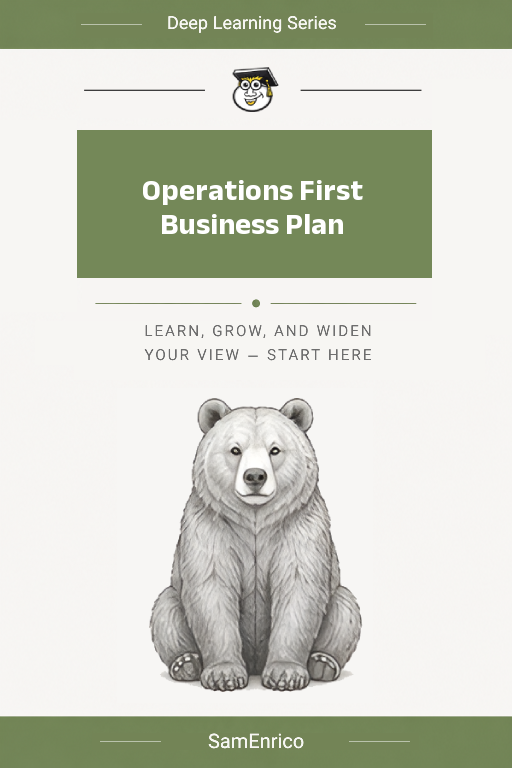
Non-FictionFirst 30 DaysOperations Management
Operations First Business Plan eBook
Design your one-page business plan around daily wo
by Manns Avery
Design your one-page business plan around daily workflows, SOPs, and fulfillment capacity for service reliability.
Formats
Free sample
Chapter 1: The Funeral Business...--The conference room smelled of stale coffee and regret. On the table lay a 47-page business plan—spiral-bound, color-coded, with a glossy cover featuring a stock photo of a team laughing around a whiteboard. It had taken Sarah three months to write. She had interviewed twenty customers, run financial projections out to five years, and crafted a mission statement so carefully worded that every verb had been debated for an hour.That was two years ago.The plan had sat in the corner of her office ever since, used occasionally as a coffee coaster and once as a doorstop. Today, Sarah was finally throwing it away.
As she dropped the spiral-bound document into the recycling bin, she felt not relief but a hollow ache. She had worked so hard on something that had never helped her deliver a single project on time, never prevented a single client complaint, never told a new hire what to do at 9:01 AM on a Tuesday."I don't need a doorstop," she said to the empty room. "I need to know why my team keeps missing deadlines."This book is for every founder who has written a plan that sits on a shelf. It is for the agency owner whose beautiful strategy deck has nothing to say about what happens when a client says "yes." It is for the consultant who can recite their mission statement from memory but cannot figure out why every project goes off the rails at the same point, every single time.The funeral in that conference room is not just Sarah's story. It is a metaphor for the hundreds of hours small business owners waste annually on plans that serve no operational purpose.
Across a survey of 500 small business owners, 75 percent rated their own strategic plans as "substandard" or "irrelevant" within ninety days of writing them. The reason is not poor strategy. It is poor fit for purpose.Traditional business plans were designed for exactly two audiences: bank loan officers and venture capitalists. Neither group cares about daily workflows, Standard Operating Procedures, or fulfillment capacity. They care about market size, exit multiples, and collateral.
This is a catastrophic mismatch for the service business owner who needs to deliver a client project at 2:00 PM on a Tuesday.This chapter will bury the traditional business plan and resurrect something far more useful: a one-page operating system that actually helps you deliver.The Four Fatal Flaws of Traditional Plans Let us examine the corpse on the table. The traditional business plan suffers from four fatal flaws that make it useless for operations.Flaw One: Obsession with Market Size The traditional plan dedicates entire sections to TAM (Total Addressable Market), SAM (Serviceable Available Market), and SOM (Serviceable Obtainable Market). These metrics rarely change week to week. They provide zero guidance for daily decisions. Knowing that your total addressable market is $2 billion does not tell you how to onboard a new client today.
It does not tell you what to do when a support ticket goes unanswered for six hours. It does not help you decide whether to hire another designer or buy a new piece of software.Market size matters for investors. It does not matter for operators. Yet founders spend weeks researching and modeling these numbers while their daily operations crumble around them.Flaw Two: The Hockey Stick Fantasy The traditional plan projects five years of financials based on "hockey stick" growth assumptions that almost never materialize. Revenue goes flat, flat, flat, then shoots upward at a 45-degree angle.
The author has reviewed hundreds of these projections. Not one has ever come true. The hockey stick is a fiction designed to impress people who will never run your business.The real financials that matter are not five years out. They are this week's collections, this month's cash runway, and this quarter's profit margin. A plan that cannot tell you whether you will make payroll in thirty days is not a plan.
It is a fantasy.Flaw Three: The 9:01 AM Void Open any traditional business plan and search for what happens at 9:01 AM on a Tuesday when a customer actually says "yes." You will find nothing. The plan describes the market, the competition, the team bios, and the exit strategy. It does not describe the workflow that turns a signed contract into a delivered project. It does not describe who does what, in what order, by when, and with what quality check.This void is where service businesses die. The gap between "signed contract" and "happy client" is filled with ambiguity, rework, missed deadlines, and founders working seventy-hour weeks.
The traditional plan pretends this gap does not exist.Flaw Four: Storytelling Over Structure The traditional plan rewards storytelling. The more persuasive the narrative, the more likely the plan is to get funded. This is the opposite of what an operating document needs. An operating document should be boring. It should be a checklist.
It should leave no room for interpretation or charisma.When a new hire asks "How do I do this task," they do not need a story. They need a bullet list. The traditional plan gives them a narrative about market disruption. The operations-first business gives them a one-page recipe card.The Operations-First Mindset Shift The solution is not a better traditional plan. The solution is to stop writing traditional plans altogether.
This requires a fundamental shift in how you think about your business.The Market-First mindset asks: "What could we sell? Who are our competitors? What is the exit strategy?" These are not wrong questions. They are just the wrong questions for daily operations. They produce plans that are persuasive but useless.The Operations-First mindset asks a different set of questions: "What can we reliably deliver with our current workflow?
What is our capacity ceiling? What is the daily delivery rhythm that keeps clients happy? Where do things get stuck? What do we need to document so a new hire can start without me?"Notice the difference. The Market-First mindset looks outward at opportunities.
The Operations-First mindset looks inward at execution. One produces a document for investors. The other produces a machine for customers.The One-Page Impact Plan The central artifact of this book is not a fifty-page document. It is a single landscape-oriented page divided into three vertical columns. Call it the One-Page Impact Plan.
It fits on one page because clarity drives execution. The shorter the plan, the more likely it will be used. The more it is used, the more it will improve. The more it improves, the more reliably your machine runs.The Strategy Column The Strategy Column occupies twenty percent of the page. It answers three questions.First, who do we serve?
This is not a broad market definition. It is a specific description of the client who gets the best results from your service. "Small businesses" is too broad. "Service-based businesses with three to ten employees and annual revenue between five hundred thousand and two million dollars" is specific enough to guide decisions.Second, what is our one-sentence promise? This is not a mission statement crafted by committee.
It is a promise you can keep, every single time, with your current workflow. "We deliver high-quality creative work" is…
This is the end of the free sample. Get the eBook to keep going. Buy now
About this book
Details
- Author
- Manns Avery
- Publisher
- SamEnrico
- Language
- English
- Genre
- Non-Fiction, First 30 Days, Operations Management
- Released
- 2026-06-01
- Pages (approx.)
- 119
- Available as
- eBook, Audiobook

Read better in the ZLOADR app
Your eBooks on your phone or tablet. Sign in with your SamEnrico account and start reading.
More by Manns Avery
 Values And Mission Alignment Core Principles GuideManns Avery$11.99
 TM for Pilots GuideManns Avery$11.99
 Embracing Failure For SuccessManns Avery$11.99
 Affirmations for Parenting Young KidsManns Avery$11.99
 The GAD in Older Adults GuideManns Avery$11.99
 The Great Flu Heist: How a Stolen Virus Nearly Doomed the WorldManns Avery$11.99
 Gravit Designer Free Replaces FigmaManns Avery$12.99
 Understanding Transcobalamin Ii DeficiencyManns Avery$17.99
 Vice President of Land Acquisitions and DevelopmentManns Avery$11.99
 How to Start a Cinema Business (Beginners Guide)Manns Avery$11.99
You may also like
 Hong Kong Handover 1997Dunn Johnnie$11.99
 Zumba For Postnatal Recovery CourseNeal Christian$11.99
 Zumba for BeginnersLadner Nikia$11.99
 YouTube Comment Mining GuideHumes Pandora$12.99
 Worry Box MeditationCarlin Rudy$11.99
 Workplace Stress MeditationNguyen Lynn$11.99
 Workplace Stress and Sleep RepairHawley Ivory$11.99
 Workplace Perfectionism CureDelaney Jeffry$11.99
 Workplace Injustice Anger GuideWallen Isabelle$11.99
 Work Addiction and Burnout LinkGreenwood Ester$11.99
 Women in Yoga and WellnessBeattie Galina$11.99
 Women in Stand Up ComedyChun Evangeline$11.99