
Non-FictionInformativeEducational
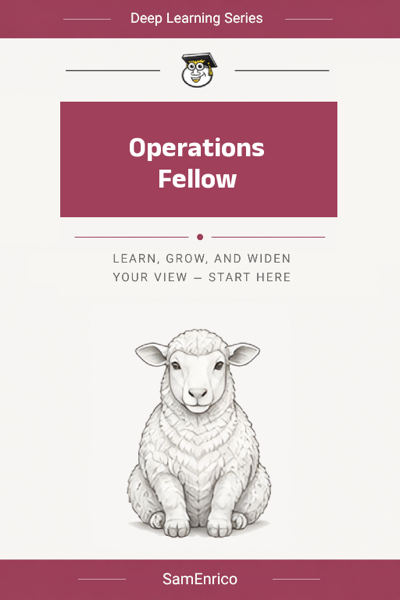
Operations Fellow eBook
A Coursebook on Operations Fellow
A Coursebook on Operations Fellow
Formats
Free sample
Chapter 1: The Apprentice Assumption--The first thing they don’t tell you about becoming an Operations Fellow is that you will spend your first ninety days feeling utterly useless. You will sit in meetings where everyone speaks a language of acronyms—MRP, ERP, OEE, TOC, SPC—as if they were born knowing them. You will be handed a spreadsheet with seventeen tabs and no legend. A well-meaning plant manager will take you on a tour of a facility that smells of lubricant and anxiety, pointing at machines that cost more than your college education, and you will nod as if you understand why a bottleneck in packaging matters more than a bottleneck in assembly. And late at night, staring at your hotel ceiling, you will wonder if you made a terrible mistake.This feeling is not a sign of failure.
It is a sign that you have misunderstood the nature of the fellowship itself.Most people enter operations roles believing that technical expertise is the destination. They think: if I just learn enough about supply chain, if I master Lean Six Sigma, if I can build a forecast in Excel with my eyes closed, then I will be valuable. Then I will be safe. Then I will be promoted. This is what I call the Apprentice Assumption—the belief that your job is to become a better technician, and that leadership will naturally follow.The Apprentice Assumption is wrong.
And it is the single biggest reason why brilliant operations analysts stall out two years into their careers.I have watched this happen more times than I can count. A high-potential analyst joins a fellowship program—maybe at a tech company, maybe a manufacturer, maybe a hospital system. They are smart, hungry, and technically adept. They learn the tools quickly. They can run a value stream map in their sleep.
They speak the language of capacity planning and safety stock. And then, around month ten, they hit a wall. Their projects stop getting funded. Their recommendations get polite nods and no action. Their stakeholders—the very people they are trying to help—start avoiding their emails.
The analyst looks at their calendar and sees nothing but coffee chats that go nowhere.The problem is never technical. The problem is that they never learned the difference between being a good analyst and being a good fellow.This book is not about making you a better analyst. This book is about making you a fellow—a strategic integrator who bridges the gap between the C-suite and the front lines, who uses deep operational expertise not as an end in itself but as a tool for influence, and who leaves behind not just better processes but better teams. By the time you finish these twelve chapters, you will understand why the Operations Fellow is the most underestimated role in modern business, and why mastering it can take you further than any MBA ever could.But first, we need to dismantle the Apprentice Assumption. We need to redefine what success looks like.
And we need to give you a roadmap that measures progress not in spreadsheet cells populated, but in rooms commanded.The Two-Year Apprenticeship That Isn’t Really an Apprenticeship Let me be precise about what an Operations Fellow actually is.An Operations Fellow is a high-potential early-to-mid-career professional placed into a finite, intensive two-year program designed to rotate through critical functional areas—supply chain, quality, logistics, process improvement, sometimes procurement or planning—while being embedded in strategic projects that matter to the executive team. Unlike a traditional operations analyst, who is measured by volume of work completed, the Fellow is measured by impact of work completed. Unlike a traditional operations manager, who is responsible for keeping the lights on day to day, the Fellow is explicitly chartered to find broken processes and fix them. And unlike either role, the Fellow reports not to a mid-level supervisor but to a senior leader—a COO, a Vice President of Operations, sometimes even a Chief Supply Chain Officer.Here is what that looks like in practice.In the first six months, you will learn the business. You will map processes you didn’t know existed.
You will sit in on budget meetings and realize that operations is always the first to get cut and the last to get credit. You will make mistakes. You will propose a solution that seemed brilliant on paper and fell apart the moment it touched reality. And you will learn that the most important question you can ask is not “How do I fix this?” but “Why hasn’t this been fixed already?” Because behind every broken process, there is a reason. And that reason is almost never stupidity.
It is almost always constraint.That question—“Why hasn’t this been fixed already?”—is the beginning of strategic thinking. It forces you to stop seeing yourself as the hero who will ride in with a Lean toolkit and save everyone. Instead, it forces you to see the system. To understand the trade-offs that previous leaders made. To recognize that the people who built the current process were not idiots; they were solving a different problem with different constraints.
Your job is not to judge them. Your job is to understand what has changed.In months six through eighteen, you will run your first major project. This is the crucible. You will have a charter, a budget (probably too small), a deadline (definitely too short), and a team that does not report to you. You will learn that authority is not the same as influence.
You will learn that the Gantt chart is the easy part; the hard part is getting people to change what they do every day. You will learn that some stakeholders will resist you not because your solution is wrong but because you did not invite them to the table early enough. And you will learn that the best project managers are not the ones with the most detailed plans but the ones who spend the first quarter of their timeline building relationships.In months eighteen through twenty-four, you will transition from doer to teacher. You will hand off your projects to people who will run them after you leave. You will document what you learned.
You will mentor the incoming cohort. And you will realize, perhaps with some surprise, that you have become the person other people come to for advice. Not because you know everything—you definitely don’t—but because you have learned how to ask better questions than anyone else in the room.Then you graduate. The fellowship ends. And you are launched into a career that could go anywhere: into general management, into supply chain leadership, into strategy, into starting your own company.
The two years were never the destination. They were the launchpad.Why the Traditional Operations Manager Mindset Will Fail You To understand what makes the Fellow different, we have to understand what makes the traditional operations manager different. And to do that, we have to be honest about the limitations of the role.A traditional operations manager is measured on stability. Their job is to maintain Key Performance Indicators, manage daily firefighting, and…
This is the end of the free sample. Get the eBook to keep going. Buy now
About this book
Details
- Author
- Brantley Nydia
- Publisher
- SamEnrico
- Language
- English
- Genre
- Non-Fiction, Informative, Educational
- Released
- 2026-05-04
- Pages (approx.)
- 137
- Available as
- eBook, Audiobook

Read better in the ZLOADR app
Your eBooks on your phone or tablet. Sign in with your SamEnrico account and start reading.
More by Brantley Nydia
 The Funnel Cost Per Lead GuideBrantley Nydia$11.99
 Burnout Recovery for CouplesBrantley Nydia$11.99
 The Last Moderate RepublicanBrantley Nydia$11.99
 Conversation Starters for Family GatheringsBrantley Nydia$11.99
 IBS Abdominal Massage GuideBrantley Nydia$11.99
 The Frozen Cure: Antarctica's Forgotten Fight Against InfectionBrantley Nydia$11.99
 The Last Dance of the Blue Angels: When Top Gun Met Real LifeBrantley Nydia$11.99
 Understanding Clayton–Smith–donnai SyndromeBrantley Nydia$17.99
 PODCAST: Digital Product LaunchBrantley Nydia$12.99
 Business Plan Example LibraryBrantley Nydia$12.99
 How to Start a Hobby in MagicBrantley Nydia$11.99
You may also like
 Hong Kong Handover 1997Dunn Johnnie$11.99
 Zumba For Postnatal Recovery CourseNeal Christian$11.99
 Zumba for BeginnersLadner Nikia$11.99
 YouTube Comment Mining GuideHumes Pandora$12.99
 Worry Box MeditationCarlin Rudy$11.99
 Workplace Stress MeditationNguyen Lynn$11.99
 Workplace Stress and Sleep RepairHawley Ivory$11.99
 Workplace Perfectionism CureDelaney Jeffry$11.99
 Workplace Injustice Anger GuideWallen Isabelle$11.99
 Work Addiction and Burnout LinkGreenwood Ester$11.99
 Women in Yoga and WellnessBeattie Galina$11.99
 Women in Stand Up ComedyChun Evangeline$11.99