
Non-FictionAI OperatorData IntegrationSystems Architecture
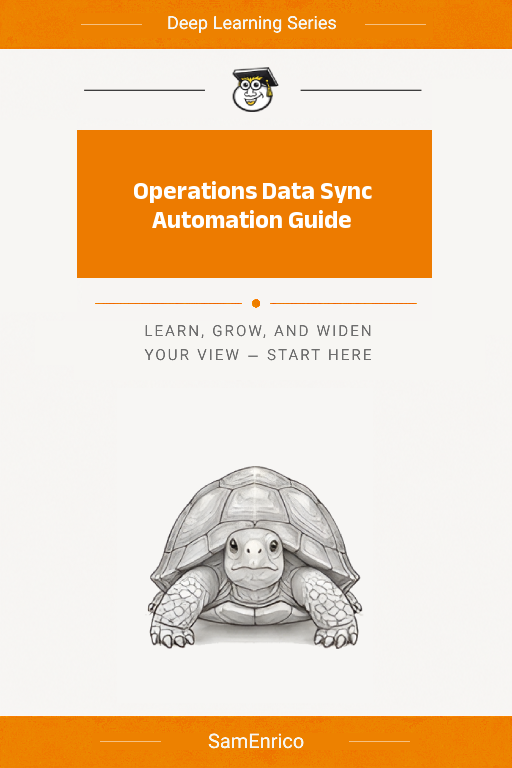
Operations Data Sync Automation Guide eBook
Connect CRM, ERP, and ticketing systems using AI m
Connect CRM, ERP, and ticketing systems using AI middleware. Schedule recurring data reconciliations and alert teams to anomalies without manual exports.
Formats
Free sample
Chapter 1: The Midnight Spreadsheet--It was 11:47 PM on a Tuesday, and Maria Vasquez had been staring at the same Excel file for four hours. Her screen showed three columns side by side: CRM sales orders, ERP fulfillment records, and ticketing system delivery confirmations. Column A said 847 units sold. Column B said 612 units shipped. Column C showed 1,203 support tickets labeled “Where is my order?”She had discovered the discrepancy at 4:00 PM.
She was still trying to explain it at midnight.Her CFO wanted answers by 9:00 AM. Her head of customer support wanted to know why the ticket queue had exploded. And her CEO had just sent a Slack message that she was too tired to open: “What’s happening with Q3 close?”Maria’s story is not unique. It plays out every night in thousands of companies—from five-person e-commerce shops to Fortune 500 enterprises. The details change, but the pattern is always the same.
Data lives in silos. Humans build bridges of copy, paste, and prayer. And eventually, those bridges collapse.This book is about why that happens, why it’s getting worse, and how a new approach called AI middleware can finally break the cycle. But before we get to solutions, we need to understand the problem in your own terms. Because until you see the true cost of fragmentation, you will keep building bridges that burn.The 5-15 System Problem: Why Your Tech Stack Is a Tower of Babel Let’s start with a simple question: How many software systems does your company use to run its daily operations?If you are in sales, you probably said CRM.
If you are in finance, ERP. If you are in support, ticketing. If you are in marketing, MAP. If you are in operations, WMS. If you are in HR, your own system.
And if you are in leadership, you have no idea.The average mid-sized enterprise runs on between five and fifteen core operational systems. Some companies have more. Few have fewer. The number itself is not the problem. The problem is that these systems were not designed to talk to each other.
Salesforce was built to track opportunities, not inventory. Net Suite was built to manage ledgers, not support tickets. Zendesk was built to handle customer complaints, not reconcile invoices.Each system is excellent at its specific job. Each system holds a piece of the truth. But no single system holds the whole truth.This is what we call the 5-15 System Problem.
It is the root cause of every reconciliation nightmare, every missed SLA, every angry customer who was told three different things by three different departments, and every operations analyst who cries in the bathroom at 6:00 PM on a Friday.The problem has three layers.Layer One: Structural Silos. The systems themselves do not share data by default. You can buy connectors, but they are usually one-way streets. Salesforce pushes data to the ERP, but the ERP never pushes back inventory updates. The ticketing system receives customer emails, but it has no idea whether that customer’s order has actually shipped.Layer Two: Semantic Silos.
Even when data moves, it speaks different languages. Salesforce calls it a “Close Date.” The ERP calls it “Actual Fulfillment Date.” The ticketing system calls it “Resolved Timestamp.” They are all timestamps. They all refer to the same event. But without translation, they might as well be in different alphabets.Layer Three: Temporal Silos. Data updates at different times.
The CRM refreshes every five minutes. The ERP batches overnight. The ticketing system streams in real time. By the time you try to reconcile a Monday morning order on Tuesday afternoon, the three systems are living in three different time zones.Maria’s midnight spreadsheet was not a failure of effort. It was a failure of architecture.
She was trying to solve a structural problem with manual labor. And no matter how hard she worked, the problem would return tomorrow night, and the night after, because the underlying silos had not changed.The Copy-Paste Tax: Calculating What Fragmentation Really Costs Most operations leaders cannot tell you exactly how much they spend on manual data reconciliation. They know it’s too much. They know it’s a drag on morale. But they have never put a number on it, because the number is buried in job descriptions, overtime requests, and the exhausted sighs of their best employees.Let’s fix that right now.The Copy-Paste Tax Formula:(Hours per week spent on manual reconciliation) × (Fully loaded cost of each employee doing it) × (Weeks per year)Here is a realistic example from a $50 million e-commerce company we will call Swift Direct.Swift Direct has three operations analysts, each earning 75,000basesalaryplusbenefits,bringingtheirfullyloadedcosttoapproximately75,000 base salary plus benefits, bringing their fully loaded cost to approximately 75,000basesalaryplusbenefits,bringingtheirfullyloadedcosttoapproximately110,000 per year.
Each analyst spends an average of fifteen hours per week—nearly two full workdays—reconciling data between their Shopify store (CRM-equivalent), Net Suite (ERP), and Zendesk (ticketing).Fifteen hours per week × 50 working weeks = 750 hours per year per analyst.750 hours × 55perhour(theirfullyloadedhourlyrate)=55 per hour (their fully loaded hourly rate) = 55perhour(theirfullyloadedhourlyrate)=41,250 per analyst per year.Three analysts = $123,750 per year.That is the direct labor cost. It does not include the engineers who are occasionally pulled in to write one-off SQL queries. It does not include the finance manager who spends four hours every month-end just reviewing reconciliation spreadsheets. It does not include the customer support agents who have to answer the same “Where is my order?” ticket three times because the CRM and ERP disagree on the shipment date.When you factor in all indirect costs, the total Copy-Paste Tax for a company of Swift Direct’s size typically lands between 200,000and200,000 and 200,000and400,000 annually.For a 500millionenterprise,thenumberoftenexceeds500 million enterprise, the number often exceeds 500millionenterprise,thenumberoftenexceeds2 million.Here is what makes this tax insidious: it grows faster than revenue. When Swift Direct launched, they had one analyst spending five hours a week on reconciliation.
As they added channels, systems, and customers, the workload grew non-linearly. Each new system adds not just its own data but also the complexity of matching it against every existing system. The Copy-Paste Tax scales with the square of the number of systems, not the square root.You can measure your own Copy-Paste Tax right now. Take out your phone. Open your calendar.
How many hours did you spend last week manually comparing data across systems? How many hours did your team spend? Multiply by your hourly cost. That is your tax. And it is almost certainly higher than you think.The Human Cost No Spreadsheet Captures Numbers tell one story.
People tell another.Maria, our midnight analyst from the opening, has been at her company for four years. She started as an operations coordinator, excited to build processes and solve problems. She was good at her job—fast, detail-oriented, relentless. But after two years of reconciliation, something changed.She stopped being excited to come to work. She started dreading month-end close.
She developed a twitch in her left eye that her doctor said was stress-related. She began fantasizing about quitting and becoming a florist.Maria is not lazy. She is not incompetent. She is burned out by…
This is the end of the free sample. Get the eBook to keep going. Buy now
About this book
Details
- Author
- Vasquez Felipe
- Publisher
- SamEnrico
- Language
- English
- Genre
- Non-Fiction, AI Operator, Data Integration, Systems Architecture
- Released
- 2026-06-01
- Pages (approx.)
- 151
- Available as
- eBook, Audiobook

Read better in the ZLOADR app
Your eBooks on your phone or tablet. Sign in with your SamEnrico account and start reading.
More by Vasquez Felipe
 Growth Hormone Cheat SheetVasquez Felipe$11.99
 Vacation Recovery Without Catch UpVasquez Felipe$11.99
 Nicotine Withdrawal Timeline GuideVasquez Felipe$11.99
 Addressing Elderly Parent CareVasquez Felipe$11.99
 Performance Review PalacesVasquez Felipe$11.99
 Dream Journaling for AddictionVasquez Felipe$11.99
 Danish Green Tax CreditsVasquez Felipe$11.99
 TM for School AdministratorsVasquez Felipe$11.99
 HGH And Longevity PathwaysVasquez Felipe$11.99
 The Weaver and the World: A Cherokee Cosmic TapestryVasquez Felipe$11.99
 The Silk Road Whisperer: How One Diplomat Broke the Ice Between EmpiresVasquez Felipe$11.99
 The High Stakes Heist: How a Casino Tycoon Outsmarted the MobVasquez Felipe$11.99
You may also like
 Hong Kong Handover 1997Dunn Johnnie$11.99
 Zumba For Postnatal Recovery CourseNeal Christian$11.99
 Zumba for BeginnersLadner Nikia$11.99
 YouTube Comment Mining GuideHumes Pandora$12.99
 Worry Box MeditationCarlin Rudy$11.99
 Workplace Stress MeditationNguyen Lynn$11.99
 Workplace Stress and Sleep RepairHawley Ivory$11.99
 Workplace Perfectionism CureDelaney Jeffry$11.99
 Workplace Injustice Anger GuideWallen Isabelle$11.99
 Work Addiction and Burnout LinkGreenwood Ester$11.99
 Women in Yoga and WellnessBeattie Galina$11.99
 Women in Stand Up ComedyChun Evangeline$11.99