
Non-FictionInformativeEducational
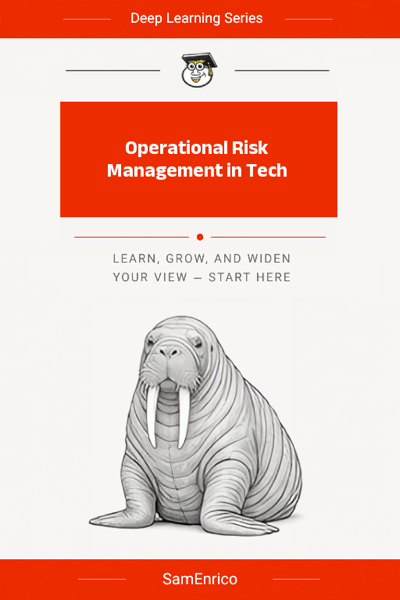
Operational Risk Management in Tech
A Coursebook on Operational Risk Management in Tec
A Coursebook on Operational Risk Management in Tech
Formats
About this book
Free sample
Inconsistencies and Repetitions in "The Tech Resilient Organization"A rigorous editorial review reveals several structural, conceptual, and pedagogical issues. Below is a categorized breakdown.I. Conceptual Inconsistencies (Internal Contradictions)1. The "Legacy ORM is dead" vs. "Use Basel/Three Lines" contradiction Chapter Position Problem Ch 1Legacy ORM frameworks "fail dramatically" in agile/cloud environments Declares traditional approaches obsolete Ch 2Adapts Basel Committee event types to modern tech Basel is a legacy ORM framework Ch 4Reimagines Three Lines of Defense for Dev Ops Three Lines is a legacy governance model Inconsistency: You cannot simultaneously claim traditional frameworks are fatally flawed and then spend two chapters adapting them.
Either Basel/Three Lines have enduring value (in which case Ch 1 is overstating) or they are truly obsolete (in which case Ch 2 and 4 are retrograde).Fix: Reframe Ch 1: "Legacy ORM as traditionally implemented (annual, spreadsheet-based, siloed) fails. But the principles within frameworks like Basel and Three Lines can be adapted—which we do in Ch 2 and 4."2. "Five-nines is insufficient" vs. "Use uptime metrics in RAROC"Chapter Position Ch 1Explicitly states: "Explain why 'five-nines availability' is insufficient as a risk metric"Ch 3Uses uptime/downtime as core inputs to RAROC calculations Inconsistency: If five-nines is insufficient, why build financial models around the same availability concept? The book never clarifies what replaces five-nines—it only critiques it.Fix: Introduce an alternative metric suite in Ch 1 (e.g., "error budget," "failure domain blast radius," "time to degraded state") and use those in Ch 3 instead of raw uptime.3.
RTO/RPO placement across two disconnected chapters Chapter Content Ch 3Risk tolerance statements include "recovery time objectives" (mentioned as KRAS metric)Ch 11RTO and RPO defined as technical concepts in disaster recovery Inconsistency: Ch 3 introduces RTO as a board-level risk appetite metric. Ch 11 introduces RTO as a technical DR concept—without referencing Ch 3. A reader encounters the same term twice, with different implied owners (board vs. engineers), and no bridge explaining that strategic RTO (board) should drive technical RTO (engineering).Fix: Ch 3 introduces "Strategic RTO" (business expectation). Ch 11 references back: "Recall the strategic RTO from Ch 3; now here is…
This is the end of the free sample. Get the eBook to keep going. Buy now
Contents
- Chapter 1
- Chapter 2
- Chapter 3
- Chapter 4
- Chapter 5
- Chapter 6
- Chapter 7
- Chapter 8
- Chapter 9
- Chapter 10
- Chapter 11
- Chapter 12
Details
- Author
- Oconnell Keeley
- Publisher
- SamEnrico
- Language
- English
- Genre
- Non-Fiction, Informative, Educational
- Released
- 2026-06-02
- Pages (approx.)
- 133
- Available as
- eBook, Audiobook

Read better in the ZLOADR app
Your eBooks on your phone or tablet. Sign in with your SamEnrico account and start reading.
More by Oconnell Keeley
 WhatsApp Addiction ManagementOconnell Keeley$11.99
 Eating Disorder Suicide Attempt GuideOconnell Keeley$11.99
 Weight Phobia Scale Face GuideOconnell Keeley$11.99
 The Stress Anaphylaxis Risk GuideOconnell Keeley$11.99
 1031 Exchange Safe HarborsOconnell Keeley$11.99
 Maui’s Fishing Line: The Hook That Tied the SkyOconnell Keeley$11.99
 Remote Review For Digital NomadsOconnell Keeley$12.99
 Digital Marketing Agency GuideOconnell Keeley$12.99
 How to Become a Ditch RiderOconnell Keeley$11.99
 Understanding Marsden–nyhan–sakati SyndromeOconnell Keeley$17.99
You may also like
 Hong Kong Handover 1997Dunn Johnnie$11.99
 Zumba For Postnatal Recovery CourseNeal Christian$11.99
 Zumba for BeginnersLadner Nikia$11.99
 YouTube Comment Mining GuideHumes Pandora$12.99
 Worry Box MeditationCarlin Rudy$11.99
 Workplace Stress MeditationNguyen Lynn$11.99
 Workplace Stress and Sleep RepairHawley Ivory$11.99
 Workplace Perfectionism CureDelaney Jeffry$11.99
 Workplace Injustice Anger GuideWallen Isabelle$11.99
 Work Addiction and Burnout LinkGreenwood Ester$11.99
 Women in Yoga and WellnessBeattie Galina$11.99
 Women in Stand Up ComedyChun Evangeline$11.99