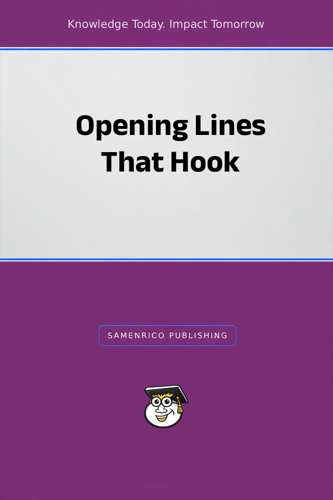
Opening Lines That Hook eBook
Craft powerful first sentences that grab attention
by Darby Jami
Craft powerful first sentences that grab attention from the very first word.
Formats
Free sample
Chapter 1: The Compound Window...–- You have already lost most of your readers. Not tomorrow, not after they finish this paragraph—but in the time it took you to read the word "lost." That is not hyperbole. That is physics.Let us sit with that discomfort for a moment. If you are writing a novel, a memoir, a business book, a blog post, or even an email to your boss, the first few words of your text are not merely an introduction. They are a survival mechanism.
And the environment they must survive in is more hostile than any previous generation of writers has faced.Consider what you are competing against. A smartphone user checks their device an average of 96 times per day. That is once every ten waking minutes. Each time the screen lights up, a battle begins between your carefully crafted sentence and a dopamine engine designed by the most sophisticated attention engineers in human history. Your sentence is fighting Tik Tok, Instagram, breaking news, text messages from real humans, and the quiet but persistent urge to check if anyone has liked your post from three hours ago.In this environment, the opening line is not art.
It is a bridge. And bridges have one job: to get someone from here to there before they turn around and walk back to where they came from.The Three Micro-Moments That Decide Everything For years, writing advice has circulated a comforting myth: you have "ten seconds" to hook a reader. This is not wrong, but it is dangerously incomplete. The truth is more precise and, frankly, more useful. Reader decisions happen in three compounding micro-moments, each lasting only a fraction of a second, each building on the last.
Understanding these three moments is the difference between guessing at your opening line and engineering it.Micro-Moment One: Millisecond Zero This is the first three to five words of your text. Before the reader has consciously registered a single noun or verb, their brain has already made a survival calculation. Is this text familiar or foreign? Safe or threatening? Worth the energy of decoding or not?Neuroscience research on pattern recognition shows that the human brain is constantly running predictive models.
When you encounter the first words of a text, your brain unconsciously asks: "Do I recognize the shape of this? Have I seen this kind of sentence before? Does it fit a pattern I already understand?" If the answer is yes, you relax slightly and continue. If the answer is no—if the opening is too strange, too abrupt, or too confusing—your brain flags it as cognitively expensive. And a brain that senses high cost with no clear reward will simply stop.Consider these two hypothetical openings:"The committee meeting had been scheduled for 2 PM...""Listen, here is what nobody tells you about committees..."The first opening triggers a mild sense of obligation.
It feels like a report. The second opening triggers curiosity and intimacy. It feels like a secret. That feeling happens before you have read the word "committee" in either sentence. That is Millisecond Zero at work.Micro-Moment Two: The Sentence Finish If you survive Millisecond Zero, the reader commits to finishing the sentence.
This is not a conscious choice—it is a momentum effect. Once the brain has invested in decoding the first few words, it will generally complete the pattern unless something goes terribly wrong. The Sentence Finish is your grace period.But here is the trap. Many writers assume that if a reader finishes their first sentence, they have won. They have not.
They have only earned the right to attempt Micro-Moment Three.Micro-Moment Three: The Second Sentence Bridge This is where careers die.Data from publishing analytics platforms and eye-tracking studies consistently show that approximately 50 percent of readers who finish your first sentence will abandon your text during your second sentence. Half. Gone. Not because your second sentence was bad, necessarily, but because your first sentence failed to do its one job.What is that job? Simple: the first sentence must sell the second sentence.Most writers believe the first sentence should sell the book.
It should not. It cannot. A single sentence cannot convey theme, character, plot, stakes, and voice simultaneously. When writers try to pack everything into sentence one, they produce bloated, confusing openers that trigger every hidden objection we will explore in Chapter 2. The first sentence has a much narrower, much more achievable goal: make the reader want to read the second sentence.
That is all. The second sentence sells the third. The third sells the fourth. And so on, like a line of falling dominoes, until the reader has finished your book and is telling their friends about it.Stephen King understands this at a cellular level. In his memoir On Writing, King describes rewriting the opening line of Carrie dozens of times.
Not because he was trying to capture the entire horror novel in one sentence—but because he was trying to build a ramp that would launch the reader into sentence two. King knows that if he loses the reader on sentence two, nothing else in the book matters. He has compared writing an opening line to building a trap: the first sentence is the bait, the second sentence is the spring, and the reader is the animal who does not realize they have been caught until they are already ten pages in.The Mirror Neuron Problem There is a deeper neurological reason why opening lines matter so much, and it has to do with a class of brain cells called mirror neurons. Discovered by Italian neuroscientists in the 1990s, mirror neurons fire both when you perform an action and when you observe someone else performing that action. They are the reason you flinch when you see someone stub their toe.
They are the reason yawns are contagious. And they are the reason readers feel what characters feel.Here is what this means for your opening line. Within milliseconds of encountering an emotion-laden word, your reader's mirror neurons begin simulating that emotion in their own body. If you write "panic," their heart rate edges up. If you write "grief," their chest tightens slightly.
If you write "boredom," their attention drifts. Your reader does not choose to feel these things. The feeling happens to them, automatically, before they can decide whether they want to feel it.This is why the emotional anchor we will discuss in Chapter 3 (The In Medias Res Explosion) is so powerful. By placing a clear emotional signal within the first ten words of your text, you are literally rewiring your reader's nervous system to match the emotional register of your story. You are not asking them to feel something.
You are making them feel it.But mirror neurons also explain why boring openings are so lethal. If you open with weather ("It was a sunny Tuesday"), your reader's mirror neurons simulate the emotional experience of a sunny Tuesday, which is to say, no emotional experience at all. You have just told their nervous system: "Nothing interesting is happening here. You may power down." And their nervous system, being efficient, will oblige.The Data Behind the Disaster Let…
This is the end of the free sample. Get the eBook to keep going. Buy now
About this book
Details
- Author
- Darby Jami
- Publisher
- SamEnrico
- Language
- English
- Genre
- Non-Fiction, Self-Help, Speech Writing
- Released
- 2026-06-06
- Pages (approx.)
- 139
- Available as
- eBook, Audiobook

Read better in the ZLOADR app
Your eBooks on your phone or tablet. Sign in with your SamEnrico account and start reading.
More by Darby Jami
 IBS And Sleep Hygiene GuideDarby Jami$11.99
 Discussing Salary and PromotionsDarby Jami$11.99
 Pills Anonymous ExplainedDarby Jami$11.99
 The Emotional Habit TrackerDarby Jami$11.99
 Schizophrenia and Smoking CessationDarby Jami$11.99
 Alcohol Detox Nutrition GuideDarby Jami$11.99
 Hippocrates & Theano: The Healing Hearts of CosDarby Jami$11.99
 Fermented Foods ListDarby Jami$11.99
 The Silent Poets of Ancient Greece: How Women Shaped Early CinemaDarby Jami$11.99
 Service Providers Guide to Reconstructive Plastic SurgeryDarby Jami$11.99
 How to Produce Traditional Leather PantsDarby Jami$11.99
 Legal and Compliance BlocksDarby Jami$12.99