
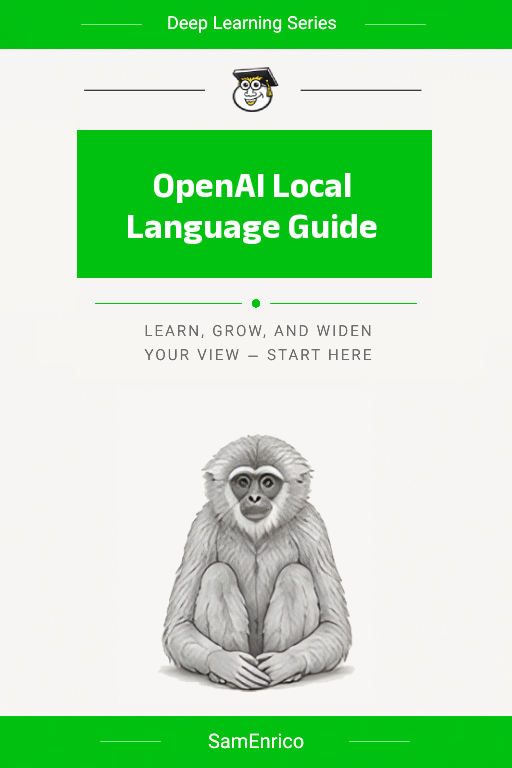
Non-FictionStartup GuideNLP for Emerging Markets
OpenAI Local Language Guide eBook
Fine tune GPT models for under resourced languages
by Staley Sandy
Fine tune GPT models for under resourced languages including Swahili, Tagalog, and Hindi with retrieval augmented generation and low cost inference strategies.
Formats
Free sample
Chapter 1: Beyond Web Scraping--–- The most dangerous sentence in artificial intelligence is also the most common: “I’ll just scrape some data and fine-tune.”I have heard this sentence spoken by engineers at well-funded startups, by researchers at top universities, and by independent developers working out of coffee shops in Manila and Nairobi. Every single one of them regretted it. Not because scraping is wrong, but because scraping alone is a trap. It gives you the illusion of progress while hiding the real work of building a language model that actually understands Swahili, Tagalog, or Hindi.Let me tell you about Mira. She was a machine learning engineer in Mumbai who had spent six weeks scraping Hindi news websites.
She had accumulated eight gigabytes of text. Eight gigabytes. She was proud of that number. She had written clever scrapers that bypassed rate limits and rotated user agents. She had stored everything in a tidy Parquet file.
And when she finally fine-tuned a small model on her eight-gigabyte corpus, the model produced Hindi that sounded like a government press release written by a robot having a stroke.Mira had made the same mistake that hundreds of engineers make every month. She confused quantity with quality. She confused accessibility with usefulness. She confused the web with the world.The reality is brutal but liberating. For under-resourced languages like Swahili, Tagalog, and Hindi, the open web is not your friend.
It is a carnival mirror that reflects a distorted version of the language. Formal news dominates. Conversational speech is nearly absent. Code-switching, dialects, and domain-specific terminology appear only in the cracks and corners that web scrapers cannot reach.This chapter is not a gentle introduction to data collection. It is a strategic intervention.
By the time you finish reading, you will understand exactly why web scraping failed for Mira and Juma and dozens of others. You will learn the three alternative data sources that actually work for low-resource languages. And you will build a data engine that produces not gigabytes of noise, but thousands of high-value sentences that will make your fine-tuned model ten times more capable than anything you could build with web-scraped garbage.Let us begin with the paradox that explains everything.The Data Scarcity Paradox Explained The numbers are worse than you think.According to the 2024 Common Crawl analysis, English accounts for fifty-eight percent of all web text. Chinese follows at twenty-one percent. Spanish, German, French, and Russian combine for another fifteen percent.
Every other language on Earth fights for the remaining six percent.Now consider the three languages at the heart of this book. Swahili, spoken by over two hundred million people across Tanzania, Kenya, Uganda, and the Democratic Republic of Congo, accounts for less than two-tenths of one percent of web text. Tagalog, the national language of the Philippines with over one hundred million speakers, accounts for roughly one-tenth of one percent. Hindi, spoken by more than six hundred million people, barely crosses half a percent.Here is the paradox. These languages have hundreds of millions of daily speakers.
They have vibrant literary traditions, thriving film industries, and active digital communities. But the public web—the part that search engines index and scrapers can access—contains almost none of their actual language use.Why? Because the majority of Swahili, Tagalog, and Hindi communication happens in spaces that web scrapers cannot reach. Whats App groups. Facebook Messenger threads.
You Tube comment sections behind login walls. Voice notes in private Telegram channels. Offline conversations in markets and offices. The living, breathing language of daily life is systematically invisible to the tools that data scientists rely on.What remains on the open web is a distorted sample. News articles written in formal registers.
Government press releases translated from English. Wikipedia articles created by a small group of dedicated editors. Some blogs and forums, yes, but overwhelmingly produced by urban, educated, male writers.This is the Data Scarcity Paradox. The languages with the most speakers outside of China have the least usable web data. And the data that does exist is systematically biased toward the most formal, most English-influenced, least representative registers of the language.If you try to fine-tune a model on this data alone, you will build a model that sounds like a news anchor who has never had a conversation.
It will fail on code-switching. It will fail on dialects. It will fail on the actual language that real people use to ask about crop pests, dispute credit card charges, or summarize legal documents.The Three Failures of Web Scraping Let me be specific about why web scraping fails for each of our target languages. These are not theoretical concerns. They are failure modes that I have watched engineers encounter in real projects.Failure One: The Swahili Register Collapse Swahili has a rich system of noun classes that function somewhat like grammatical gender in German or French, but with fifteen distinct classes instead of three.
In proper Swahili, you must match adjectives, verbs, and pronouns to the noun class of the subject. A good child is mtoto mzuri. Good children are watoto wazuri. A good book is kitabu kizuri. Good books are vitabu vizuri.Web-scraped Swahili from news websites is overwhelmingly written in the ki class (class 7, for objects and things) and the wa class (class 2, for people).
The other thirteen classes appear rarely or not at all. A model trained on this data learns that Swahili has two noun classes instead of fifteen. When a farmer asks about mahindi (maize, which belongs to class 6), the model has no idea how to agree with it.I have watched this failure happen in real time. An engineer in Nairobi had scraped fifty thousand Swahili news articles. His model generated perfectly grammatical sentences in class 7 and class 2, and nonsense everywhere else.
He had gigabytes of data. He had zero sentences that contained the noun class patterns he actually needed.Failure Two: The Tagalog Code-Switching Blindness Tagalog, as spoken in Manila and across the Philippines, is not a pure language. It is Taglish: a fluid mixture of Tagalog grammatical structures with English nouns, verbs, and adjectives. A typical Tagalog customer support query looks like this:“Yung order ko #12345, hindi pa dumadating. Saan na po?”Literally: “The order my #12345, not yet arrived.
Where already polite?”The English words “order” and “arrived” are embedded in Tagalog syntax. This is not sloppy language. It is the standard register of everyday communication. But web-scraped Tagalog from news websites contains almost no code-switching. News editors enforce language purity.
They translate English nouns into Tagalog equivalents that no one actually uses.A model trained on news Tagalog will see “Ang aking order na bilang 12345 ay hindi pa dumarating” and have no idea that this is not how real people talk. When a customer sends a genuine Taglish message, the model fails to parse the English words correctly because it was never trained on them.Failure Three: The Hindi Formality Trap Hindi exists on a spectrum. At one end is highly Sanskritized, formal Hindi used in government documents and news broadcasts. At the other end is Hinglish: Hindi mixed with English, used in Bollywood movies, Whats App messages, and…
This is the end of the free sample. Get the eBook to keep going. Buy now
About this book
Details
- Author
- Staley Sandy
- Publisher
- SamEnrico
- Language
- English
- Genre
- Non-Fiction, Startup Guide, NLP for Emerging Markets
- Released
- 2026-05-28
- Pages (approx.)
- 160
- Available as
- eBook, Audiobook

Read better in the ZLOADR app
Your eBooks on your phone or tablet. Sign in with your SamEnrico account and start reading.
More by Staley Sandy
 Teasing and Bullying TriggersStaley Sandy$11.99
 Green Beret Robin Sage TestStaley Sandy$11.99
 Food Addiction Freedom WorkbookStaley Sandy$11.99
 Creative Team Recognition GuideStaley Sandy$11.99
 Group Project Survival CourseStaley Sandy$11.99
 The Himalayan Yeti Debate: Science vs. Legend in the Roof of the WorldStaley Sandy$11.99
 The Djinn’s Oath: A Norse Warrior’s Bargain with the SandsStaley Sandy$11.99
 Chinese Student MotivationStaley Sandy$12.99
 Understanding GalactorrheaStaley Sandy$17.99
 Cloud Native DeveloperStaley Sandy$11.99
 How to Start a Snack Food Manufacturing BusinessStaley Sandy$11.99
You may also like
 Hong Kong Handover 1997Dunn Johnnie$11.99
 Zumba For Postnatal Recovery CourseNeal Christian$11.99
 Zumba for BeginnersLadner Nikia$11.99
 YouTube Comment Mining GuideHumes Pandora$12.99
 Worry Box MeditationCarlin Rudy$11.99
 Workplace Stress MeditationNguyen Lynn$11.99
 Workplace Stress and Sleep RepairHawley Ivory$11.99
 Workplace Perfectionism CureDelaney Jeffry$11.99
 Workplace Injustice Anger GuideWallen Isabelle$11.99
 Work Addiction and Burnout LinkGreenwood Ester$11.99
 Women in Yoga and WellnessBeattie Galina$11.99
 Women in Stand Up ComedyChun Evangeline$11.99