

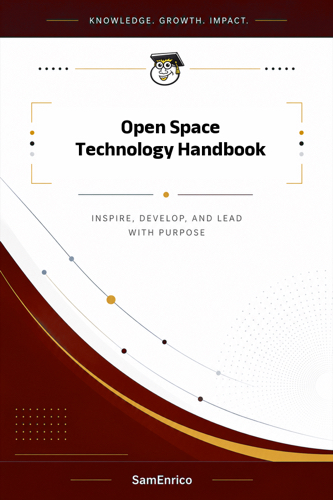
Non-FictionSelf-HelpUnconference
Open Space Technology Handbook eBook
Unleash self organized group creativity using this
Unleash self organized group creativity using this unconference collaboration method.
Formats
Free sample
Chapter 1: The $37 Billion Lie--–- The math was simple, and it was devastating. Sarah, a senior director of product at a mid-sized software company, had just completed a brutal exercise at the request of her new CEO. For two weeks, she had asked every member of her 120-person department to log every hour spent in meetings. Not the time meetings were scheduled for, but the actual time spent sitting in rooms or on Zoom calls, waiting for decisions that rarely came, watching slides that could have been emails, and feeling her soul slowly depart her body one fifteen-minute increment at a time.The number she arrived at made her dizzy. Her department was spending 2,800 hours per week in meetings.
That was seventy full-time employees — more than half her team — doing nothing but attending gatherings that most of them privately described as "necessary but not valuable." The annual cost, using fully loaded salaries and benefits, came to $4.2 million. For one department. In one year. On meetings that nobody loved, nobody remembered, and nobody would miss if they were simply deleted from the calendar.Sarah printed out the spreadsheet, walked to her CEO's office, and placed it on his desk without a word. He looked at the number.
He looked at her. He looked back at the number. Then he said something that would change the trajectory of her career and, eventually, the entire company."I know," he said. "What do we do about it?"That question — simple, desperate, honest — is the reason you are holding this book. Because Sarah had no good answer.
Neither did her CEO. Neither, as it turns out, does most of corporate America. We have built a culture of meetings that costs the US economy an estimated $37 billion annually in lost productivity, according to a synthesis of workplace studies from Atlassian, Harvard Business Review, and the consulting firm Doodle. Thirty-seven billion dollars. With a B.
That is more than the GDP of more than half the countries on earth.And the worst part? Almost nobody likes meetings. Surveys consistently show that 67 percent of senior leaders believe their organizations would be more productive with fewer meetings. Seventy-one percent of employees say meetings are "unproductive and inefficient." The average senior executive spends twenty-three hours per week in meetings, up from just ten hours in the 1960s. We have doubled our meeting time in two generations, and we have absolutely nothing to show for it except worse decisions, more exhausted teams, and a creeping sense that work has become something we attend rather than something we do.This book is the answer to Sarah's question.
It is a complete, practical, battle-tested method for turning your meetings from passive information dumps into active engines of collective intelligence. It is not a theory. It is not a set of soft skills for making bad meetings slightly less bad. It is a radical, counterintuitive, and surprisingly simple approach that has been used by everyone from Google and Nike to the United States Army and global humanitarian organizations. It works for five people in a conference room and five thousand people in a convention center.
It works in person, online, and in the messy hybrid space in between.But before we get to the solution — before we talk about circles and bulletin boards and the strange magic of surrendering control — we have to stare directly into the problem. Because the first step to curing a disease is admitting you have it. And corporate America, my friends, is very, very sick.The Math You Have Been Avoiding Let us get specific. Not with abstract statistics about "engagement" or "culture," but with the actual, painful math of your own calendar.Take out your phone or open your laptop. Go to your calendar for the past week.
Count every meeting that was scheduled for thirty minutes or longer. Do not count quick check-ins or fifteen-minute stand-ups. Count the real meetings — the ones with agendas (however loosely defined), the ones where someone shared a screen, the ones where you sat silently for long stretches wondering why you were there.How many did you find? The average knowledge worker has between fifteen and twenty-three such meetings per week. Now multiply that number by the average length of those meetings.
Most corporate meetings run forty-five minutes to an hour, but the truly destructive ones — the strategy offsites, the quarterly reviews, the all-hands "updates" — can consume entire days.Now do the salary math. Take your fully loaded hourly rate (your annual salary divided by two thousand working hours, plus 20-30 percent for benefits, overhead, and the quiet despair of opportunity cost). Multiply that by the hours you spent in meetings last week. That is what your meetings cost your employer last week. Just you.Now multiply that by the number of people in your department.
Then by the number of departments in your company. Then by the number of weeks in a year. What number did you get? If you are at a company of five hundred people, the answer is almost certainly north of $5 million. If you are at a company of five thousand, you are burning $50 million or more.
Every year. On meetings that most people describe, in anonymous surveys, as a waste of time.I have run this exercise with more than two hundred organizations over the past decade. Not once has a leader looked at the result and said, "That seems worth it." Not once. The typical response is a kind of queasy silence, followed by a slightly desperate question: "But what else can we do? We have to coordinate.
We have to align. We have to keep everyone informed."These are valid concerns. Coordination matters. Alignment matters. Information sharing matters.
But here is the lie that the meeting-industrial complex has sold us: the lie that the only way to achieve these goals is to gather everyone in a room (physical or virtual) and talk at them for an hour. The lie that presence equals productivity. The lie that a full calendar is a proxy for a full contribution.This is the $37 billion lie. And it is time to stop believing it.The Coffee Break Conspiracy In 1985, a man named Harrison Owen did something unusual. He organized a large international conference on organizational transformation.
He spent months planning the agenda, recruiting speakers, scheduling panels, and designing breakout sessions. He was proud of the result. The conference ran smoothly. The speakers showed up. The sessions started and ended on time.And then he read the evaluations.Owen had expected glowing reviews.
Instead, he found something puzzling. The formal sessions — the keynotes, the panels, the carefully structured workshops — received mediocre ratings at best. But the coffee breaks? The unstructured time between sessions? The hallway conversations that happened when nobody was watching?
Those were rated as the most valuable parts of the entire event.This made no sense to Owen. He had spent months designing the formal program. He had spent exactly zero minutes designing the coffee breaks. And yet, according to the participants, the coffee breaks were where the real work happened — where connections were made, where ideas crossed-pollinated, where problems that had seemed intractable suddenly revealed their solutions.Owen…
This is the end of the free sample. Get the eBook to keep going. Buy now
About this book
Details
- Author
- Lovell Solomon
- Publisher
- SamEnrico
- Language
- English
- Genre
- Non-Fiction, Self-Help, Unconference
- Released
- 2026-06-06
- Pages (approx.)
- 135
- Available as
- eBook, Audiobook

Read better in the ZLOADR app
Your eBooks on your phone or tablet. Sign in with your SamEnrico account and start reading.
More by Lovell Solomon
 Menopause Muscle Tension GuideLovell Solomon$11.99
 The Anger Antecedent AnalysisLovell Solomon$11.99
 Workaholism And OCD LinkLovell Solomon$11.99
 Navy SEAL BUD/S Training GuideLovell Solomon$11.99
 The Volcano Oracle: How Ancient Javanese Astronomers Predicted Cosmic FireLovell Solomon$11.99
 Prometheus Unbound: The Titan Who Gave Fire to MortalsLovell Solomon$11.99
 VIPKid Teaching Success GuideLovell Solomon$12.99
 Founder Buy Sell GuideLovell Solomon$12.99
 BackgammonLovell Solomon$11.99
 How to Start a Axial Flow Pump Business (Beginners Guide)Lovell Solomon$11.99
 Understanding Fryns–fabry–remans SyndromeLovell Solomon$17.99
You may also like
 Hong Kong Handover 1997Dunn Johnnie$11.99
 Zumba For Postnatal Recovery CourseNeal Christian$11.99
 Zumba for BeginnersLadner Nikia$11.99
 YouTube Comment Mining GuideHumes Pandora$12.99
 Worry Box MeditationCarlin Rudy$11.99
 Workplace Stress MeditationNguyen Lynn$11.99
 Workplace Stress and Sleep RepairHawley Ivory$11.99
 Workplace Perfectionism CureDelaney Jeffry$11.99
 Workplace Injustice Anger GuideWallen Isabelle$11.99
 Work Addiction and Burnout LinkGreenwood Ester$11.99
 Women in Yoga and WellnessBeattie Galina$11.99
 Women in Stand Up ComedyChun Evangeline$11.99