
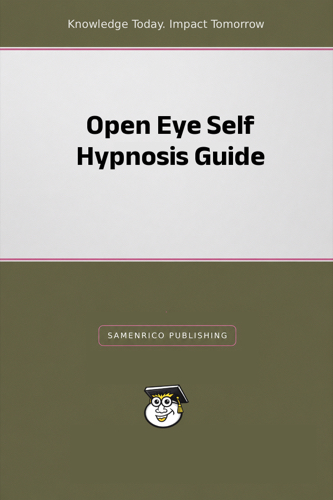
Non-FictionSelf-HelpAlert Hypnosis
Open Eye Self Hypnosis Guide eBook
Maintains trance with eyes open for practical dail
Maintains trance with eyes open for practical daily use.
Formats
Free sample
Chapter 1: The Gatekeeper’s Lie...--–- You are already a hypnotist. You have been one your entire life. The only problem is that you have been using your power backward—hypnotizing yourself into stress, limitation, and repetition while believing you were simply “living your life.”Every time you have driven a familiar route and arrived at your destination with no memory of the last ten miles, you were in a trance. Every time you have lost yourself in a movie, a video game, or even a good argument, you were in a trance. Every time you have bitten your nails, reached for a cigarette, or opened the refrigerator without conscious hunger, you were responding to a post-hypnotic suggestion you installed yourself.This is not metaphor.
This is neuroscience.The word “hypnosis” comes from the Greek hypnos, meaning sleep—a terrible translation that has caused more confusion than almost any other term in psychology. You do not need to sleep to enter hypnosis. In fact, the most powerful and practical form of self-hypnosis happens with your eyes wide open, your brain fully alert, and your body active in the world.This book exists because traditional self-hypnosis has failed you. It has failed most people. The standard model—lie down, close your eyes, listen to a soothing voice, and “drift into a deep, peaceful state”—requires conditions that do not exist in a modern life.
You cannot close your eyes in a boardroom. You cannot lie down on a subway. You cannot “drift” while your children need attention or your boss expects answers.The open eye method solves all of this. It works because you stay awake, not in spite of it.But before you learn the how, you must understand the why. And the why begins with a lie you have been told your entire life by the most convincing liar you will ever meet: your own conscious mind.The Gatekeeper Imagine for a moment that your brain is a castle.
This castle has two distinct regions. The outer bailey is your conscious mind—the part that reads these words, makes grocery lists, calculates tips, and worries about tomorrow’s meeting. It is loud, linear, and convinced of its own importance. The inner keep is your subconscious mind—the vast, silent library that runs your heartbeat, stores your memories, regulates your digestion, and holds every belief you have ever formed about who you are and what you deserve.Between these two regions stands a guard. Psychologists call him the Critical Factor.
In this book, we will call him the Gatekeeper.The Gatekeeper has one job: to protect the inner keep from unverified information. Every suggestion, every affirmation, every new idea must pass his inspection before it can reach your subconscious. And the Gatekeeper is ruthless. He rejects anything that conflicts with existing beliefs. He laughs at “positive thinking” that contradicts lived experience.
He says things like, “You cannot quit smoking—you have tried before,” and, “You are not a confident person—remember that presentation you botched in 2017?”Here is the lie the Gatekeeper tells you: I am you. My voice is your voice. My doubts are reality.This is false. The Gatekeeper is not you. He is a neural filter located primarily in your dorsolateral prefrontal cortex—a piece of brain hardware designed to maintain cognitive consistency, not to determine truth.
He confuses familiarity with fact. He mistakes repetition for reality. And he has no idea that he is about to become obsolete.The Great Misconception Most people believe that hypnosis requires the Gatekeeper to fall asleep. They imagine a stage show where a swinging watch and a deep voice somehow “turn off” the conscious mind, leaving the subject vulnerable and suggestible. This is not only wrong; it is the opposite of how effective hypnosis actually works.Stage hypnosis is entertainment, not therapy.
The swinging watch is a prop. The “sleep” command is theater. What actually happens—whether on a stage or in a therapist’s office—is that the subject’s attention is occupied, not eliminated.Here is the key insight that changes everything: the Gatekeeper can only process one focused stream of attention at a time.When you give the Gatekeeper a task—reading aloud, staring at a fixed point, counting breaths, even tapping your fingers in a pattern—he becomes so busy performing that task that he lowers his guard. He cannot simultaneously scan for “dangerous” new beliefs while decoding symbols on a page. He cannot reject a suggestion while maintaining a fixed gaze.
The task occupies his processing capacity, and the suggestions slip past him like whispers through a distracted security checkpoint.This is not speculation. This is the foundation of the Valencia Model of Waking Hypnosis, developed at the University of Valencia and validated by dozens of clinical trials since the 1980s. The researchers discovered what stage hypnotists had known intuitively for centuries: the most powerful inductions are not the ones that make you sleepy. They are the ones that make you busy.The Two Trances You Already Know Before you learn to induce trance intentionally, you need to recognize that you already enter two distinct types of open-eye trance almost every day. Naming them gives you power over them.Type A: Alert Performance Trance This is the state athletes call “the zone.” Surgeons enter it during complex procedures.
Musicians lose themselves in it during solos. You have experienced it when you were so focused on a task that time distorted, self-consciousness disappeared, and actions felt automatic.The characteristics of Type A trance:Eyes open, often with reduced blinking Brainwaves in low-alpha to high-alpha range (8–12 Hz)Heightened focus, not reduced awareness Peripheral vision narrows (tunnel vision)Self-talk ceases Performance improves without conscious effort Time either speeds up (hours feel like minutes) or slows down (seconds feel like eternities)Type A trance is ideal for confidence, public speaking, athletic performance, creative work, and any situation where you need to perform at your peak while staying fully alert.Type B: Relaxation Trance This is the state you enter when you stare into a campfire, watch waves crash on a beach, or get lost in a painting. Your eyes remain open, but your body relaxes, your breathing deepens, and your mind grows quiet.The characteristics of Type B trance:Eyes open but soft focus, often with heavy eyelids Brainwaves shift from alpha toward theta (4–8 Hz)Parasympathetic nervous system activates (rest and digest)Muscle tension decreases Heart rate and breathing slow Suggestibility increases significantly Time often slows or becomes irrelevant Type B trance is ideal for stress reduction, pain management, breaking habits, and reprogramming deep-seated beliefs.Here is what almost no one tells you: both of these trances are open eye states. Neither requires closing your eyes. Neither requires lying down.
Neither requires a dark room or a special voice. You have been entering both states spontaneously for years. This book teaches you to enter them intentionally and use them strategically.Why Closed-Eye Hypnosis Fails the Modern World Traditional self-hypnosis is not wrong. It simply belongs to another era. The standard protocol—close your eyes, relax your body, take three deep breaths, count backward from ten to one, and then give…
This is the end of the free sample. Get the eBook to keep going. Buy now
About this book
Details
- Author
- Medley Lorina
- Publisher
- SamEnrico
- Language
- English
- Genre
- Non-Fiction, Self-Help, Alert Hypnosis
- Released
- 2026-06-10
- Pages (approx.)
- 133
- Available as
- eBook, Audiobook

Read better in the ZLOADR app
Your eBooks on your phone or tablet. Sign in with your SamEnrico account and start reading.
More by Medley Lorina
 AI Deck Version ControlMedley Lorina$11.99
 Strength Training For Busy ParentsMedley Lorina$11.99
 The Beginner's Retreat GuideMedley Lorina$11.99
 FDA 702B Recall AuthorityMedley Lorina$11.99
 Justin Jones TN ThreeMedley Lorina$11.99
 Indigenous Body EsteemMedley Lorina$11.99
 Czech Semiconductor Supply ChainMedley Lorina$11.99
 Agent Orange WidowMedley Lorina$11.99
 The Unseen Hand: How Tim Scott Shaped the Senate’s FutureMedley Lorina$11.99
 The Frozen Rescue of the Viking Lost: A Saga of Survival in the IceMedley Lorina$11.99
 The Silent Revolution: How Alexander Graham Bell's Secret War Changed the WorldMedley Lorina$11.99
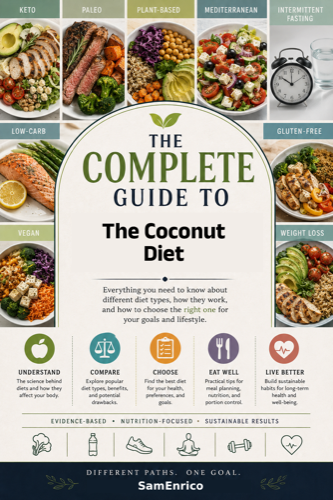 The Complete Guide to the Coconut DietMedley Lorina$11.99
You may also like
 Hong Kong Handover 1997Dunn Johnnie$11.99
 Zumba For Postnatal Recovery CourseNeal Christian$11.99
 Zumba for BeginnersLadner Nikia$11.99
 YouTube Comment Mining GuideHumes Pandora$12.99
 Worry Box MeditationCarlin Rudy$11.99
 Workplace Stress MeditationNguyen Lynn$11.99
 Workplace Stress and Sleep RepairHawley Ivory$11.99
 Workplace Perfectionism CureDelaney Jeffry$11.99
 Workplace Injustice Anger GuideWallen Isabelle$11.99
 Work Addiction and Burnout LinkGreenwood Ester$11.99
 Women in Yoga and WellnessBeattie Galina$11.99
 Women in Stand Up ComedyChun Evangeline$11.99